27
In practice, there is considerable duplication in the work of central and local governments, with ministries, rather than local governments, holding operators accountable for basic service delivery. The involvement of international institutions and partners contributes to this confusion – the promotion of Sector-Wide Approaches (in water, but also in some transport projects, e.g. Bus Rapid Transit) managed by ministries tends to ignore the subsidiarity principle and encourages a narrow focus that loses sight of the city as a whole. Access to basic services Many experts argue that a major reason for Africa’s failure to reach MDG goals and targets is related to its lack of basic service provision and to the lack of empowerment and involvement of local governments in basic service delivery (particularly water, sanitation, electricity and solid waste). Water and sanitation Across the continent, almost two-thirds of the population is estimated to have access to “improved” water sources, and just over 40% to “improved” sanitation facilities. In the context of rapid urbanization, there is a growing urban gap between supply and demand, and the share of those with piped water is actually declining. While some cit-
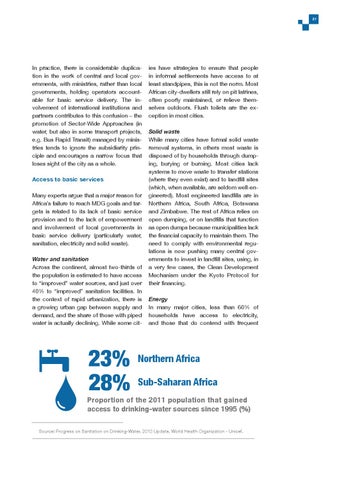
23% 28%
ies have strategies to ensure that people in informal settlements have access to at least standpipes, this is not the norm. Most African city-dwellers still rely on pit latrines, often poorly maintained, or relieve themselves outdoors. Flush toilets are the exception in most cities. Solid waste While many cities have formal solid waste removal systems, in others most waste is disposed of by households through dumping, burying or burning. Most cities lack systems to move waste to transfer stations (where they even exist) and to landfill sites (which, when available, are seldom well-engineered). Most engineered landfills are in Northern Africa, South Africa, Botswana and Zimbabwe. The rest of Africa relies on open dumping, or on landfills that function as open dumps because municipalities lack the financial capacity to maintain them. The need to comply with environmental regulations is now pushing many central governments to invest in landfill sites, using, in a very few cases, the Clean Development Mechanism under the Kyoto Protocol for their financing. Energy In many major cities, less than 60% of households have access to electricity, and those that do contend with frequent
Northern Africa Sub-Saharan Africa
Proportion of the 2011 population that gained access to drinking-water sources since 1995 (%) Source: Progress on Sanitation on Drinking-Water. 2013 Update. World Health Organization - Unicef.