21
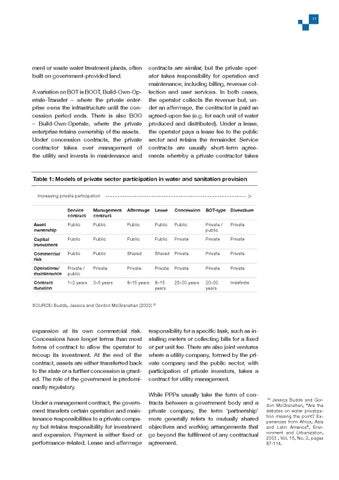
ment or waste water treatment plants, often built on government-provided land. A variation on BOT is BOOT, Build-Own-Operate-Transfer – where the private enterprise owns the infrastructure until the concession period ends. There is also BOO – Build-Own-Operate, where the private enterprise retains ownership of the assets. Under concession contracts, the private contractor takes over management of the utility and invests in maintenance and
contracts are similar, but the private operator takes responsibility for operation and maintenance, including billing, revenue collection and user services. In both cases, the operator collects the revenue but, under an affermage, the contractor is paid an agreed-upon fee (e.g. for each unit of water produced and distributed). Under a lease, the operator pays a lease fee to the public sector and retains the remainder. Service contracts are usually short-term agreements whereby a private contractor takes
Table 1: Models of private sector participation in water and sanitation provision Increasing private participation
---------------------------------------------------------- >
Service contract
Management contract
Affermage
Lease
Concession
BOT-type
Divestiture
Asset ownership
Public
Public
Public
Public
Public
Private / public
Private
Capital investment
Public
Public
Public
Public
Private
Private
Private
Commercial risk
Public
Public
Shared
Shared
Private
Private
Private
Operations/ maintenance
Private / public
Private
Private
Private
Private
Private
Private
Contract duration
1–2 years
3–5 years
8–15 years
8–15 years
25–30 years
20–30 years
Indefinite
SOURCE: Budds, Jessica and Gordon McGranahan (2003) 22
xpansion at its own commercial risk. e Concessions have longer terms than most forms of contract to allow the operator to recoup its investment. At the end of the contract, assets are either transferred back to the state or a further concession is granted. The role of the government is predominantly regulatory. Under a management contract, the government transfers certain operation and maintenance responsibilities to a private company but retains responsibility for investment and expansion. Payment is either fixed or performance-related. Lease and affermage
responsibility for a specific task, such as installing meters or collecting bills for a fixed or per unit fee. There are also joint ventures where a utility company, formed by the private company and the public sector, with participation of private investors, takes a contract for utility management. While PPPs usually take the form of contracts between a government body and a private company, the term ‘partnership’ more generally refers to mutually shared objectives and working arrangements that go beyond the fulfilment of any contractual agreement.
22 Jessica Budds and Gordon McGranahan, “Are the debates on water privatization missing the point? Experiences from Africa, Asia and Latin America”, Environment and Urbanization, 2003 , Vol. 15, No. 2, pages 87-114.