EXECUTIVE SUMMARY
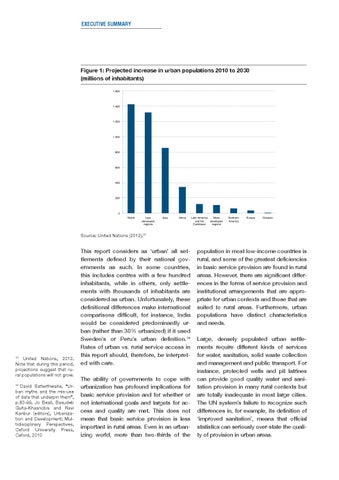
Figure 1: Projected increase in urban populations 2010 to 2030 (millions of inhabitants)
Source: United Nations (2012).13
United Nations, 2012. Note that during this period, projections suggest that rural populations will not grow. 13
David Satterthwaite, “Urban myths and the mis-use of data that underpin them”, p.83-99, Jo Beall, Basudeb Guha-Khasnobis and Ravi Kanbur (editors), Urbanization and Development; Multidisciplinary Perspectives, Oxford University Press, Oxford, 2010 14
This report considers as ‘urban’ all settlements defined by their national governments as such. In some countries, this includes centres with a few hundred inhabitants, while in others, only settlements with thousands of inhabitants are considered as urban. Unfortunately, these definitional differences make international comparisons difficult, for instance, India would be considered predominantly urban (rather than 30% urbanized) if it used Sweden’s or Peru’s urban definition.14 Rates of urban vs. rural service access in this report should, therefore, be interpreted with care. The ability of governments to cope with urbanization has profound implications for basic service provision and for whether or not international goals and targets for access and quality are met. This does not mean that basic service provision is less important in rural areas. Even in an urban izing world, more than two-thirds of the
population in most low-income countries is rural, and some of the greatest deficiencies in basic service provision are found in rural areas. However, there are significant differences in the forms of service provision and institutional arrangements that are appropriate for urban contexts and those that are suited to rural areas. Furthermore, urban populations have distinct characteristics and needs. Large, densely populated urban settlements require different kinds of services for water, sanitation, solid waste collection and management and public transport. For instance, protected wells and pit latrines can provide good quality water and sanitation provision in many rural contexts but are totally inadequate in most large cities. The UN system’s failure to recognize such differences in, for example, its definition of ‘improved sanitation’, means that official statistics can seriously over-state the quality of provision in urban areas.