RAPPORT ANNUEL 2018
Travailler en partenariat pour rĂŠaliser les agendas locaux et mondiaux
RAPPORT ANNUEL 2018 Travailler en partenariat pour rĂŠaliser les agendas locaux et mondiaux
Rapport annuel 2018
0
Rapport annuel 2018
Sommaire
Sommaire
5
Page 06
Renforcement du réseau
Éditorial L’année des partenariats qui forgeront le Congrès de CGLU Nos moments clés de l’année
1
Page 08
Temps fort Les Conseils politiques de CGLU 1.1 Retour à nos racines : la démocratie locale au cœur de notre action 1.3 Finances 1.4 Logement 1.5 Migration 1.6 Transition écologique 1.7 Villes intermédiaires
2
Page 22
Les gouvernements locaux et régionaux devant l’Organisation des Nations Unies
Les priorités politiques de CGLU pilotées par nos membres
1.2 Genre
Page 54
3
5.1 Séminaire et Campus 2018 de CGLU
Page 26
5.2 Une organisation dirigée par ses représentant·e·s politiques 5.3 Campagnes de communication et de sensibilisation
Suivi
Temps fort Faire entendre la voix de nos membres lors du Forum de haut niveau des gouvernements locaux et régionaux (FPHN)
4
7
Page 74
Mécanismes de consultation de CGLU
Page 48
2.1 Agenda 2030 pour le développement 2.2 Nos membres au Forum urbain mondial 2.3 Agenda sur le climat et la résilience 2.4 Renforcement du dialogue entre les gouvernements nationaux et locaux
Apprentissage 3.1 Les objectifs de développement durable, à l’avant-garde de nos recherches 3.2 L’Observatoire mondial des finances et de l’investissement des gouvernements infranationaux 3.3 Suivi du nouvel agenda urbain
4.1 Apprentissage par l’action 4.2 Localiser les agendas mondiaux
6 Les priorités des sections
Page 62
8
Page 78
L’Organisation
Rapport annuel 2018
Rapport annuel 2018
Éditorial
0
Éditorial
L’année des partenariats qui forgeront le Congrès de CGLU
Nos moments clés de l’année
Éditorial
L
es partenariats font, ont fait et feront toujours partie intégrante de notre Organisation mondiale et des agendas mondiaux ambitieux ne peuvent pas être réalisés par un seul acteur. Nous avons donc redoublé d’efforts pour que le réseau puisse maintenir et renforcer les collaborations existantes avec les organisations sœurs, telles que notre collaboration structurelle avec ICLEI et les autres membres de la Global Taskforce, mais aussi avec de nouveaux partenaires comme International IDEA, l’Union internationale des transports publics, le Programme pour les villes du Pacte mondial, entre autres. Le Séminaire de CGLU nous a permis d’exposer notre intention de faire passer nos partenariats au niveau supérieur. Au cours de la rencontre, nous nous sommes concentrés sur la dimension mondiale de l’initiative africaine « Know Your City » à travers des partenariats renforcés entre CGLU et Slum Dwellers International et Cities Alliance. L’amélioration de la collaboration avec l’Internationale des services publics et World Enabled était une autre des résolutions prises pendant le Séminaire. Une fois de plus, notre partenariat avec l’Union européenne nous a permis d’améliorer notre plan de travail, tout en nous permettant d’élargir nos collaborations et de renforcer nos sections régionales, qui ont acquis une plus grande influence sur la scène internationale. Le partenariat stratégique a également permis de renforcer le dialogue entre l’Union européenne et les gouvernements locaux et régionaux. CGLU fait partie intégrante de Local 2030, une initiative multipartite mondiale visant à soutenir la mise en œuvre des ODD au niveau local. Cette collaboration a permis de mettre en œuvre un événement spécial consacré à Local 2030, dans le cadre du Forum politique de haut niveau. Il réunissait des parties prenantes sans se limiter aux seuls gouvernements, pour apporter différentes expériences et points de vue permettant de réaliser les ODD depuis la base. L’année 2019 offrira, bien sûr, de nombreuses occasions à notre Organisation d’élargir son action sociale, de renforcer son rôle en tant que réseau d’apprentissage, organisation qui développe les connaissances et amène de nouveaux partenaires à la table
6
des négociations, et de devenir une organisation rayonnante pour la prochaine décennie. Depuis des années, nous demandons que les villes soient écoutées, tout en reconnaissant qu’il est tout aussi important d’offrir un espace de dialogue qui nous permette de réfléchir à nos politiques et à nos solutions. C’est la seule façon d’obtenir la transformation dont le monde a besoin. Cependant, obtenir une place à la table des négociations mondiales n’est pas un objectif en soi. Il s’agit d’une transformation de la gouvernance, de différents mécanismes de prise de décision, avec différentes parties prenantes. Le Congrès de CGLU, qui se tiendra à Durban en novembre 2019, jettera les bases du type de participation qui transformera le modèle de gouvernance, qui deviendra plus pertinent pour notre collectif, le mouvement et le monde. Il devra être pertinent pour toutes les parties prenantes, refléter toute notre force et la diversité de notre Organisation, tout en contribuant à l’établissement de liens solides entre notre Organisation et la société civile. Nous savons que le dialogue seul ne suffit pas. Nous réunirons les intervenants à la table des négociations, mais nous comprenons qu’il en faudra plus pour faire changer la gouvernance. Par conséquent, le Congrès de CGLU permettra d’élaborer des politiques. Les sections y seront représentées et apporteront leurs idées politiques à travers nos assemblées, assurant ainsi le renouvellement et la consolidation de notre stratégie, dans le but de ne laisser personne pour compte. L’avenir est entre nos mains. Nous sommes tou·te·s essentiel·le·s au changement que nous voulons pour nos communautés, et ce n’est que grâce à nos efforts conjoints que nous serons en mesure de mettre sur pied un Congrès qui soit vraiment novateur pour notre mouvement.
Parks Tau Président de CGLU
Emilia Saiz Secrétaire générale de CGLU
D
eux mille dix-huit a été une année de partenariats pour notre Organisation mondiale. Tout au long de l’année, nous avons pu nous assurer que les gouvernements locaux et régionaux ne relèveront pas seuls les défis mondiaux, en renforçant et en élargissant nos collaborations en cours avec des organisations sœurs, en faisant participer de nouveaux partenaires, et en créant de nouveaux partenariats avec International Idea, l’Union internationale des transports publics et le Programme pour les villes du Pacte mondial, entre autres. Le Forum des gouvernements locaux et régionaux, au sein du FPHN (Forum politique de haut niveau pour le développement durable). Notre présence a eu un impact politique important, qui devrait se transformer en influence politique dans les années à venir. Plus de 300 déléguées des gouvernements locaux et régionaux ont animé les conversations sur les objectifs du développement durable pendant deux jours entiers, et la localisation de l’Agenda 2030 est devenue un des sujets les plus abordés lors du Forum de haut niveau. Le logement, le financement, l’égalité, les institutions responsables et le renforcement des partenariats figuraient parmi les principales priorités de nos membres au cours de l’événement. La documentation regroupant les visions et expériences de nos membres a conduit à la publication du deuxième rapport « Vers la localisation des ODD », qui constitue l’épine dorsale de notre stratégie de plaidoyer auprès du FPHN. Ce rapport a, pour la première fois, recueilli les contributions d’autres organisations de gouvernements locaux participant à la Global Taskforce, contribuant ainsi à la consolidation du seul instrument permettant de faire entendre les voix des gouvernements locaux. Favoriser un meilleur dialogue entre les sphères de gouvernement a constitué une priorité constante tout au long de l’année. En plus de renforcer sa présence au Forum politique de haut niveau, CGLU a également co-facilité, avec C40, Urban 20, une initiative qui vise à développer des positions communes entre les maires des villes du G20 pour informer et enrichir les discussions des dirigeants nationaux du G20, en fournissant l’expertise et la vision des grandes villes sur les questions de développement mondial.
Nos conseils politiques, créés en 2017, ont permis d’améliorer les processus d’élaboration des politiques qui ont favorisé les débats avec les gouvernements nationaux et d’autres acteurs dans le cadre de nos instances statutaires. Ils ont joué un rôle essentiel pour consolider nos priorités, une étape importante de nos travaux auprès des institutions internationales, et ont permis de prendre des engagements transversaux et des décisions politiques sur des questions qui nous concernent tou·te·s. Les vagues d’action de CGLU : sur le logement, les migrations et les finances. Nous avons été en mesure d’apporter un élan positif sur ces questions, ce qui a conduit près de 40 villes et entités métropolitaines à adhérer à la Déclaration des villes pour un logement convenable, demandant que le droit au logement ne soit plus un droit de base, mais relève des droits humains. 14 villes ont rejoint notre programme sur les migrations en Méditerranée, et 4 autres devraient suivre l’année suivante. Ces villes sont à l’origine de la vague qui culminera avec des contributions au Pacte mondial sur les migrations, qui sera adopté à Marrakech. Enfin, la première stratégie de CGLU sur la localisation du financement municipal a conduit à la création d’une coalition internationale appelant à de nouveaux mécanismes financiers et plus de 20 villes ont rejoint la communauté de pratiques consacrée à ce sujet. Tout au long de l’année, nous avons travaillé à l’amélioration de nos stratégies, jetant ainsi les bases de notre Organisation mondiale pour la prochaine décennie. Notre stratégie d’égalité des genres, qui se concrétisera en 2019, a été présentée pour la première fois lors du Séminaire de CGLU et, par la suite,au Conseil mondial. Notre stratégie de localisation du financement, qui est le résultat de la vague d’action sur le financement, nous a permis de construire le cadre d’un Fonds d’investissement municipal, conjointement avec le Fonds d’équipement des Nations Unies, en partenariat avec le FMDV. Nous sommes donc prêt·e·s à agir et à jouer notre rôle pour assurer le financement de nos communautés et pour transformer la gouvernance mondiale, avec différentes parties prenantes. Notre rôle en tant que réseau d’apprentissage a été renforcé par la formation de formateurs, avec plus de 25 ateliers organisés dans le monde entier sur l’action locale pour les ODD. Enfin, il convient de souligner les avancées importantes réalisées par les réseaux régionaux, à travers les sections de CGLU, qui ont multiplié les activités sur tous les continents, offrant une visibilité ainsi que des opportunités pour apprendre et tisser des liens. 2018 a été une année passionnante pour CGLU, pour l’ensemble de nos membres et pour le mouvement municipal. Alors que nous arrivons en 2019, à la fin de cette décennie et prêt·e·s à relever de nouveaux défis, la voie que nous suivons nous permettra de devenir une organisation encore plus forte, au service de ses membres et du développement du monde. 7
1 Les priorités politiques de CGLU pilotées par nos membres Nos initiatives, mises de l’avant au sein des conseils politiques, se sont avérées être à l’origine de vagues d’action importantes et positives, telles que celles que nous avons observées dans les domaines de la migration, du logement et des finances locales, qui peuvent véritablement transformer et améliorer notre Organisation mondiale et qui ont atteint des jalons vraiment remarquables.
Rapport annuel 2018
Temps fort les premiers dialogues organisés par les conseils politiques de CGLU LES CONSEILS POLITIQUES CONSTITUENT LES MÉCANISMES DE CONSULTATION ET LE MOTEUR DES PRIORITÉS STRATÉGIQUES 2016-2022 DE CGLU. Ils proposent des initiatives, des idées et des recommandations, ils renforcent le sentiment d’appropriation des politiques et le débat politique au sein de l’Organisation. Ils sont également essentiels pour renouveler la participation d’un groupe plus large de dirigeant·e·s politiques. Les conseils politiques, qui se concentrent sur des thèmes stratégiques, reflètent à la fois les questions clés des agendas mondiaux et les axes prioritaires de l’Engagement de Bogota et se présentent comme suit : Droit à la ville et territoires inclusifs ; Opportunités pour tou·te·s, culture et diplomatie des villes : les clés du développement durable et de la paix ; Gouvernance territoriale multiniveaux et financement durable ; et Villes plus sûres, résilientes, durables et capables de faire face aux crises. Les conseils politiques sont composés d’un maximum de 15 représentant∙e∙s doté∙e∙s d’un mandat politique, dont un membre de la Présidence. Droit à la ville et territoires inclusifs. Co-présidé par Ada Colau, maire de Barcelone et coprésidente de CGLU, et Patrick Braouezec, président de l’aire métropolitaine de Plaine Commune, et coprésident de la Commission inclusion
Conseil politique :
Droit à la ville et territoires inclusifs
10
Rapport annuel 2018
Les priorités politiques de CGLU pilotées par nos membres
Les priorités politiques de CGLU pilotées par nos membres
1.1 Conseil politique :
Opportunités pour tou·te·s, culture et diplomatie des villes : les clés du développement durable et de la paix
Conseil politique :
La démocratie locale au cœur de notre action
Conseil politique :
Gouvernance territoriale multiniveaux et financement durable
Des Villes plus sûres, résilientes, durables et capables de faire face aux crises
sociale, démocratie participative et droits humains de CGLU.
été à l’origine de vagues d’action importantes et positives, telles que celles que nous avons observées dans les domaines des migrations, du logement et du financement local, qui peuvent véritablement transformer et améliorer notre Organisation mondiale et qui ont permis des réalisations vraiment remarquables. Les réunions des conseils politiques de CGLU ont eu lieu en 2018, dans le cadre du Bureau exécutif de CGLU à Strasbourg. Les conseils politiques ont permis d’organiser des dialogues entre les fonctionnaires et les dirigeant·e·s des gouvernements locaux, dans le but d’accroître l’engagement politique vis-à-vis des défis auxquels sont confrontées les sphères de gouvernement locales et régionales. Ces dialogues ont représenté une avancée vers une meilleure compréhension entre les sphères de gouvernement et ont servi de précurseurs aux conversations qui ont eu lieu au sein du Forum politique de haut niveau. A Madrid, dans le cadre du Conseil mondial de CGLU et du Forum sur la violence urbaine et l’éducation pour la cohabitation et la paix, les conseils politiques de CGLU ont organisé des dialogues politiques intégrant le concept de paix dans leur travail, dans le but de diriger des initiatives de consolidation de la paix dans tous les travaux de l’Organisation.
Opportunités pour tou·te·s, culture et diplomatie des villes : les clés du développement durable et de la paix. Coprésidé par Jan van Zanen, maire d’Utrecht et président de l’Association des municipalités néerlandaises ; Eduardo Vázquez, Secrétaire à la Culture de Mexico, et coprésident de la Commission Culture de CGLU ; et Juan Mari Aburto, maire de Bilbao et vice-président de la Commission Culture de CGLU. Gouvernance territoriale multiniveaux et financement durable. Coprésidé par Mercè Conesa Pagés, présidente du Conseil provincial de Barcelone ; et Mónica Fein, maire de Rosario et vice-présidente de CGLU pour l’Amérique latine. Des Villes plus sûres, résilientes, durables et capables de faire face aux crises. Co-présidé par Fatimetou Mint Abdel Malick, présidente du Conseil régional de Nouakchott et vice-présidente de REFELA pour la région Nord ; et Roland Ries, maire de Strasbourg, président de Cités Unies France, coprésident de CGLU et coprésident de la communauté de pratiques de CGLU sur la mobilité. Nos initiatives, mises en avant au sein des conseils politiques, ont
LA DÉMOCRATIE LOCALE EST AU CŒUR DE NOTRE ORGANISATION MONDIALE DEPUIS SA FONDATION. Elle constitue un processus permanent pour nos membres, qui nous engage à travailler non seulement pour la décentralisation, mais aussi pour un processus fondé sur des principes démocratiques. L’Organisation mondiale et ses membres s’emploient déjà à inclure la démocratie locale dans leurs axes thématiques et de travail en renforçant, entre autres principes, le respect des droits humains, la participation citoyenne, l’égalité des sexes et la décentralisation. La Conférence de l’Observatoire international de la démocratie participative nous a en outre expliqué comment renforcer la démocratie locale, faire reconnaître les villes comme l’espace impulsant l’innovation démocratique et aider l’Organisation mondiale à façonner la démocratie locale en adoptant l’Agenda pour la démocratie locale, qui vise à améliorer l’inclusion des mécanismes de participation pour renforcer la démocratie au niveau local.
La Conférence de l’OIDP montre au niveau local comment la démocratie fait partie intégrante du développement mondial et pourquoi elle devient de plus en plus pertinente dans le monde entier. C’est la raison pour laquelle elle fait son retour au sein de notre Organisation mondiale. Des tensions surgissent de nouveau au niveau de la mise en œuvre des services publics et des compétences des gouvernements locaux et régionaux. Une démocratie locale plus solide fait certainement partie de la solution à ces problèmes et constitue un moyen de renforcer entièrement les mécanismes démocratiques. En constatant comment la perception publique de nos institutions s’érode, nous pouvons aussi voir comment les villes s’organisent pour lutter contre la désillusion de la société et préserver le bien public. Les défis auxquels sont confrontées les démocraties locales sont colossaux et, pour les relever, nos communautés doivent être placées au cœur de l’action politique et institutionnelle.
Le Conseil mondial de CGLU à Madrid nous a fourni une mission explicite : réintroduire une démocratie locale décente et claire au sein de l’agenda politique de l’Organisation. Nous devons réellement renforcer la décentralisation et fournir les outils nécessaires pour l’autonomisation des communautés locales, tout en nous basant sur la démocratie locale comme un élément clé pour bâtir des villes où règne la paix. La relation entre la démocratie locale et la consolidation de la paix a été particulièrement mise en avant lors de la réunion du conseil politique à Madrid. Le conseil politique a en outre annoncé que l’opportunité offerte par cette coïncidence permettrait de développer une politique de CGLU sur la consolidation de la paix, qui pourrait éventuellement servir de référence aux différentes parties du réseau en matière de co-développement de la paix. Le débat politique a exhorté les participant·e·s à réfléchir à la manière dont les gouvernements locaux peuvent accroître leur rôle de bâtisseurs de la paix et à ce qu’ils peuvent accomplir au niveau régional, pour assurer des liens entre les futures politiques de paix de l’Organisation mondiale et le Prix de CGLU pour la paix, et pour développer une banque interactive des pratiques locales.
11
Rapport annuel 2018
Les priorités politiques de CGLU pilotées par nos membres
1.2
Égalité des genres L’ÉGALITÉ DES GENRES REPRÉSENTE UN OBJECTIF DE LONGUE DATE POUR CGLU ET LES ASSOCIATIONS QUI NOUS ONT PRÉCÉDÉS. Nous avons fait nos preuves en matière de plaidoyer mondial visant à améliorer les politiques d’égalité entre les genres parmi nos membres et pour encourager la participation des femmes à la prise de décision au niveau local. Des mesures tout aussi importantes ont été prises pour renforcer l’égalité au sein de l’Organisation mondiale, en transformant la Commission pour l’égalité des genres en une Commission permanente, en assurant la présence des femmes à la Présidence de CGLU et en appliquant des quotas de femmes aux instances statutaires de CGLU.
A l’initiative du Secrétariat mondial et avec le plein soutien de la Présidence, le Séminaire de CGLU en 2018 a discuté de nouvelles étapes possibles vers la mise en œuvre d’une stratégie de genre pour l’ensemble de CGLU. La proposition a été présentée au Bureau exécutif à Strasbourg, qui a à son tour chargé le Secrétariat mondial de prendre les premières mesures en vue d’une stratégie de genre pour l’ensemble de CGLU. Le Séminaire comprenait deux séances sur l’égalité des genres. La première des deux était une réunion informelle au cours de laquelle les participant·e·s ont recherché un consensus sur les prochaines étapes des stratégies de CGLU en matière d’égalité des genres, ainsi que sur la localisation de l’ODD 5. En outre, les échanges qui ont eu lieu au cours de la réunion avaient pour but d’intégrer les amendements ou révisions qui pourraient être apportés au document afin d’améliorer la stratégie en matière d’égalité des genres, en tenant compte des contributions de plusieurs domaines de travail et sections de l’Organisation. Un projet de stratégie d’égalité des genres pour l’ensemble de CGLU a été présenté au Conseil mondial de Madrid en 2018, et les travaux concernant cette stratégie devraient se poursuivre tout au long de 2019 et dans le cadre du prochain mandat de l’Organisation mondiale.
Rapport annuel 2018
1.3
Finances locales LE PRINCIPAL OBSTACLE À L’ALLOCATION DE RESSOURCES AUX GOUVERNEMENTS LOCAUX ET RÉGIONAUX EST D’ORDRE POLITIQUE, et c’est la principale raison pour laquelle notre Organisation mondiale est en train d’élaborer un nouveau message sur la localisation des financements. Nous préconisons la localisation du financement, non seulement parce que nous sommes une sphère de gouvernement à part entière, mais aussi parce que c’est le meilleur moyen d’obtenir des résultats. Compte tenu de la nécessité de développer la capacité de CGLU à influencer le débat international sur les finances locales, et afin d’éviter la duplication des travaux des membres dans différents réseaux, la relation entre CGLU et le FMDV a fait un pas en avant cette année. Après des réunions entre les deux directions, le FMDV a été intégré comme mécanisme de CGLU, avec un contrôle politique exercé par ses organes statutaires. Au cours de la dernière année, nous avons travaillé sans relâche à l’élaboration d’une nouvelle stratégie de localisation des finances. Ce n’est qu’en
12
Les priorités politiques de CGLU pilotées par nos membres
consolidant l’accès au financement que nous pourrons non seulement atteindre les objectifs mondiaux, mais aussi transformer avec succès le modèle actuel de gouvernance en un modèle plus juste et plus durable. Nous devons remettre en question et changer le paradigme, nous devons développer un écosystème de compréhension mutuelle entre les intervenants qui permette aux finances municipales de prospérer, un écosystème qui nous permette de réussir et d’agir de façon autonome. Pour renforcer nos capacités, nous devons contourner les cadres juridiques qui sont, dans de nombreux cas, mal conçus pour financer les gouvernements locaux et accroître notre capacité à compter sur nos propres ressources. La stratégie de CGLU sur la localisation du financement vise à construire un écosystème de compréhension mutuelle entre les parties prenantes qui permette aux financements d’atteindre les communautés qui en ont le plus besoin. Le Fonds d’investissement municipal que nous avons créé avec le Fonds d’équipement des Nations Unies (FENU) est un pas dans cette direction. La communauté de pratiques, qui s’est réunie dans le cadre du Conseil mondial de CGLU à Madrid, nous aidera à élaborer nos lignes de travail afin d’avancer. Elle nous permettra de partager nos expériences, d’apprendre les uns des autres et de tester nos innovations. Les résultats de cette communauté de pratiques alimenteront également le travail de nos conseils politiques et nous aideront à trouver des résultats.
Les premières étapes de la stratégie ont été définies lors du Séminaire de CGLU en janvier, après quoi un dialogue a été engagé avec le FENU, dans le but de créer une première « coalition démonstrative » (dirigée par le FENU et CGLU) visant des investissements pilotes dans certaines municipalités, afin de montrer aux investisseurs institutionnels et privés le potentiel des investissements dans les infrastructures municipales. Le Conseil politique de CGLU sur la gouvernance territoriale multiniveaux et le financement durable qui s’est tenu à Strasbourg, a rappelé la nécessité d’aligner les priorités de toutes les sphères de gouvernement avec les ODD, et la nécessité de promouvoir la gouvernance multiniveaux et le développement d’un nouveau modèle de gouvernance pour la réalisation des agendas mondiaux. Les représentants des entités supramunicipales ont évoqué l’importance de gérer les tensions entre les sphères du gouvernement et les niveaux local et national, puis ils ont partagé leurs expériences et leurs attentes pour l’avenir. L’amélioration des relations entre les sphères de gouvernement est une nécessité, ont soutenu les participant·e·s, si nous voulons passer du modèle actuel de gouvernance à un modèle fondé sur la solidarité, et non sur les compétences. Le Conseil politique de CGLU sur la gouvernance territoriale multiniveaux a en outre organisé un dialogue au sein du Conseil mondial, au cours duquel il a convenu de l’importance d’une approche territoriale complète avec la participation de toutes les sphères du gouvernement pour atteindre les ODD. Il a également souligné qu’il faudrait faire des efforts pour renforcer la participation des associations de gouvernements locaux au niveau du suivi des ODD, et pour développer un dialogue national structurel sur la mise en œuvre de l’Agenda 2030.
13
Rapport annuel 2018
1.4
Logement
14
Les priorités politiques de CGLU pilotées par nos membres
SOUS LA DEVISE « LE LOGEMENT EST UN DROIT ET NON UNE MARCHANDISE », CGLU S’EFFORCE DE DÉFENDRE LE DROIT AU LOGEMENT DANS LE CADRE DU DROIT À LA VILLE, AVEC UNE MULTITUDE D’ACTEURS. CGLU est également activement impliqué dans « Make the Shift », un mouvement dirigé par la Rapporteuse spéciale des Nations Unies sur le droit à un logement convenable, Leilani Farha, en partenariat avec le Haut-Commissariat des Nations Unies pour les droits de l’homme. Le mouvement cherche à mobiliser un large éventail d’acteurs pour que le logement soit considéré comme un droit humain. Le logement en tant que moyen de garantir le droit à la ville a été évoqué lors du Forum urbain mondial. Lors d’une session spéciale intitulée « Le logement au centre, vecteur d’inclusion socio-
économique », les participant·e·s des gouvernements nationaux et locaux ont partagé des propositions sur la manière de repositionner le logement au centre de l’urbanisation et de faire évoluer la vision du logement au-delà du simple point de vue de la construction. Leilani Farha, Rapporteuse spéciale des Nations Unies sur le droit au logement, a participé par le biais d’un message vidéo, ce qui a permis d’encadrer les conversations ultérieures. Elle y a souligné l’idée du logement comme moyen d’assurer la sécurité et l’inclusion. L’un des principaux moyens de favoriser l’inclusion des populations à risque dans les villes est d’accroître le nombre de logements abordables. Dans le cadre de la campagne « Make the Shift », CGLU a plaidé pour que le logement soit considéré comme un droit humain lors de la session du Conseil des droits de l’homme convoquée par le Rapporteur spécial de l’ONU sur le droit au logement à Genève : « Pour que le logement ne soit plus une marchandise mais un droit de l’homme ». La promotion de stratégies de logement fondées sur les droits humains dans toutes les sphères de gouvernement, la lutte contre la marchandisation du logement à l’échelle mondiale et l’avancement des discussions sur la gouvernance du logement ont été les points clés de la session, et l’avancement des relations entre les sphères de
Rapport annuel 2018
Les priorités politiques de CGLU pilotées par nos membres
gouvernement a été jugé essentiel afin de mettre en œuvre l’initiative « Make the Shift ». Le Conseil politique sur le droit à la ville, qui s’est réuni à Strasbourg, a abordé la question fondamentale du logement dans les villes, avec la présentation du Manifeste de Barcelone sur le logement - qui allait devenir la Déclaration des villes pour le logement, et qui a ensuite été présenté lors du Forum politique de haut niveau - comme un élément clé représentant le travail de CGLU et de ses membres, étroitement lié à l’ODD 11. Le logement était un thème fondamental de la délégation des gouvernements locaux et régionaux au Forum politique de haut niveau. La maire de Barcelone, Ada Colau, a présenté la Déclaration des villes pour un logement convenable lors d’une session spéciale, avant le Forum des gouvernements locaux et régionaux, intitulée : « #MakeTheShift : Les villes pour le droit à un logement convenable ». Elle a plaidé pour que le logement soit considéré comme un droit et non comme une marchandise, afin que les villes puissent réaliser les droits humains de leurs habitant·e·s. La Commission inclusion sociale, démocratie participative et droits humains de CGLU a promu l’adoption de la Déclaration « Les villes pour un logement convenable » dans le cadre
de la vague d’action sur le logement, en reliant les municipalités signataires. Le message commun des membres de CGLU sur le droit au logement a été renforcé par l’adoption de l’initiative par les maires de Berlin, Montevideo, Madrid, Montréal et Strasbourg, ainsi que par le vice-président de Plaine commune et l’adjoint au maire de New York chargé de la stratégie des districts, qui ont exprimé leur engagement envers le droit au logement et ont adopté la Déclaration. Au total, 36 villes et entités métropolitaines ont adopté la déclaration. Le rapport GOLD V comprendra également un effort de présentation de rapports thématiques sur l’une des questions politiques fondamentales soulevées par le débat mondial actuel sur le développement et les objectifs mondiaux eux-mêmes (par exemple, l’ODD 11.1) : le logement, le droit à un logement adéquat et les politiques en matière de logement élaborées par les gouvernements locaux et régionaux ou qui les concernent.
15
Rapport annuel 2018
1.5
Les migrations
16
Les priorités politiques de CGLU pilotées par nos membres
LA VAGUE D’ACTION SUR LES MIGRATIONS VISE À CHANGER LA PERCEPTION DE CE PHÉNOMÈNE ET À DÉMONTRER LES ASPECTS POSITIFS DES MIGRATIONS par un travail conjoint entre le Secrétariat mondial, les sections et les commissions, sous la devise « tous migrants, tous citoyens ». Le Projet Migration Ville à Ville en Méditerranée (MC2CM) vise à améliorer la gouvernance de la migration au niveau local dans les villes d’Europe et du sud de la Méditerranée. L’initiative est dirigée par le Centre international pour le développement des politiques migratoires (ICMPD), en partenariat avec CGLU et ONU-Habitat. Le projet, cofinancé par la CE et la Direction du développement et de la coopération (DDC), fait intervenir le Haut-Commissariat des Nations Unies pour les réfugiés (HCR). Les villes participantes sont : Amman, Beyrouth, Lisbonne, Lyon, Madrid, Tanger, Tunis, Turin et Vienne.
Avec le soutien de la Commission européenne, la deuxième phase du projet, qui doit s’achever en 2021, a commencé à se développer sur le terrain, avec encore plus de villes et de partenaires, en provenance principalement de l’hémisphère sud. Le principal objectif de la vague d’action sur les migrations tout au long de 2018 a été et continuera d’être l’élaboration du Pacte mondial pour des migrations sûres, ordonnées et régulières. Bien que CGLU se réjouisse des engagements pris dans la première ébauche du Pacte mondial, nous ne pouvons que
Rapport annuel 2018
Les priorités politiques de CGLU pilotées par nos membres
souligner la nécessité d’une plus grande implication des gouvernements locaux et régionaux au niveau des processus migratoires mondiaux. CGLU a assuré le suivi des discussions sur le Pacte mondial et a plaidé en faveur de l’inclusion des points de vue des parties prenantes lors des réunions et des discussions qui ont eu lieu entre les Etats membres de l’ONU. Nous nous efforçons de faire en sorte que les gouvernements locaux et régionaux jouent un rôle plus important au sein du Pacte mondial, en particulier au niveau du processus de mise en œuvre et de la définition du Pacte. La question de la gestion des migrations se pose de plus en plus, les initiatives et les débats sont florissants et, en tant que sphère gouvernementale la plus proche des citoyen·ne·s, les gouvernements locaux et régionaux sont les mieux placés pour contribuer à améliorer la gouvernance des migrations et relever les défis qui y sont liés. Le Conseil politique sur le droit à la ville se concentre sur les efforts que nous
déployons pour changer le discours sur la migration, en la présentant comme un phénomène qui offre des opportunités plutôt que des défis. Pour soutenir ces possibilités, il est essentiel d’élaborer des politiques éducatives inclusives et d’améliorer le travail avec la société civile et le secteur privé. Les maires de la région méditerranéenne se sont engagés à Madrid à renforcer la coopération de ville à ville et l’échange de connaissances. Ils ont encouragé les gouvernements locaux à participer au forum des maires qui a eu lieu en décembre, avant la conférence finale qui devait adopter le Pacte mondial sur les migrations. L’Organisation internationale pour les migrations a convenu de continuer à travailler avec CGLU pour intégrer la participation des gouvernements locaux à l’adoption et au suivi du Pacte mondial sur les migrations, et pour trouver des moyens de renforcer le leadership et le rôle des gouvernements locaux pour changer la perception des migrations, afin de lutter contre le racisme et la xénophobie.
17
Rapport annuel 2018
Les priorités politiques de CGLU pilotées par nos membres
Rapport annuel 2018
1.7
1er Forum mondial des villes intermédiaires
1.6
Transition écologique LES GOUVERNEMENTS LOCAUX ET RÉGIONAUX DU MONDE ENTIER DOIVENT FAVORISER LA TRANSFORMATION DES MODÈLES DE PRODUCTION POUR ASSURER UN AVENIR SOBRE EN CARBONE. L’action climatique doit aller au-delà de l’atténuation du changement climatique et viser à assurer une véritable transition écologique qui ne laisse personne pour compte. Le statu quo n’est pas une option, et nos membres en sont bien conscients. Le dialogue organisé par notre Conseil politique pour des villes plus sûres, résilientes et durables à Strasbourg, dans le cadre des Dialogues de Talanoa, vise à encadrer les conversations sur le changement climatique et à accroître les actions entre toutes les parties prenantes, afin d’atteindre les objectifs climatiques de Paris. Le dialogue a porté sur la conception de politiques visant à améliorer la durabilité et la résilience, ce qui implique de concevoir des villes préparées pour l’avenir. 18
Les participant·e·s au dialogue ont commencé par définir le concept de résilience et sa relation avec tous les secteurs de l’urbanisme. Ils ont ensuite souligné la nécessité d’élaborer des plans de résilience avec des approches multidisciplinaires qui tiennent compte de tous les acteurs, plutôt que des plans sectoriels. Sous le titre « Les gouvernements locaux à la tête de la transition écologique », le Conseil politique de CGLU sur la résilience a tenu un débat à Madrid. Il a abordé le rôle des gouvernements locaux et régionaux au niveau de la transition écologique, pour aller au-delà de l’atténuation du climat et travailler au développement de politiques de sensibilisation des citoyennes au climat. Le Conseil politique de CGLU a en outre accepté de soumettre à la discussion la Déclaration universelle des droits de l’humanité, qui agira comme un texte com-
plémentaire établissant certains droits et devoirs qui ne sont pas simplement individuels, mais collectifs. La Déclaration propose la création d’une interdépendance entre les espèces vivantes, afin de garantir le droit d’exister et le droit de l’humanité à vivre dans un environnement sain et écologiquement durable. Notre Organisation mondiale veut s’assurer que la lutte pour réaliser la transition écologique commence par nos membres. Cet engagement a conduit à l’organisation d’un atelier de formation, avec nos sections régionales et en partenariat avec la Convention Mondiale des Maires (GCoM), dans le but de fournir un aperçu clair de nos priorités régionales en matière de stratégie et d’action climatique, et de commencer à élaborer un dialogue entre les sections de CGLU et le GCoM portant sur les aspects stratégiques et pratiques du climat.
POUR CGLU, L’AGENDA URBAIN ENGLOBE AUSSI LES TERRITOIRES, ET NOUS ENVISAGEONS DES SYSTÈMES TERRITORIAUX INTÉGRÉS QUI RELIENT LES VILLES ET LES TERRITOIRES QUI LES ENTOURENT. Dans cette vision, le rôle des villes intermédiaires est essentiel. Le Forum de CGLU sur les villes intermédiaires est un mécanisme de consultation et de politique qui permet d’organiser un événement tous les deux ans. Mené par la ville de Chefchaouen, et avec le soutien d’un noyau de villes intermédiaires pilotes, sa première édition a eu lieu précisément, à Chefchaouen, en juillet 2018. Plus de 250 participant·e·s en provenance de 40 pays différents, notamment des acteurs des gouvernements nationaux et régionaux et des représentant·e·s de différents types de villes, ont travaillé à identifier les défis des villes intermédiaires et les stratégies à utiliser pour mettre en œuvre les objectifs mondiaux dans les villes intermédiaires. Un accent particulier a été mis sur la participation des femmes
Les priorités politiques de CGLU pilotées par nos membres
dans la sphère politique et sur l’élaboration d’approches participatives au niveau de la mise en œuvre des objectifs. Le premier Forum mondial des villes intermédiaires a abouti à l’adoption de la Déclaration-Charte de Chefchaouen des villes intermédiaires du monde. Les représentant·e·s des villes intermédiaires y ont déclaré la nécessité d’enraciner les agendas mondiaux du développement dans les expériences des villes intermédiaires, ainsi que de développer des systèmes de gouvernance à plusieurs niveaux et une approche intégrée du développement des territoires.
Les gouvernements locaux qui ont signé la Déclaration-Charte des villes intermédiaires du monde se sont engagés à organiser un deuxième Forum mondial des villes intermédiaires de CGLU et ont déclaré que :
Un dialogue plus concret et à plusieurs niveaux en tant que système de réglementation pour définir et mettre en œuvre les agendas mondiaux est nécessaire. Il est nécessaire d’enraciner les agendas mondiaux de développement dans les valeurs et les expériences des villes intermédiaires. Il est nécessaire de mieux structurer et définir les « systèmes vivants » des territoires et de les traduire en stratégies qui peuvent être développées, comprises et soutenues au niveau international. Il est essentiel de promouvoir des modèles intégrés de gouvernance qui impliquent toutes les sphères de gouvernement, y compris les gouvernements métropolitains et les zones rurales. Reconnaître le rôle des villes intermédiaires comme un espace important d’intermédiation entre le milieu urbain et le milieu rural est essentiel à la structuration et à l’organisation territoriale de l’économie. Il est nécessaire de défendre la qualité de vie et l’accès aux services de base sur leur territoire afin de réduire les inégalités. La résilience des villes intermédiaires est fortement liée à leur identité, à leur culture et à la défense de la diversité.
19
2
Les gouvernements locaux et régionaux devant l’Organisation des Nations Unies
Les programmes mondiaux ne sont réalisables que s’ils sont liés au niveau local, et c’est pourquoi notre Organisation mondiale a placé la localisation - veiller à ce que les programmes mondiaux soient pris en charge par leurs communautés et mis en œuvre à partir de la base - au cœur de notre stratégie et dans tous nos domaines de travail.
Rapport annuel 2018
2.1
L’Agenda 2030 pour le développement L’UN DE NOS PRINCIPAUX EFFORTS TOUT AU LONG DE 2018, EN TERMES DE PLAIDOYER, A ÉTÉ D’OUVRIR DES ESPACES DE DIALOGUE AU SEIN DU SYSTÈME DES NATIONS UNIES. Nous avons appelé à la mise en œuvre de tous les agendas mondiaux au niveau local, à la nécessité de repenser la finance mondiale pour que les agendas mondiaux soient couronnés de succès mais, surtout, nous nous sommes entretenus avec des représentant·e·s des plus hauts niveaux des Nations Unies pour définir nos priorités et travailler à une participation accrue à tout le processus de localisation. Le Forum politique de haut niveau (FPHN) est la plate-forme centrale des Nations Unies pour le suivi et la révision de l’Agenda 2030 pour le développement durable. Plus de 300 représentant·e·s de gouvernements locaux et régionaux, dont 70 maires et présidents régionaux, se sont mobilisé·e·s au cours du Forum politique de haut niveau sur le logement de 2018, s’intéressant à l’ODD 11 et à ses principaux liens avec d’autres ODD, avec une attention
22
Les gouvernements locaux et régionaux devant l’Organisation des Nations Unies
particulière pour le logement. La Global Taskforce s’est réunie pendant le FPHN pour travailler sur une position commune et fixer les priorités pour l’avenir. Le résultat des délibérations a été la Déclaration des gouvernements locaux et régionaux, publiée par la Global Taskforce, qui appelle le système des Nations Unies à ne pas oublier les questions de gouvernance locale et de cohésion territoriale. Les représentant·e·s des gouvernements locaux et régionaux ont souligné leur nécessité d’être en mesure d’accéder au financement afin de s’approprier l’Agenda 2030. Les membres ont également préconisé l’adoption de nouveaux modèles de gouvernance qui impliquent toutes les sphères du gouvernement. Des modèles de gouvernance qui, à leur tour, sont essentiels pour favoriser l’inclusion des communautés locales et faire en sorte que personne, ni aucun territoire, ne soit laissé pour compte. La Déclaration appelle en outre les gouvernements nationaux et la communauté internationale à promouvoir la mise en œuvre d’autres agendas de développement - tels que le Nouvel Agenda urbain - et les liens entre eux pour accélérer la réalisation des objectifs mondiaux. Les engagements des gouvernements locaux et régionaux sont réitérés dans la Déclaration qui, tout en célébrant le premier Forum des gouvernements locaux et régionaux, appelle le système des Nations Unies à aller plus loin et à garantir des espaces de dialogue entre les sphères de gouvernement lors des prochaines éditions du FPHN.
Rapport annuel 2018
Les gouvernements locaux et régionaux devant l’Organisation des Nations Unies
STATEMENT OF THE LOCAL AND REGIONAL GOVERNMENTS CONSTITUENCY GATHERED IN THE GLOBAL TASKFORCE
This Statement was adopted by the Global Taskforce of Local and Regional Governments at the Local and Regional Authorities Forum, held within the framework of the High-Level Political Forum, in New York at the UN Headquarters, on 16 July 2018.
Our place at the global table
The Development Agendas adopted throughout 2015 and 2016, in particular the 2030 Agenda, the New Urban Agenda and the Paris Agreement represent not only a unique landmark to achieve a shift of our societies and systems towards sustainability, but perhaps the last opportunity to preserve our planet and build new patterns of development. Our commitment and political will towards the implementation process is what we describe as localization. Going beyond the simple adaptation of global goals to the local level, localization is about political will, co-creation with our communities and to find solutions at the local level for the global challenges and objectives. The local and regional government networks gathered in the Global Taskforce are convinced that the achievement of the Sustainable Development Goals depends on their full ownership by our communities, cities and regions. Local and regional governments around the world are also convinced that they have a key role to play in triggering that ownership, and an important responsibility in fostering implementation by integrating the various agendas on the ground and ensuring territorial cohesion.
The first edition of the Local and Regional Governments Forum within the framework of the HLPF 2018 represents a key milestone for our constituency, and should provide us with the opportunity to share our vision, experiences and commitments before national governments and the international community. As an organized constituency we consider this Forum and the Local2030 network as key contribution to our quest for a permanent seat at the global policy making table.
STATEMENT OF THE LOCAL AND REGIONAL GOVERNMENTS CONSTITUENCY
Temps fort faire entendre la voix de nos membres lors du FPHN 2018 Le Forum des gouvernements locaux et régionaux
LA PREMIÈRE ÉDITION DU FORUM DES GOUVERNEMENTS LOCAUX ET RÉGIONAUX DANS LE CADRE DU FPHN 2018 a permis de présenter la deuxième édition du rapport « Les gouvernements nationaux et infranationaux sur la voie de la localisation des ODD », et relayer les messages de nos membres au plus haut niveau de l’ONU. Les participant·e·s ont souligné que la seule façon d’assurer les services essentiels et de réaliser les objectifs mondiaux est de changer la donne. Nous ne serons en mesure de mettre en œuvre les agendas mondiaux que lorsque toutes les sphères de gouvernement et toutes les parties prenantes seront impliquées dans les processus nationaux et internationaux. C’est la raison pour laquelle les participant·e·s ont plaidé en faveur d’une plus grande participation locale aux stratégies et aux processus d’établissement de rapports relatifs aux ODD aux niveaux national et international. Ils ont également
montré l’efficacité d’une planification territoriale intégrée pour construire des communautés résilientes et inclusives, et souligné la nécessité de repenser le financement aux niveaux local et régional et de créer un système de suivi efficace au niveau local. Ils ont en outre souligné qu’il fallait créer des cadres adéquats pour protéger le droit au logement en tant que pilier de la réalisation de l’ODD 11. Ils ont appelé à l’autonomisation des femmes et à la mise en place d’administrations locales fortes et dotées de ressources, essentielles pour réaliser la plupart des objectifs. Une conversation à huis clos a eu lieu dans le cadre du Forum des gouvernements locaux et régionaux. Il s’agissait d’une occasion unique pour le plus haut niveau du système international, représenté par Amina Mohammed, vice-secrétaire générale des Nations Unies, Maimunah Mohd Sharif, directrice exécutive d’ONU-Habitat, ainsi que le président de l’ECOSOC et les représentants du président de l’Assemblée générale, de participer à un échange portant sur les priorités dans différentes parties du monde, contribuant à renforcer notre position collective devant les Nations unies. En collaboration avec la Global Taskforce des gouvernements locaux et régionaux, l’Initiative Local 2030, une plate-forme d’engagement multipartite, a organisé un événement spécial réunissant des expert·e·s des secteurs privé, public et non gouvernemental pour discuter de
la meilleure façon de mettre en œuvre les agendas mondiaux sur la durabilité - avec un accent particulier sur le climat et la résilience. Les participant·e·s ont abordé des sujets tels que la féminisation de la politique et la participation des femmes dans la sphère publique, le rôle des gouvernements locaux et régionaux et du secteur privé au niveau de la planification de la réduction des risques de catastrophe, et la manière de travailler ensemble pour atténuer le changement climatique. Cette journée d’échanges a permis d’identifier les synergies possibles et les actions communes au niveau local qui pourraient impliquer toutes les parties prenantes. Le travail dans le cadre de Local 2030 constitue une contribution importante à la localisation des agendas mondiaux et ouvre une fenêtre sur le travail des différentes agences des Nations Unies.
23
Rapport annuel 2018
Les gouvernements locaux et régionaux devant l’Organisation des Nations Unies
Le 2nd rapport Vers la localisation des ODD
LA GLOBAL TASKFORCE DES GOUVERNEMENTS LOCAUX ET RÉGIONAUX (GTF), FACILITÉE PAR CGLU, A PRÉSENTÉ LE RAPPORT DES GOUVERNEMENTS LOCAUX ET RÉGIONAUX SUR LA LOCALISATION DES OBJECTIFS DE DÉVELOPPEMENT DURABLE (ODD) AU FPHN 2018. Le rapport reflète l’alignement des politiques entre tous les domaines de l’Organisation mondiale et les objectifs mondiaux. Les recherches fournies par l’Observatoire mondial de la démocratie locale et de la décentralisation se sont avérées indispensables à son élaboration. Le rapport volontaire visait à compléter les informations que les États membres de l’ONU fournissent au Forum politique de haut niveau dans le cadre de leurs examens nationaux volontaires. Combinant une analyse approfondie des ENV, une évaluation approfondie de la mise en œuvre des ODD du point de vue des gouvernements locaux et une enquête - diffusée auprès des membres de la GTF et de CGLU, le rapport vise à compléter les informations que les États membres des Nations Unies fournissent au Forum politique de haut niveau. Il permet de recueillir directement des informations auprès des gouvernements locaux et de leurs associations, en étudiant ce qu’ils ont pu accomplir pour contribuer à la localisation. La GTF et CGLU sont maintenant en mesure de cartographier la participation des gouvernements locaux et régionaux aux ENV et le processus de mise en œuvre au cours des trois dernières années (20162018) dans 99 pays, avec des résultats positifs. La participation des gouvernements locaux et régionaux aux ENV est passée de 43 % en 2016-17 à 53 % des pays déclarants. Depuis 2016, 39 % des gouvernements locaux et régionaux
La contribution de nos membres au suivi des agendas mondiaux
#HLPF2018 #LISTEN2CITIES #SUBNATIONALHLPF
1 2
17
16
3
4
15
11
14
5
SUSTAINABLE CITIES AND COMMUNITIES
13
6
12
7
10
8 9
LOCAL AND REGIONAL GOVERNMENTS’ REPORT TO THE 2018 HLPF
2nd REPORT
TOWARDS THE LOCALIZATION OF THE SDGs Facilitated by:
24
interrogés dans le cadre du processus ont reconnu leur participation aux mécanismes nationaux de coordination institutionnelle. Toutefois, il reste encore beaucoup de chemin à parcourir pour que les gouvernements locaux et régionaux soient pleinement conscients et participatifs, et pour qu’ils s’approprient et dirigent le processus de localisation. La sensibilisation, une implication plus forte dans les ENV, une auto-évaluation constructive des politiques locales de mise en œuvre et de meilleurs échanges de connaissances et de pratiques entre pairs sont quelques-unes des mesures qui doivent être prises pour renforcer le rôle central des gouvernements locaux et régionaux au niveau du processus de suivi et de mise en œuvre. La collaboration entre les partenaires s’est avérée essentielle à la préparation du rapport. Les partenaires de la Global Taskforce tels que C40, ICLEI, l’AIMF, l’UITP, l’ISWA, IIED, l’UNISDR, ainsi que les sections et commissions de CGLU ont apporté leurs contributions pour enrichir le Rapport, qui fournit une analyse détaillée des ODD évalués cette année, avec un accent particulier mis sur l’ODD 11 et ses implications fondamentales pour la vie urbaine. La question du logement décent, le droit à la ville, la mobilité durable, l’eau et l’assainissement, et des services accessibles et abordables constituent le noyau de l’étude.
Rapport annuel 2018
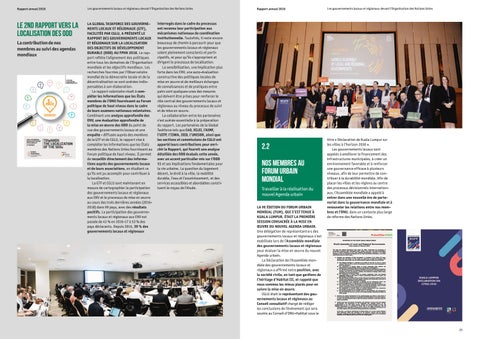
2.2 Nos membres au Forum urbain mondial Travailler à la réalisation du nouvel Agenda urbain LA 9E ÉDITION DU FORUM URBAIN MONDIAL (FUM), QUI S’EST TENUE À KUALA LUMPUR, ÉTAIT LA PREMIÈRE SESSION CONSACRÉE À LA MISE EN ŒUVRE DU NOUVEL AGENDA URBAIN. Une délégation de représentant·e·s des gouvernements locaux et régionaux s’est mobilisée lors de l’Assemblée mondiale des gouvernements locaux et régionaux pour évaluer la mise en œuvre du nouvel Agenda urbain. La Déclaration de l’Assemblée mondiale des gouvernements locaux et régionaux a affirmé notre position, avec la société civile, en tant que gardiens de l’héritage d’Habitat III, et rappelé que nous sommes les mieux placés pour en suivre la mise en œuvre. CGLU était le représentant des gouvernements locaux et régionaux au Conseil consultatif chargé de rédiger les conclusions de l’événement qui sera soumis au Conseil d’ONU-Habitat sous le
Les gouvernements locaux et régionaux devant l’Organisation des Nations Unies
titre « Déclaration de Kuala Lumpur sur les villes à l’horizon 2030 ». Les gouvernements locaux sont appelés à améliorer le financement des infrastructures municipales, à créer un environnement favorable et à renforcer une gouvernance efficace à plusieurs niveaux, afin de leur permettre de contribuer à la durabilité mondiale. Afin de placer les villes et les régions au centre des processus décisionnels internationaux, l’Assemblée mondiale a appelé à entrer dans une nouvelle ère de partenariat dans la gouvernance mondiale et à renouveler les relations entre nos membres et l’ONU, dans un contexte plus large de réforme des Nations Unies.
#Listen2Cities #WUF9 STATEMENT AT THE NINTH WORLD URBAN FORUM
World Assembly of Local and Regional Governments Kuala Lumpur, 8 February 2018
We, local and regional governments from across the globe, representing the populations of metropolises, peripheral cities, intermediary cities, regions, rural areas, and small municipalities, are at the World Assembly of Local and Regional Governments, convened by the Global Taskforce of Local and Regional Governments and our local government associations, at the Ninth World Urban Forum in Kuala Lumpur, 1. Reaffirm the positioning of local governments as guardians of the Habitat III legacy together with civil society. In this regard we would like to recall the important joint commitments agreed upon in the New Urban Agenda adopted in Quito and in particular: a) The landmark inclusion of a reference to the Right to the City as part of a shared vision of “cities for all”, as well as the inclusion of many of the its core components in the Quito document; b) The commitment of Member States to ensure appropriate fiscal, political and administrative decentralization based on the principle of subsidiarity; c) The commitment of Member States to strengthen effective multi-level governance, ensuring the involvement of subnational and local governments in decision-making and providing them with the necessary authority and resources to manage critical urban, metropolitan and territorial concerns; d) The commitment of Member States to promote participatory policy and planning approaches rooted in new forms of direct partnership between civil society and governments at all levels; e) The commitment of Member States to “take measures to promote women’s full and effective participation and equal rights in all fields and in leadership at all levels of decision-making, including in local governments”; f) The recognition of the importance of planning and “an integrated urban and territorial approach” to encourage urban-rural interactions and connectivity; g) The recognition of culture and heritage as an important dimension in achieving the goals of the agenda, notably in the context of citizens’ empowerment, access to urban services and ownership of regeneration and social cohesion strategies; h) The commitment of Member States to expand decentralized and city-to-city cooperation to contribute to sustainable urban development. i) The acknowledgement of the valuable inputs by all stakeholders and constituencies towards Habitat III and their key role in the implementation, monitoring and follow up of the agenda. 2. Enhance the political commitment for the implementation and effective achievement of the New Urban Agenda, fostering the commitment of Member-States in the above matters, as well as the commitments made by local and regional authorities to lead local action for global sustainability. Define more clear and effective mechanisms and modalities to ensure local and regional governments full involvement in the monitoring and reporting process of the implementation of the New Urban Agenda, through the World Assembly of Local and Regional Governments as mentioned in article 169 of the Quito Declaration and the recognition of the importance of continuing to engage in the follow-up and review of the New Urban Agenda with sub-national and local governments associations. 3.
In this light, we recall the commitment of Member States of a 2-years process (October 2016 September 2018) that mandated the UN Secretary General and UN General Assembly to conduct consultations, dialogues and analysis and agree on the institutional framework of the follow-up and review of the New Urban Agenda.
25
Rapport annuel 2018
Les gouvernements locaux et régionaux devant l’Organisation des Nations Unies
2.3
Agenda sur le climat et la résilience CGLU ne travaille pas de la même façon que de nombreux autres réseaux et organisations qui se concentrent sur l’adaptation au changement climatique et l’atténuation de ses effets. Nous pensons que nous, les villes, devons prendre l’initiative d’une transition écologique, que nous ne pouvons pas être de simples témoins et que nous devons insister pour que notre rôle dans la réalisation de l’Accord de Paris soit mieux reconnu et que toutes les parties prenantes s’engagent davantage à en faire une réalité.
S’engageant à accroître l’ambition climatique et à mettre à jour, améliorer et déterminer au niveau national les contributions d’ici l’an 2020. S’engageant sur la voie d’une transformation économique et technologique à long terme qui garantisse des emplois décents et une plus grande résilience. Renforçant des actions émanant de la base en faveur du climat, en soutenant et en accélérant l’action climatique aux niveaux local et régional. L’appel à l’action mondiale pour le climat s’est terminé en signalant les étapes cruciales essentielles pour mobiliser les parties prenantes, telles que le dialogue de Talanoa lors de la COP24 qui était alors à venir, ainsi que le Sommet sur le climat du secrétaire général des Nations Unies.
26
24ÈME CONFÉRENCE DES PARTIES À KATOWICE, POLOGNE
SOMMET MONDIAL POUR L’ACTION CLIMATIQUE
Le Sommet mondial sur le climat a réuni des parties prenantes (des sphères gouvernementales nationales au secteur privé) du monde entier, dont plus de 100 élus locaux, dans le but d’accélérer les actions visant à réaliser l’Accord de Paris. Les parties prenantes réunies à San Francisco ont lancé l’Appel à l’action mondiale pour le climat, appelant à des actions de collaboration et de transformation à tous les niveaux et dans tous les secteurs de la société, afin de respecter les engagements pris lors de la COP21. L’appel à l’action mondiale pour le climat appelait à accélérer l’action pour le climat en :
Rapport annuel 2018
CONFÉRENCE DU GIEC SUR LES VILLES À EDMONTON
Convoquée par le Groupe d’experts intergouvernemental sur l’évolution du climat (GIEC) et co-organisée par différents réseaux de gouvernements locaux et régionaux, la Conférence des villes du GIEC visait à établir un agenda de recherche mondial pour combler les principales lacunes relevées par les universitaires, les praticiens et les décideurs politiques des villes. La conférence était précédée par le Sommet mondial des maires sur le changement climatique, qui a permis de recueillir les points de vue des dirigeant·e·s des gouvernements locaux. Les organisations partenaires ont publié la Déclaration conjointe « La science dont nous avons besoin pour les villes que nous voulons : travailler ensemble pour mettre en œuvre l’agenda mondial de recherche et d’action sur les villes et le changement climatique ». Elle décrit comment travailler ensemble afin de soutenir la mise en œuvre de l’agenda climatique, en s’accordant sur quatre engagements clés pour en faire une réalité : promouvoir et mettre en œuvre l’agenda mondial de recherche sur les villes et le changement climatique ; stimuler la recherche et la production de connaissances sur la diversité des questions liées aux villes et au changement climatique ; encourager les actions climatiques reposant sur des données scientifiques et factuelles dans les villes ; et créer et renforcer les partenariats.
Les négociations de la COP24 ont eu lieu à la fin d’une année marquée par une augmentation sans précédent des températures sur tous les continents, ainsi que par des catastrophes naturelles touchant les populations locales à une échelle jamais vue jusqu’à présent. De nombreux appels ont été lancés aux nations pour qu’elles renforcent leurs engagements, notamment lors du Sommet mondial sur le climat, qui s’est tenu à San Francisco en septembre 2018. L’année 2018 a été marquée par la publication du rapport spécial du GIEC sur les 1,5 degré, rajoutant à l’urgence climatique. Il nous avertit que même un scénario à 1,5 degré d’augmentation de la température aura des répercussions mondiales importantes : jusqu’à 69 millions de personnes exposées aux inondations et 15 % de la population exposée à une chaleur intense. Lors de la COP24, une délégation de 80 dirigeants locaux et régionaux de toutes les régions du monde a apporté son engagement en faveur d’une transformation profonde, tout en appelant les nations à transposer la dynamique mondiale en décisions et actions politiques permettant de réaliser des ambitions climatiques plus élevées.
Les gouvernements locaux et régionaux devant l’Organisation des Nations Unies
Avec les dirigeants locaux et régionaux de tous les réseaux internationaux de gouvernements locaux et régionaux de la Global Taskforce, notamment ICLEI, la Convention mondiale des maires, C40, nrg4SD et Climate Chance, ainsi que nos propres sections et membres de CGLU, le CCRE et CGLU Afrique, nous avons pris des engagements communs pour développer des travaux sérieux et transformateurs pour favoriser pleinement la transition écologique et changer les tendances actuelles qui nous poussent vers une catastrophe climatique, et pour assurer une utilisation bien équilibrée de nos ressources naturelles. À Katowice, nos membres ont appelé les chefs d’État et les ministres à prendre des engagements d’atténuation non ambigus et beaucoup plus audacieux, qui s’alignent sur l’objectif de 1,5 degré et reflètent le potentiel de réduction des émissions des villes. Les gouvernements locaux et régionaux ont plaidé pour une décision claire permettant d’intégrer ce processus aux règles de mise en œuvre de l’Accord de Paris, assurant notre place comme partenaires essentiels et actifs avant 2020 et au-delà.
8ÈME ÉDITION DU FORUM MONDIAL DE L’EAU
CGLU a représenté ses membres au Forum mondial de l’eau et co-organise, avec ICLEI, la Global Water Operators’ Partnership Alliance (GWOPA), le Conseil mondial de l’eau et des partenaires brésiliens, la Conférence internationale des autorités locales et régionales, qui vise à aider les gouvernements locaux et régionaux à partager leurs expériences et solutions portant sur l’eau et l’assainissement. L’édition de cette année s’est tenue à Brasilia, sous le thème « Partager l’eau », et visait à promouvoir la sensibilisation, à renforcer l’engagement politique et à déclencher des actions sur les questions critiques relatives à l’eau. La Conférence internationale des autorités locales et régionales a publié l’Appel des gouvernements locaux et régionaux de Brasilia pour une action sur l’eau qui reprend les résultats des discussions qui ont eu lieu tout au long de la conférence et formule cinq recommandations aux parties prenantes.
27
Rapport annuel 2018
2.4 Renforcement du dialogue entre les gouvernements nationaux et locaux La naissance d’Urban 20
Les gouvernements locaux et régionaux devant l’Organisation des Nations Unies
L’INITIATIVE URBAN 20 (U20) a été lancée sous la direction de M. Larreta, maire de Buenos Aires, et de Mme Hidalgo, maire de Paris, en 2017. Elle vise À COORDONNER UNE POSITION COMMUNE ENTRE LES MAIRES DES GRANDES VILLES DU G20 AFIN D’ORIENTER ET ENRICHIR LES DISCUSSIONS DES DIRIGEANTS NATIONAUX DU G20. L’initiative vise à mettre en lumière l’expertise des villes pour toute une série de questions portant sur le développement mondial, à contribuer à la recherche de solutions au G20 et à formuler des recommandations claires aux gouvernements nationaux. U20 n’est donc pas un nouveau réseau de villes, mais plutôt un forum au sein duquel les villes développent des messages collectifs visant à renforcer la présence des thèmes urbains et des gouvernements locaux dans l’agenda du G20. CGLU est, avec C40, le coorganisateur de l’initiative et joue un rôle actif pour la réalisation des objectifs, des réunions et des documents finaux, et pour assurer le lien entre les agendas et les positions d’U20 et ceux du reste des membres.
Le premier Sommet des Maires Urban 20 s’est tenu à Buenos Aires les 29 et 30 octobre 2018. Parmi les thèmes prioritaires de l’édition 2018 figuraient l’action climatique, l’avenir du travail, l’intégration et l’inclusion sociales. D’autres sujets pertinents ont été abordés : l’autonomisation des femmes, la sécurité alimentaire, l’accès au financement et l’infrastructure pour le développement. Trente-cinq maires et représentants de villes se sont engagés à promouvoir le dialogue et la coopération entre le G20 et les villes du monde entier. Ils ont présenté une position commune au président du G20, le président argentin Mauricio Macri. Les villes ont en outre exprimé leur engagement à continuer à travailler dans le cadre de cette plateforme en vue de la réunion du G20 en 2019, organisée par Tokyo.
3 Suivi CGLU plaide pour renforcer la visibilité et la place centrale des gouvernements locaux et régionaux, en mettant en place un cadre de suivi et de production de rapports des activités de mise en œuvre des agendas mondiaux de développement et en pilotant l’élaboration du prochain Rapport mondial sur la démocratie locale et la décentralisation (GOLD V), qui sera publié en 2019.
Rapport annuel 2018
Rapport annuel 2018
Suivi
3.1 Les Objectifs de développement durable au premier plan de nos recherches Observatoire Mondial sur la Démocratie Locale et la Décentralisation
2018 AURA VU LA CONSOLIDATION ET LA PRÉPARATION DU 5ÈME RAPPORT DE L’OBSERVATOIRE MONDIAL SUR LA DÉCENTRALISATION ET LA DÉMOCRATIE LOCALE (GOLD), qui sera publié en 2019. Cette édition étudiera la localisation des ODD et des autres agendas mondiaux, en réunissant l’expertise des gouvernements locaux et régionaux, des chercheurs de différentes régions géographiques et des commissions et partenaires de CGLU, à travers un processus participatif. Sept équipes régionales sont en train de créer les chapitres régionaux qui composeront le rapport GOLD V. En novembre 2018, CGLU disposait d’une première série de projets de travail, afin de commencer à impliquer les sections régionales, les commissions et les partenaires internationaux, et donc le processus de validation des résultats du rapport. GOLD V évaluera les stratégies nationales pour la mise en œuvre des agendas mondiaux dans chaque région du monde. Il analyse en outre l’évolution des cadres institutionnels des gouvernements
locaux, métropolitains et régionaux, en accordant une attention particulière aux efforts déployés par ceux-ci pour atteindre les objectifs et susciter un changement transformateur. GOLD V est un rapport élaboré à partir de la base, en consultation avec les membres, et qui nous permet de rapporter les points de vue de nos collectivités, villes et territoires et de la façon dont ils contribuent aux agendas mondiaux. Les données ont été recueillies dans le cadre d’une enquête, qui s’est consolidée en tant qu’outil permettant de recueillir l’engagement et la participation des gouvernements locaux. Les recherches de GOLD V inspireront le troisième rapport des gouvernements locaux et régionaux du FPHN 2019, pour achever le processus d’évaluation et d’établissement de rapports au plus haut niveau institutionnel. Elles contribueront également au processus que l’ONU finalisera en publiant son propre premier rapport quadriennal sur la mise en œuvre des ODD.
3.2 L’Observatoire mondial des finances et de l’investissement des gouvernements infranationaux
Suivi
L’OBSERVATOIRE MONDIAL DES FINANCES DES GOUVERNEMENTS INFRANATIONAUX EST LE FRUIT DU PARTENARIAT ENTRE CGLU ET L’OCDE. Il apporte un éclairage significatif aux recherches de l’Organisation mondiale sur les finances locales, en contrôlant les capacités financières des gouvernements infranationaux et leur rôle de partenaires du développement. L’Observatoire mondial a organisé un atelier à Barcelone au cours de l’année, pour réviser et valider la méthodologie de l’Observatoire en matière de collecte de données. Des fiches d’information par pays sont en cours de collecte pour plus de 45 pays. Cet effort collaboratif devrait améliorer et mettre à jour la quantité massive d’informations de qualité que CGLU et l’OCDE avaient déjà collectées pour leur publication conjointe de 2016. Pour ce faire, des points focaux régionaux ont été mis
en place pour collecter les données. En partenariat avec l’Organisation de coopération et de développement économiques, le Fonds d’équipement des Nations Unies, l’Agence française de développement et Décentralisation et gouvernance locale (DeLog), il validera la fiabilité des données publiques portant sur les finances infranationales. Ce processus permettra non seulement de mettre à jour la base de données et les profils de pays existants, mais aussi d’entamer une analyse systématique de l’efficacité des processus de décentralisation fiscale dans le monde. Un comité directeur réunissant tous les intervenants et contributeurs pertinents se réunira en décembre. Ce sera l’occasion de partager et de présenter les résultats préliminaires à tous les partenaires intéressés.
3.3
Suivi du Nouvel agenda urbain LE NOUVEL AGENDA URBAIN EST ESSENTIEL POUR ACCÉLÉRER LA MISE EN ŒUVRE DE L’AGENDA 2030 et, de fait, de l’ensemble des agendas mondiaux de développement. Les gouvernements locaux et régionaux peuvent jouer un rôle inestimable dans sa mise en œuvre, ainsi que dans le suivi et l’établissement de rapports sur la réalisation du Nouvel Agenda urbain. La nécessité d’organiser un dialogue structurel spécifique à nos membres guide leurs contributions et celles de CGLU aux débats portant sur le Nouvel Agenda urbain qui ont eu lieu au cours de l’année.
30
31
4 Apprentissage L’équipe d’apprentissage de CGLU a travaillé pour fournir aux gouvernements locaux et régionaux des outils pour améliorer la gestion locale et stimuler l’inspiration et l’innovation, grâce à des échanges entre pairs. Elle a encore consolidé la méthodologie de « formation des formateurs » autour des ODD, avec des actions promues par les membres dans le monde entier. L’apprentissage fera également partie intégrante du Congrès mondial de CGLU, qui accueillera un Forum d’apprentissage.
Rapport annuel 2018
Apprentissage
Rapport annuel 2018
4.2
Localisation des ODD
4.1
Apprentissage par l’action LE MANDAT STRATÉGIQUE DE CGLU EST DE SOUTENIR L’APPRENTISSAGE DE SES MEMBRES EN PROMOUVANT UNE COOPÉRATION DÉCENTRALISÉE et la coopération internationale entre les gouvernements locaux et leurs associations, ainsi que de promouvoir les échanges entres pairs comme un moyen d’apprentissage mutuel. Dans le même esprit de promotion de l’apprentissage entre pairs au sein des municipalités, CGLU, FLACMA, l’Organisation Internationale du Travail et le Ministère des Autonomies de Bolivie ont organisé un événement d’apprentissage entre pairs à Riberalta, en Bolivie, dans le but de construire un réseau de coopération et d’apprentissage entre pairs pour renforcer le développement de politiques et soutenir les villes petites et moyennes dans la région amazonienne. Les participant·e·s de villes, de régions et d’associations de gouvernements locaux du Brésil, de Bolivie, de Colombie, d’Équateur et du Pérou y ont échangé leurs expériences sur la planification urbaine stratégique, la conservation, le développement économique local et les emplois verts dans une perspective Sud-Sud. 34
En collaboration avec CGLU ASPAC, la plateforme internationale des villes Connective Cities et ses créateurs, la Deutsche Gesellschaft fuer Internationale Zusammenarbeit (GIZ) et la municipalité de Surabaya ont organisé l’atelier d’apprentissage par les pairs sur « La construction d’une alliance des gouvernements locaux pour localiser le cadre de Sendai pour la réduction des risques de catastrophe (SFDRR) 2015-2030 en Asie-Pacifique ». L’événement s’est tenu à Surabaya, en Indonésie, en même temps que le Congrès de CGLU-ASPAC. Il a rassemblé des experts de la réduction des risques de catastrophe (RRC) de la région Asie-Pacifique et d’Allemagne, pour échanger leurs points de vue et expériences sur les politiques et instruments de RRC. Les résultats de cet atelier seront utilisés pour l’élaboration des politiques futures en matière de réduction des risques de catastrophe et de préparation aux catastrophes, et alimenteront une stratégie d’apprentissage axée sur la localisation et la mise en œuvre du Cadre de Sendai.
LES DÉFIS AUXQUELS SONT CONFRONTÉS LES URBANISTES ET DIRIGEANTS DES VILLES DANS LE CONTEXTE ACTUEL SONT IMMENSES. CGLU s’engage à la localisation des ODD pour permettre aux gouvernements locaux et régionaux de s’appuyer sur les idées, opportunités et priorités locales. Les gouvernements locaux ont un rôle crucial à jouer dans ce processus de localisation des agendas mondiaux. En tant que décideurs politiques, catalyseurs du changement et acteurs clés du développement, les villes sont les seules à pouvoir mettre en œuvre et effectuer le suivi du développement durable, de la prospérité et du bien-être au niveau local. Deux sessions d’apprentissage ont eu lieu au Forum urbain mondial : une session de formation axée sur la localisation des ODD dans les villes de taille moyenne, qui
Apprentissage
a souligné le rôle des régions, des villes intermédiaires et des associations de gouvernements locaux pour la localisation des ODD, et a été organisée conjointement par CGLU, l’Association des municipalités néerlandaises (VNG) et le Conseil provincial de Barcelone ; et un jeu de rôle sur la gestion des déchets et l’économie circulaire qui a permis aux participant·e·s de discuter et évaluer les incidences des différentes politiques et variables qui influencent les processus de décision en matière de gestion des déchets. Les ateliers comprenaient une introduction générale au processus de création de l’Agenda 2030, ainsi que des présentations soulignant l’importance de la sensibilisation et de l’inclusion civique active dans le processus de localisation au niveau régional. La municipalité métropolitaine de Quito, qui avait été la ville hôte de la Conférence Habitat III, a organisé deux ateliers de formation de formateurs sur la localisation des ODD. En collaboration avec le Fonds andalou des municipalités pour la solidarité internationale (FAMSI) et l’Union des capitales ibéro-américaines (UCCI), CGLU a soutenu la préparation des ateliers. La municipalité d’eThekwini a organisé un événement de formation de formateurs sur la localisation des ODD. L’équipe d’apprentissage de CGLU a organisé l’atelier en collaboration avec l’Académie municipale d’eThekwini et l’Académie africaine des
35
Rapport annuel 2018
Apprentissage
5 Renforcer le Réseau
collectivités territoriales (ALGA) de CGLUAfrique. L’un des principaux résultats de cette discussion a été d’apporter une perspective africaine aux chapitres du module d’apprentissage. L’Agenda 2030 et les ODD ont été les thèmes principaux du Congrès de CGLUEurasie à Cheboksary. Le Congrès a accueilli un séminaire d’apprentissage sur la localisation des ODD ainsi qu’un atelier animé par le Secrétariat mondial de CGLU, conjointement avec la Commission Culture de CGLU. Il s’est concentré sur des exemples concrets d’alignement des stratégies et projets locaux avec les objectifs mondiaux, avec une attention particulière pour les politiques culturelles en tant que quatrième pilier de la durabilité.
Renforcer les capacités des gouvernements locaux à atteindre les objectifs du développement durable grâce à notre Toolkit d’apprentissage Un Toolkit d’apprentissage pour la localisation des ODD, visant à renforcer les capacités des gouvernements locaux et régionaux à réaliser l’Agenda 2030, a été élaboré et est utilisé pour former les participant·e·s à nos activités d’apprentissage. Actuellement, trois modules pour la localisation des objectifs mondiaux ont été produits, et CGLU devrait développer un quatrième module. Le module de formation 1 du Toolkit était un module d’introduction visant à sensibiliser les participant·e·s aux questions clés relatives à la localisation des ODD, et a été publié en 2017. Le module de formation 2 vise à découvrir comment les ODD et les principes qui sous-tendent l’Agenda 2030 contribuent à la planification urbaine, et comment la planification urbaine contribue à la réalisation des ODD. Le module de formation 3, qui met l’accent sur le rôle des associations de gouvernements locaux pour la présentation de rapports aux examens nationaux volontaires, devrait être lancé en 2019.
36
Le renforcement des partenariats a été l’un de nos principaux objectifs tout au long de l’année, et cela s’est reflété dans tout notre travail, en particulier lors de notre Séminaire annuel. En 2018, nous avons également travaillé à la synergie des priorités politiques de nos sections régionales, en intégrant les politiques dans nos réunions statutaires.
Rapport annuel 2018
5.1
Séminaire et Campus de CGLU 2018
Rapport annuel 2018
Renforcer le réseau
DANS LE BUT DE FAÇONNER LES PRIORITÉS DE NOS MEMBRES ET DE CRÉER ET D’ÉTENDRE LES SYNERGIES ENTRE LES DIFFÉRENTES PARTIES DU RÉSEAU, le Séminaire et campus de CGLU est devenu un rendez-vous important pour améliorer le dialogue et façonner notre stratégie. Plus de 180 participant·e·s ont assisté à cette édition 2018, avec la présence significative d’organisations partenaires, permettant de consolider ce rassemblement, une réunion importante qui démontre le potentiel de ce que le mouvement municipal peut réaliser avec ses partenaires. Le renforcement des partenariats était l’un des principaux objectifs du Séminaire, et une constante pour CGLU tout au long de l’année. Ainsi, l’un des principaux résultats des discussions a été la mondialisation de l’initiative africaine « Connaissez votre ville », grâce à des partenariats renforcés entre CGLU, Slum Dwellers International et Cities Alliance. Le renforcement de la collaboration avec l’Internationale des services publics et World Enabled a également été l’un des engagements pris au cours de ce Séminaire, démontrant ainsi tout son potentiel.
Nos membres ont réaffirmé que le droit à la ville, la résilience, la gouvernance à plusieurs niveaux et les opportunités pour tou·te·s constituaient nos priorités politiques. Le droit au logement est également une question centrale du droit à la ville et de la manière de garantir les droits des citoyen·ne·s. La Global Taskforce des gouvernements locaux et régionaux (GTF) a également organisé une session spéciale pendant le Séminaire, qui s’est concentrée sur la manière dont elle pourrait contribuer à la réalisation des agendas mondiaux.
5.2 Une organisation dirigée par ses représentant·e·s politiques CGLU, EN TANT QU’ORGANISATION, TRAVAILLE À CHANGER L’APPROCHE DE SES RÉUNIONS STATUTAIRES EN INCORPORANT L’ÉLABORATION DES POLITIQUES DANS LES RÉUNIONS, COMME UN MOYEN DE RENFORCER ET D’ALIGNER LES PRIORITÉS DE L’ORGANISATION. Lors de notre Bureau exécutif à Strasbourg, les réunions statutaires se sont tenues en même temps que les Dialogues pour des villes résilientes entre les gouvernements nationaux et locaux, tandis que notre Conseil mondial à Madrid, organisé dans le cadre du Forum mondial sur la violence urbaine, a été l’occasion de renforcer l’agenda pour la paix de CGLU et le lien entre promotion de la paix et démocratie locale.
Bureau exécutif de CGLU La ville de Strasbourg, à l’invitation du maire Roland Ries, coprésident de CGLU, a accueilli la première session du Bureau exécutif de CGLU du 23 au 25 mai 2018. Elle a réuni plus de 300 participant·e·s, dont plus de 80 maires, et a également compté sur la présence de nombreux représentants de gouvernements nationaux, qui ont discuté des priorités des gouvernements locaux et régionaux au niveau de la mise en œuvre du Nouvel agenda urbain et des ODD, lors de dialogues politiques organisés avec ONUHabitat. Le Bureau exécutif de Strasbourg a été le théâtre d’un dialogue de haut niveau entre ministres, maires, gouverneurs et d’autres représentants gouvernementaux. Organisé en partenariat avec le Comité consultatif des autorités locales auprès des Nations Unies (UNACLA), les sessions visaient à établir un lien entre la mise en œuvre du Nouvel agenda urbain et celle de l’Agenda 2030, et à déterminer comment accélérer la mise en œuvre. 38
Renforcer le réseau
Conseil mondial Le Conseil mondial de CGLU s’est réuni à Madrid, à l’invitation de la maire Manuela Carmen, et a réuni environ 380 participant·e·s de plus de 110 villes, 35 associations et 10 gouvernements régionaux et provinciaux, représentant toutes les régions du monde. Les réunions du Conseil mondial ont également compté sur la présence de la Commission européenne, d’organisations sœurs telles que Cities Alliance, d’agences des Nations Unies ainsi que de nombreux autres partenaires de l’Organisation. Le Conseil mondial de CGLU a eu lieu dans le cadre du Forum mondial sur les violences urbaines et l’éducation pour la cohabitation et la paix, une réunion qui vise à rassembler les dirigeants locaux, les organisations internationales, les universitaires, les ONG et la société civile pour débattre, réfléchir et construire des solutions pour développer des environnements urbains qui éradiquent la violence. La consolidation de la paix et le développement de sociétés exemptes de violence étaient au cœur des discussions de Madrid. Elles ont mis en lumière les efforts de nos membres pour consolider la paix dans le monde et expliquer qu’un monde
exempt de violence est possible, mais que nous devons considérer toutes les personnes impliquées pour y parvenir.
Les Conseils politiques de CGLU Les Conseils politiques de CGLU se sont réunis pour la première fois dans le cadre du Bureau exécutif de CGLU à Strasbourg, organisant des dialogues entre les responsables des gouvernements locaux et les ministres en préparation du Forum politique de haut niveau, dans le but de renforcer l’engagement politique face aux défis auxquels les gouvernements locaux et régionaux sont confrontés. Ces dialogues ont représenté une étape importante vers une meilleure compréhension entre les sphères du gouvernement. Le cadre du Conseil mondial de CGLU et du Forum sur la violence urbaine et l’éducation pour la coexistence et la paix a été l’occasion d’inclure la consolidation de la paix parmi les priorités de l’organisation mondiale. Cet égard, les dialogues organisés par les Conseils politiques visaient à instaurer la paix dans le cadre de leurs travaux et à développer des initiatives de consolidation de la paix dans l’ensemble de l’Organisation mondiale.
39
Rapport annuel 2018
5.3
Campagnes de communication et de sensibilisation
Rapport annuel 2018
Renforcer le réseau
TOUT AU LONG DE L’ANNÉE 2018, LES EFFORTS EN MATIÈRE DE COMMUNICATION ONT ÉTÉ PORTÉS SUR LE RENFORCEMENT DE LA CAPACITÉ DE DIFFUSION DE NOS MESSAGES. Grâce à des campagnes de communication, nous avons pu accroître notre présence dans les réseaux sociaux et contribuer à la diffusion des principaux messages de nos membres. Tout au long de l’année, nous avons continué à développer certaines des campagnes qui ont été lancées au cours des années précédentes, comme #BeCounted, qui avait été lancée à New York au cours de l’année précédente. Il s’agit d’un appel à améliorer les données sur l’égalité des genres dans les gouvernements locaux, afin d’atteindre l’objectif 5, et qui a fait l’objet d’une attention particulière pendant les journées européennes du développement en juin. L’initiative #Listen2Cities, lancée au cours de l’année précédente, était essentielle pour prendre de l’élan avant et pendant le Forum politique de haut niveau. La campagne du FPHN a permis à CGLU et à la Global Taskforce d’être plus présents que jamais dans le flux des réseaux sociaux de l’ONU. Lors du Forum des gouvernements locaux et régionaux, CGLU était le compte le plus visible, et a culminé à la 3ème place lors du FPHN. La campagne a également permis de faire participer d’autres comptes au sein de la famille CGLU, comme l’équipe GOLD, et de toucher un public plus large.
La campagne #CitiesforHousing, conçue pour accompagner la présentation du Manifeste des villes pour le logement, était également présente au Forum politique de haut niveau et au-delà, notamment lors de la présentation du Manifeste pour mettre en lumière les revendications des autorités locales et régionales en matière de droit au logement. CGLU s’est joint à la campagne #Act4SDG, lancée par les Nations Unies, visant à montrer ce que les acteurs individuels et collectifs font pour sensibiliser aux objectifs mondiaux, coïncidant avec le 3e anniversaire de leur adoption le 25 septembre. Le Secrétariat de CGLU a contribué à la campagne en enregistrant des vidéos des membres de CGLU et des commentaires du personnel sur leur contribution aux ODD dans leur travail ou leur vie quotidienne.
Renforcer le réseau
Impact des médias sociaux de CGLU 2018
On dénombre plus de 6 200 nouveaux abonnés sur Twitter, 800 nouveaux fans sur Facebook et 50 % de visionnages en plus sur notre chaîne YouTube par rapport à l’année précédente. Notre site Web a également connu une augmentation de 67 015 utilisateurs uniques au cours de l’année.
Youtube
Nombre de vidéos visionnées
26 603
2017
39 349
2018
Ç Augmentation 12 746 vues (47,91%) Nombre de vidéos partagés
Followers sur twitter 25 870
2018
19 621
2017
1 346
2018
725
2017
Ç Augmentation 621 partages (+86,66%)
ÇAugmentation 6 249 followers
www.uclg.org
Nombre d’utilisateurs
Fans 5 451
2018 2017
Ç Augmentation 785 fans
4 666
151 958
2018 2017
84 943
Ç Augmentation 67 015 visites Par langue
40
EN
SP
FR
38%
34%
11%
41
Rapport annuel 2018
Rapport annuel 2018
Renforcer le réseau
Publications
Newsletters
Institutionnel
Douze newsletters mensuelles ont été envoyées à notre vaste réseau de contacts. Ces newsletters comprenaient des informations régulières et particulières pouvant intéresser les gouvernements locaux et régionaux et des informations recueillies par le Secrétariat mondial de CGLU, les sections, les commissions et les groupes de travail, et par les membres. A l’aide d’outils de campagne spécifiques, plusieurs envois massifs ont été réalisés pour promouvoir la campagne #Act4SDG et la Journée internationale de la femme, et informer de notre participation au 9ème Forum urbain mondial et au Forum politique de haut niveau.
Rapport annuel 2017
Seminaire&Campus 2018
Renforcer le réseau
Dialogue sur les villes durables
Agenda Global
Collaborations dans la presse Comment CGLU contribue aux ODD
Mesurer l’agenda global
Commissions et Groupes de travail
La culture dans les objectifs de développement durable
42
Mobility champions
Module 2 d’apprentissage: Localiser les ODD
Global Taskforce
Towards the localization of the SDGs
Local and Regional Action at the Heart of the High-level Political Forum 2018
Courant 2018, l’offre de journaux et de blogs dans lesquels nous avons présenté nos initiatives et nos publications a considérablement augmenté. Les membres ont collaboré à la publication et/ou à la diffusion de nos articles dans les médias écrits et en ligne tout au long de 2018. CGLU a joué un rôle de premier plan pour le FPHN 2018, avec un article sur le Blog officiel, et avec un article invité publié sur le Knowledge Hub de l’IIDD, se concentrant sur le 2ème rapport « Vers la localisation des ODD ». Un article supplémentaire a également été publié dans le journal espagnol El País, commentant les résultats et les attentes de nos membres après le FPHN. Un article intitulé « World Urban Forum 9 : A promise or a responsibility » a été publié sur le Citiscope, ainsi que deux éditoriaux pour le CIDOB, l’un centré sur le
rôle des villes dans les agendas mondiaux et l’autre sur les résultats du séminaire du CIDOB « Repenser l’écosystème des réseaux de villes internationales : Défis et opportunités ».
43
6 Priorités des sections Au cours de l’année, les membres ont souligné la nécessité de renforcer les capacités, la formation et la collaboration entre le réseau et les sections afin d’élaborer une stratégie commune pour faire aboutir les ODD. L’échange de connaissances entre les continents, y compris une séance de travail des secrétaires généraux, a permis de déployer notre potentiel d’apprentissage.
Rapport annuel 2018
Rapport annuel 2018
Priorités des sections
EUROPE regagner la confiance des citoyen·ne·s grâce au gouvernement ouvert LA SECTION EUROPÉENNE S’EFFORCE D’ÉLARGIR LA PERSPECTIVE MONDIALE SUR DES QUESTIONS TELLES QUE LE CHANGEMENT CLIMATIQUE, LES MIGRATIONS ET L’INTÉGRATION. La section européenne a lancé un appel fort en faveur d’une stratégie commune en matière de migration, en particulier au vu de la crise qui a entraîné la mort de nombreuses personnes en Méditerranée. La section européenne est également disposée à travailler sur des politiques de gouvernement ouvert pour aider à regagner la confiance des citoyen·ne·s, en développant des institutions basées sur la transparence, la participation et la responsabilité. En outre, l’Europe insiste sur la nécessité d’impliquer les citoyen·ne·s dans les affaires publiques, en particulier les jeunes.
CGLU-ASPAC Localiser le cadre de Sendai et la coopération de ville à ville, pierres angulaires du travail de CGLU-ASPAC
AFRIQUE Dialogues intergénérationnels pour construire un avenir avec les jeunes LA PRINCIPALE PRIORITÉ DE LA SECTION AFRICAINE AU COURS DE L’ANNÉE A ÉTÉ LE 8E SOMMET AFRICITÉS, LE GRAND RASSEMBLEMENT DE MUNICIPALITÉS DU CONTINENT AFRICAIN. Organisé à Marrakech, l’événement a permis au mouvement municipal africain d’aborder, dans une perspective d’espoir, les questions les plus importantes - et même douloureuses - de la région. Parmi les sujets abordés, on peut citer comment assurer un avenir à la
CGLU-MEWA La résilience urbaine et le développement local, essentiels pour atteindre les ODD LES PRINCIPALES PRIORITÉS DE LA SECTION POUR 2018 ET AU-DELÀ ONT ÉTÉ LES MIGRATIONS ET LA COHÉSION SOCIALE, L’ADAPTATION AU CHANGEMENT CLIMATIQUE, LA RÉSILIENCE URBAINE, LE DÉVELOPPEMENT LOCAL ET LA GOUVERNANCE. Les commissions et groupes de travail de CGLU-MEWA ont accordé une attention particulière à la mise en œuvre à court et moyen termes des agendas mondiaux, et la section aspire à assurer des méthodes appropriées de mise en œuvre, de suivi et d’élaboration de rapports pour toutes ses activités, dans les 4 domaines prioritaires. 46
Priorités des sections
jeunesse africaine, la question des enfants des rues, la remise en cause de l’omniprésence des établissements informels dans les plus grandes villes de la région, le rôle que le secteur informel joue dans l’économie africaine et la réduction des inégalités en Afrique. Le Sommet a également vu l’élection de la nouvelle présidente de CGLU-Afrique, Rose Christiane Ossouka Raponda, maire de Libreville. La section a également travaillé tout au long de l’année sur l’égalité des genres, en étroite coordination avec le REFELA. Ils travaillent actuellement sur diverses campagnes de sensibilisation à la violence contre les femmes et à l’autonomisation des femmes africaines. CGLU Afrique œuvre également pour une plus grande inclusion des jeunes dans les plans d’action.
EN 2018, CGLU-ASPAC A RENFORCÉ SA COLLABORATION AVEC L’ASEAN, L’ASSOCIATION DES NATIONS DE L’ASIE DU SUD-EST. CGLU-ASPAC est une section qui fait face à de nombreux défis, parmi lesquels les risques de catastrophes naturelles, une urbanisation rapide et la croissance démographique. En ce sens, la section a travaillé tout au long de l’année 2018 sur des programmes d’apprentissage, afin de favoriser une coopération active entre les membres et les villes, ainsi qu’un engagement fort en faveur d’une autonomie locale démocratique. Le 7ème Congrès de CGLU-ASPAC s’est tenu en septembre et a été l’un des temps forts de l’année pour la section, avec l’élection d’une nouvelle présidente, Tri Rishmaharini, la première femme à occuper ce poste, qui a souligné son engagement à travailler pour l’autonomisation des femmes de la région.
AMÉRIQUE LATINE Coordination et travail conjoint entre tous nos membres d’Amérique latine NOUS AVONS DE NOMBREUX MEMBRES, TRÈS BIEN ORGANISÉS EN AMÉRIQUE LATINE, QUI FONT PROGRESSER LA COORDINATION DES AUTORITÉS LOCALES D’AMÉRIQUE LATINE (CORDIAL, EN ESPAGNOL), POUR ÉTABLIR UNE REPRÉSENTATION UNIFIÉE DE NOS MEMBRES LATINO-AMÉRICAINS AU SEIN DE CGLU, EN METTANT L’ACCENT SUR LA COOPÉRATION, LE CONSENSUS ET LA CRÉATION DE VALEUR AJOUTÉE. Dans le cadre du Conseil mondial, ainsi que du XIe Forum ibéro-américain des gouvernements locaux, les réseaux qui forment CORDIAL se sont réunis pour développer la mission et la vision de l’organisation, discuter de la manière de
renforcer la coordination entre les réseaux latino-américains et envisager une stratégie de communication commune. LE XXIIIÈME SOMMET MERCOCIUDADES S’EST TENU À LA PAZ, EN METTANT L’ACCENT SUR LA CULTURE EN TANT QUE PILIER DU DÉVELOPPEMENT. Dans la Déclaration de La Paz, Mercociudades a réaffirmé son engagement à construire des espaces de dialogue, de travail en commun, d’échange d’expériences et de coopération mutuelle, pour faire face aux difficultés que nos sociétés rencontrent chaque jour. En outre, ils ont souligné la nécessité de continuer à travailler pour promouvoir l’égalité des droits et des chances, considérant l’Agenda 21 de la culture comme un accélérateur clé du développement durable.
Le Sommet continental de FLACMA en 2018 a culminé avec l’adoption de la Déclaration de Punta del Este, qui marque l’engagement à œuvrer pour l’intégration économique, commerciale et culturelle des 33 pays représentés au sein de FLACMA afin de surmonter les inégalités, en particulier les inégalités entre les genres et la pauvreté. Elle a souligné les valeurs de la « riche culture millénaire de la région », bien supérieures aux défis qui doivent être relevés. L’Union des capitales ibéro-américaines (UCCI, en espagnol) a organisé son Assemblée générale dans le but de promouvoir la démocratie participative dans toute l’Amérique latine et pour tisser des liens entre les gouvernements locaux et leurs citoyen·ne·s. 47
Rapport annuel 2018
Priorités des sections
Rapport annuel 2018
Priorités des sections
METROPOLIS Une approche territoriale qui unit les métropoles et leur environnement
Cette orientation a conduit la section à revoir sa stratégie, à adapter ses outils d’apprentissage et à lancer 12 projets pilotes dans différents domaines politiques, créant ainsi un plus grand espace d’échange et d’apprentissage. La section s’est également employée à achever la transformation de sa plateforme de transfert de politiques, afin de présenter des solutions novatrices et pratiques aux problèmes urbains et d’échanger des connaissances entre les urbanistes du monde entier.
METROPOLIS, NOTRE SECTION MÉTROPOLITAINE, A TRAVAILLÉ SUR LE RENFORCEMENT DES CAPACITÉS ET LE DÉVELOPPEMENT D’UN MESSAGE MÉTROPOLITAIN qui considère la relation des métropoles dans leur environnement.
AMÉRIQUE DU NORD Le renforcement des capacités des gouvernements locaux est la pierre angulaire de la réalisation des agendas mondiaux
LA SECTION NORAM A ÉTÉ PARTICULIÈREMENT IMPLIQUÉE DANS LES GROUPES DE TRAVAIL ET COMMISSIONS DE CGLU. Le secrétariat de la section, assuré par la FCM, contribue aux plans de travail et à la coordination générale de la Commission de développement économique et social local et du Groupe de travail CIB. La
FCM et ses membres ont aussi fortement contribué aux examens nationaux volontaires du Canada, en vue du Forum politique de haut niveau de 2018, qui a mis en lumière les possibilités de dialogue entre les municipalités et le gouvernement fédéral au Canada.
FORUM DES RÉGIONS La démocratie alimentaire, partie intégrante de la transition écologique
EURASIE Intégrer la protection du patrimoine dans les stratégies de localisation 48
LA SECTION EURASIE CONSIDÈRE QU’IL EST VITAL DE MAINTENIR LA PARTICIPATION DES JEUNES AUX PROJETS PATRIMONIAUX, AFIN D’ATTEINDRE LES OBJECTIFS DU DÉVELOPPEMENT DURABLE. En octobre, la ville de Cheboksary, conjointement avec la
EN 2018, LE FORUM A RÉAFFIRMÉ SON ENGAGEMENT EN FAVEUR DES OBJECTIFS DU DÉVELOPPEMENT DURABLE ET DES AGENDAS MONDIAUX. Il a pour objectif de promouvoir des stratégies de développement alignées sur les objectifs fixés par les ODD. Le Forum des Régions de CGLU et la communauté de pratiques sur la sécurité alimentaire ont travaillé sur la question de l’accès à la transition alimentaire et agricole afin de défendre un changement
de paradigme. La démocratie alimentaire est en passe de devenir un élément incontournable des priorités politiques de l’Organisation, puisqu’une approche territoriale de la sécurité alimentaire permettra de transformer la démocratie locale et de créer un monde dans lequel les petits producteurs et transformateurs, soutenus par l’action des gouvernements locaux, redonneront vie à nos territoires et ancreront l’emploi et le développement local.
Section eurasienne et la Commission Culture de CGLU, a organisé un séminaire d’apprentissage sur les ODD, axé sur le travail de localisation. La santé publique a également été identifiée comme l’une des priorités de la section.
49
7 Mécanismes de consultation de CGLU Les commissions de CGLU sont des groupes organisés de membres de gouvernements locaux représentés par des politiciens, qui se réunissent pour travailler sur un domaine politique spécifique. Chaque commission est dotée d’un secrétariat spécifique et d’un groupe de membres provenant de toutes les sections de l’Organisation. Il rend des comptes au Conseil mondial, en étroite coordination avec les conseils politiques.
Rapport annuel 2018
Commission Inclusion sociale, démocratie participative et droits HUMAINS LA COMMISSION A FACILITÉ ET ENCOURAGÉ L’ADOPTION DE LA DÉCLARATION « LES VILLES POUR UN LOGEMENT CONVENABLE » DANS LE CADRE DE LA VAGUE D’ACTION SUR LE LOGEMENT. La commission a constitué un lien important entre les municipalités signataires, le système des droits de l’homme des Nations Unies et la Plate-forme mondiale pour le droit à la ville. Elle a également été présente ou a participé à l’organisation de plusieurs manifestations sur le droit au logement, issues de réunions de gouvernements locaux (à Madrid, en janvier et New-York, en juillet), des Nations Unies (37e session du Conseil des droits de l’homme, en mars et Forum urbain mondial, en février) ou de la société civile (Urbamonde et la Plateforme pour la production sociale d’Habitat, en juillet). Dans le même ordre d’idées, ses membres ont promu les droits humains et le droit à la ville dans les agendas mondiaux et des gouvernements locaux, ainsi que dans le cadre de CGLU (jouant un rôle dans l’organisation du Conseil politique sur le droit à la ville). Elle a co-organisé ou participé à des rencontres internationales sur le droit à la ville et les droits humains à
Saint Denis, Gwangju, Madrid, Barcelone, Montevideo, Naples, Montréal. Dans la mesure où le rôle des gouvernements locaux dans la gouvernance des migrations et l’inclusion des migrant·e·s a joué un rôle central dans nombre de ces réunions, la commission a également apporté une contribution précieuse à la vague d’action sur les migrations. La commission a été impliquée et a continué à soutenir les stratégies de communication et de plaidoyer de CGLU tout au long de l’année. Son secrétariat a pris contact avec les 400 municipalités signataires de la Charte européenne de sauvegarde des droits de l’homme dans la ville et a assuré un suivi de sa mise en œuvre 20 ans après son adoption. Elle a organisé, en partenariat avec le Haut-Commissariat des Nations Unies aux droits de l’homme, une formation à l’intention de la société civile sur les mécanismes internationaux pour la protection des droits humains. De même, elle a aidé les gouvernements locaux membres à diffuser et à évaluer les initiatives locales en matière d’inclusion sociale, de démocratie participative et de droits humains, en tirant parti du site Web rénové de la commission.
Commission Planification stratégique urbaine 2018 A ÉTÉ UNE ANNÉE AU COURS DE LAQUELLE LA COMMISSION A RENFORCÉ SA POSITION AU NIVEAU DE LA PROMOTION DE LA PLANIFICATION STRATÉGIQUE URBAINE et joué un rôle accru au sein du réseau d’apprentissage. La commission de planification stratégique urbaine a participé activement à l’élaboration du matériel d’apprentissage pour le Toolkit sur la localisation des ODD, qui a été utilisé pour former des formateurs dans le monde entier. Les membres de la commission ont plaidé pour que les gouvernements locaux possèdent de meilleures connaissances en matière de planification. Ils appellent à 52
Rapport annuel 2018
Mécanismes de consultation de CGLU
un renforcement des liens entre les villes du monde entier, les réseaux existants et les institutions internationales, dans des forums tels que le Forum urbain mondial et le Forum politique de haut niveau, et par leur présence à la réunion du Groupe d’experts organisée par ONU-Habitat. Les membres de la commission ont joué un rôle essentiel en informant les villes sur la planification stratégique, en organisant des ateliers dans la ville de Durban et en organisant des sessions de formation et des cours au Forum urbain mondial et au Forum africain pour la sécurité urbaine.
Commission de développement économique et social local UNE STRATÉGIE ET UN PLAN DE TRAVAIL POUR LES PÉRIODES 2018-2020 ONT ÉTÉ DÉFINIS EN 2018, ainsi que la constitution d’un secrétariat technique, en partenariat avec la municipalité de Séville. La commission de développement économique et social local a renforcé le rôle des gouvernements locaux et régionaux au niveau du développement économique local, en permettant à l’Organisation de participer aux débats du Forum mondial du développement économique local, et en organisant des débats politiques à Strasbourg, Chefchaouen, Madrid, Marrakech et Quito. La commission a également accueilli des ateliers d’apprentissage à Séville, Marrakech, Chefchaouen, Quito et Huelva.
Commission Culture LA COMMISSION CULTURE A ÉTÉ TÉMOIN DU SUCCÈS EXTRAORDINAIRE DE LA TROISIÈME ÉDITION DE SON PRIX INTERNATIONAL « CGLU – VILLE DE MEXICO - CULTURE 21 ». Les cérémonies de remise des prix ont été associées à un séminaire international sur les « Droits culturels et la paix dans la ville » et à la réunion annuelle de la Commission Culture de CGLU (18-20 octobre 2018). Cette année a également vu la consolidation des programmes d’apprentissage, de renforcement des capacités et de mise en réseau qui s’appuient sur le Toolkit « Culture 21 Action » (Leading Cities, Pilot Cities et Culture 21 Lab). La commission a également contribué à la diffusion des connaissances au sein du réseau avec la publication du document « La culture et les ODD. Guide pour l’action locale », ainsi qu’avec le lancement d’OBS, le site web dédié de la commission présentant plus de 130 bonnes pratiques, consultables pour les 17 ODD, les 9 engagements de Culture 21 Actions et 70 mots clés.
Mécanismes de consultation de CGLU
Les groupes de travail de CGLU rassemblent des praticien·ne·s doté·e·s de compétences et d’une expertise spécifique, mobilisé·e·s sur les thèmes et projets précis. Les membres des gouvernements locaux des groupes de travail peuvent être représentés par des conseiller·e·s - avec ou sans mandat politique. Les activités des groupes de travail seront suivies par un·e représentant·e politique membre d’un conseil politique.
Groupe de travail de CGLU sur la prévention et la gestion territoriales des crises AU COURS DE L’ANNÉE 2018, CGLU ASPAC ET LE GROUPE DE TRAVAIL SUR LA PRÉVENTION ET LA GESTION TERRITORIALES DES CRISES A LANCÉ LE PREMIER APPEL INTERNATIONAL DE SOLIDARITÉ EN FAVEUR DE L’INDONÉSIE À TOUS LES MEMBRES DE CGLU, suite au séisme meurtrier qui a frappé l’île de Sulawesi en Indonésie le vendredi 28 septembre 2018, et qui a provoqué un tsunami. Toutes les activités promues seront mises en œuvre pour aider les villes indonésiennes à se réhabiliter. Le groupe de travail a coordonné deux études qui seront partagées pour discussion et approbation par les membres de CGLU en 2019 : un protocole d’engagement entre les autorités locales et les acteurs humanitaires en cas de crise urbaine et un document d’orientation de CGLU sur le rôle des autorités locales et régionales dans la prévention et la riposte à une crise. Il a co-organisé deux sessions de travail sur « Les villes en crise » en partenariat avec ONU-HABITAT et l’Alliance mondiale pour les crises urbaines (GAUC) lors du Forum politique de haut niveau
Fonds mondial pour le développement DES VILLES (FMDV)
Il a participé au séminaire d’apprentissage par les pairs de CGLU lors du congrès de CGLU-ASPAC sur le thème « Construire une alliance de gouvernements locaux pour localiser le cadre de Sendai pour la réduction des risques de catastrophes 2015-2030 dans la région Asie-Pacifique » et contribuer à la note d’apprentissage par les pairs de CGLU en rédigeant une approche pour des villes résilientes. Le groupe de travail a co-organisé un séminaire GAUG au Liban, qui a réuni des représentants des autorités locales, des universitaires, des spécialistes du développement, des praticiens de l’aide humanitaire et des professionnels de l’environnement bâti dans le cadre d’une série de consultations structurées. Cette consultation a permis aux participantes de : favoriser les échanges entre les représentantes des organisations humanitaires, de développement, universitaires et des autorités locales impliquées dans des crises urbaines, de contribuer aux produits de connaissance actuellement produits par l’Alliance mondiale
CES DERNIÈRES ANNÉES, CGLU A TRAVAILLÉ POUR S’ASSURER QUE LES INSTRUMENTS APPROPRIÉS SOIENT DÉVELOPPÉS ET MIS AU SERVICE DE SES MEMBRES. Avec Metropolis, CGLU a créé le Fonds mondial pour le développement des villes (FMDV), initialement conçu comme un outil d’assistance technique pour aider les collectivités locales et régionales à accéder aux ressources financières. Afin d’améliorer sa capacité de mise en œuvre et d’aider CGLU à mettre en œuvre sa stratégie renouvelée en matière de financement, le FMDV a été intégré en tant que mécanisme CGLU en 2018. En 2018, afin d’atteindre les objectifs fixés par ses membres, le FMDV a travaillé sur trois niveaux d’intervention :
Groupe de travail sur le renforcement institutionnel et des capacités LE GROUPE DE TRAVAIL SUR LE RENFORCEMENT INSTITUTIONNEL ET DES CAPACITÉS (CIB) A MENÉ DES RECHERCHES SUR LA MANIÈRE D’ORGANISER EFFICACEMENT LES ÉVALUATIONS EXTERNES. Une étude a également été menée sur les stratégies de mise en œuvre des ODD au sein des organisations membres du CIB et dans leurs agendas internationaux. Les deux études ont été présentées lors de la réunion du CIB à Stockholm, en juin, organisée par les trois associations actives dans la coopération internationale : SALAR, ICLD et SKL International. La réunion a également permis de discuter de la façon dont les membres du CIB peuvent soutenir la participation des gouvernements locaux aux discussions nationales et internationales sur les ODD, comment aider les gouvernements locaux et régionaux partenaires à mettre en œuvre les ODD et à en assurer le suivi au cours de la prochaine année, et comment aligner les différents systèmes pour suivre les progrès des ODD. Le groupe de travail CIB travaillera en étroite collaboration avec le Secrétariat mondial de CGLU sur ces questions. Divers webinaires ont été organisés et doivent encore l’être cette année, notamment sur la programmation internationale en matière d’égalité des genres, de développement économique local, de préparation aux catastrophes naturelles et de développement durable. La conception de stratégies et de solutions opérationnelles et l’organisation d’environnements adaptés au financement des territoires urbains, par exemple à travers le développement de programmes régionaux en Europe (sur le logement abordable et la création du Laboratoire financier des villes). Organiser des dialogues multipartites et une coopération sur le financement des territoires, y compris des sessions de jumelage en Europe, en Afrique et en Amérique latine pour lier la demande de financement des maires ou des ministres à l’offre de solutions par les bailleurs et investisseurs dans les projets urbains.
53
8 L’Organisation Le Secrétariat mondial de CGLU à Barcelone est responsable de la gestion quotidienne de l’Organisation mondiale et de ses affaires financières. Cela inclut la coordination du travail de plaidoyer mondial de CGLU, la gestion de la présence et des publications en ligne de l’Organisation, et la facilitation des projets d’apprentissage. CGLU organise également les réunions statutaires et le Congrès mondial.
Rapport annuel 2018
Rapport annuel 2018
L’organisation
CGLU ESTG COMPOSÉ DE 7 SECTIONS RÉGIONALES, 1 SECTION MÉTROPOLITAIRE ET 1 SECTION POUR LES GOUVERNEMENTS RÉGIONAUX. Les membres sont présents sur les cinq continents (+175 Associations nationales de Gouvernements locaux et +240 000 villes et régions).
BUDGET DU SECRÉTARIAT MONDIAL
Secrétariat Mondial
CCRE/CEMR CGLU -MEWA
CGLU-Afrique CGLU-ASPAC
Metropolis Forum des Regions
RÉPARTITION DES REVENUS Communication
Recherche
6% 3%
Structure opérationnelle
24%
15% Apprentissages
16%
18%
Plaidoyer et Partenariats
18%
Services des Commissions & aux Membres
Affaires Statutaires et institutionnelles
Une plus grande synergie entre les domaines d’activité
Le secrétariat mondial est responsable de la gestion quotidienne de l'organisation mondiale, y compris de ses affaires financières. Il est basé à Barcelone. La ville de Barcelone fournit les bureaux du Secrétariat mondial et couvre des dépenses importantes du siège.
CGLU-Eurasia
CGLU Noram
L’organisation
Mercociudades FLACMA (CORDIAL)
AU-DELÀ LES RESSOURCES FINANCIÈRES GÉRÉES PAR LES SECTIONS, nous devons reconnaître les principaux contributeurs à la réalisation des Programmes de CGLU : • Fondation européenne pour le climat • Organisation Internationale pour le Travail • Conseil provincial de Barcelone • Ministère de l’Europe et des Affaires étrangère de la France
LES COMMISSION ET LES GROUPES DE TRAVAIL SONT un outil important pour approfondir les différentes thématiques de CGLU. Certaines d'entre elles sont situées au siège du Secrétariat mondial : • Commission Culture, • Commission Inclusion Sociale, Démocratie participative et Droits humains, • Observatoire de la démocratie participative Et d'autres sont soutenus directement par nos membres (CIB, Villes numériques, Villes Périphériques).
RESSOURCES HUMAINES
LES CHANGEMENTS organisationnels initiés en 2015 se sont poursuivis en 2018 et des progrès ont été réalisés en termes de nouvelles méthodes de travail et d’interaction entre les différentes équipes de travail au sein du Secrétariat mondial, ainsi que dans le reste du réseau. Des collaborations ont démarré avec des consultantes externes et les nouveaux techniciens d’évaluation et de suivi, ce qui a permis à CGLU d’améliorer son mécanisme de travail et de fournir de meilleurs services aux membres. Le travail de nos collaborateurs a permis de placer CGLU comme acteur clé sur la scène internationale, augmentant la visibilité des activités quotidiennes de l’organisation.
Personnel de CGLU
Un fonctionnaire du ministère français de l’Europe et des Affaires étrangères
FEMMES EXÉCUTION DU BUDGET Structure opérationnelle Services des Commissions & aux Membres Affaires Statutaires et institutionnelles Plaidoyer et Partenariats Apprentissages Communication Recherche
56
EN 2018, LE PLAN DE TRAVAIL DU SECRÉTARIAT MONDIAL a été mis en œuvre comme convenu par les organes directeurs et l’exécution du budget n’a donc pas subi d’écarts. Une attention particulière s’est portée sur une utilisation équilibrée des ressources entre les différents programmes. Des efforts ont été déployés en particulier pour renforcer les différentes parties du réseau grâce au travail mis en œuvre par les commissions, les sections et le développement des services aux membres.
UN PROCHE PARTENAIRE, LA COMMISSION EUROPEÉNNE soutient les activités de CGLU depuis 2014 à travers une subvention de fonctionnement et son engagement envers les gouvernements locaux et régionaux.
Un membre du personnel délégué par la ville de Séoul
HOMMES
16 NATIONALITÉS
14 langues
d’Europe, d’Asie, d’Amérique latine et du Nord, et d’Afrique
sont parlées couramment, dont les trois langues officielles (anglais, français et espagnol)
anglais français espagnol italien portugais allemand russe coréen japonais hollandais arabe polonais chinois fula
57
Rapport annuel 2018
Rapport annuel 2018
Copyright © 2019 UCLG Tous droits réservés. Nulle partie de ce livre ne peut être réimprimée, reproduite ou utilisée sous quelconque forme ou par quelconque moyen électronique, mécanique ou autre, actuel ou futur, y compris la photocopie et l’enregistrement, ou tout système de stockage d’information ou de récupération, sans autorisation écrite des éditeurs. United Cities and Local Governments Cités et Gouvernements Locaux Unis Ciudades y Gobiernos Locales Unidos Avinyó 15 08002 Barcelona www.uclg.org Ce document a été réalisé avec le soutien financier de l’Union européenne. Le contenu de ce document est de la responsabilité de CGLU et sous aucun prétexte il ne peut être interprété comme le reflet du positionnement de l’Union européenne. Crédits photos : @UCLG/Schardan @UCLG-CGLU/Joel Sheakoski Toutes les autres photos de ce rapport sont de CGLU. Conception graphique et mise en page : Glass Cube www.glasscubebcn.com
Travailler en partenariat pour réaliser les agendas locaux et mondiaux 58
59
uclg.org
Avec le soutien de: