28
UCLG Peer Learning
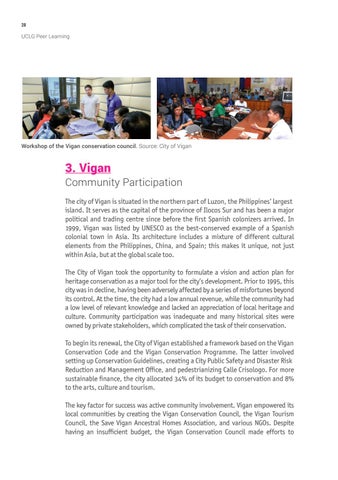
Workshop of the Vigan conservation council. Source: City of Vigan
3. Vigan
Community Participation The city of Vigan is situated in the northern part of Luzon, the Philippines’ largest island. It serves as the capital of the province of Ilocos Sur and has been a major political and trading centre since before the first Spanish colonizers arrived. In 1999, Vigan was listed by UNESCO as the best-conserved example of a Spanish colonial town in Asia. Its architecture includes a mixture of different cultural elements from the Philippines, China, and Spain; this makes it unique, not just within Asia, but at the global scale too. The City of Vigan took the opportunity to formulate a vision and action plan for heritage conservation as a major tool for the city’s development. Prior to 1995, this city was in decline, having been adversely affected by a series of misfortunes beyond its control. At the time, the city had a low annual revenue, while the community had a low level of relevant knowledge and lacked an appreciation of local heritage and culture. Community participation was inadequate and many historical sites were owned by private stakeholders, which complicated the task of their conservation. To begin its renewal, the City of Vigan established a framework based on the Vigan Conservation Code and the Vigan Conservation Programme. The latter involved setting up Conservation Guidelines, creating a City Public Safety and Disaster Risk Reduction and Management Office, and pedestrianizing Calle Crisologo. For more sustainable finance, the city allocated 34% of its budget to conservation and 8% to the arts, culture and tourism. The key factor for success was active community involvement. Vigan empowered its local communities by creating the Vigan Conservation Council, the Vigan Tourism Council, the Save Vigan Ancestral Homes Association, and various NGOs. Despite having an insufficient budget, the Vigan Conservation Council made efforts to