24
UCLG Peer Learning
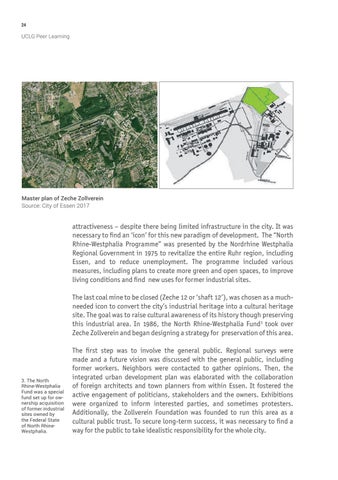
Master plan of Zeche Zollverein Source: City of Essen 2017
attractiveness – despite there being limited infrastructure in the city. It was necessary to find an ‘icon’ for this new paradigm of development. The “North Rhine-Westphalia Programme” was presented by the Nordrhine Westphalia Regional Government in 1975 to revitalize the entire Ruhr region, including Essen, and to reduce unemployment. The programme included various measures, including plans to create more green and open spaces, to improve living conditions and find new uses for former industrial sites. The last coal mine to be closed (Zeche 12 or ‘shaft 12’), was chosen as a muchneeded icon to convert the city’s industrial heritage into a cultural heritage site. The goal was to raise cultural awareness of its history though preserving this industrial area. In 1986, the North Rhine-Westphalia Fund3 took over Zeche Zollverein and began designing a strategy for preservation of this area.
3. The North Rhine-Westphalia Fund was a special fund set up for ownership acquisition of former industrial sites owned by the Federal State of North RhineWestphalia.
The first step was to involve the general public. Regional surveys were made and a future vision was discussed with the general public, including former workers. Neighbors were contacted to gather opinions. Then, the integrated urban development plan was elaborated with the collaboration of foreign architects and town planners from within Essen. It fostered the active engagement of politicians, stakeholders and the owners. Exhibitions were organized to inform interested parties, and sometimes protesters. Additionally, the Zollverein Foundation was founded to run this area as a cultural public trust. To secure long-term success, it was necessary to find a way for the public to take idealistic responsibility for the whole city.