20
UCLG Peer Learning
The history of Kota Tua is important because it not only has historical monuments but has also been a melting-pot of various cultures for a considerable time. Jakarta was one of the largest trading ports in Asia during the 17th and 18th centuries, having been designed and built almost from scratch by Dutch colonists. Historical buildings, warehouses, canals and defensive walls were constructed in Kota Tua from this period onwards. After the period of Dutch settlement, Chinese immigrants arrived, bringing with them the furniture industry. A Portuguese influence is also evident. All of these cultures left their mark in both tangible and intangible ways. Moreover, Kota Tua’s historic multicultural fabric clearly demonstrates a model of unity within diversity and this is a strong reason why this area should be registered as a UNESCO World Cultural Heritage site. Three key players are involved in the application for UNESCO World Cultural Heritage status. These are: the Indonesian Ministry of Education and Culture, which must present the application to UNESCO; the City of Jakarta, which is in charge of conserving the area; and various other stakeholders, who UNESCO recommends should be involved in the management of the process.
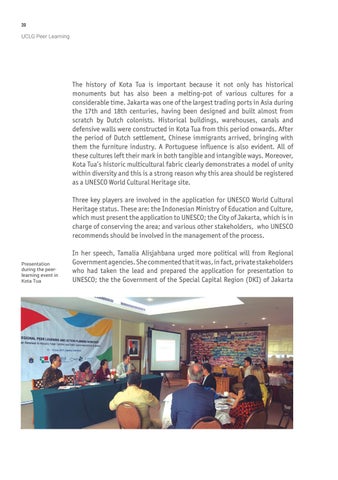
Presentation during the peerlearning event in Kota Tua
In her speech, Tamalia Alisjahbana urged more political will from Regional Government agencies. She commented that it was, in fact, private stakeholders who had taken the lead and prepared the application for presentation to UNESCO; the the Government of the Special Capital Region (DKI) of Jakarta