16
UCLG Peer Learning
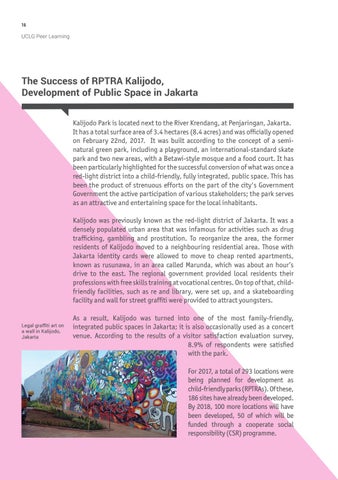
The Success of RPTRA Kalijodo, Development of Public Space in Jakarta Kalijodo Park is located next to the River Krendang, at Penjaringan, Jakarta. It has a total surface area of 3.4 hectares (8.4 acres) and was officially opened on February 22nd, 2017. It was built according to the concept of a seminatural green park, including a playground, an international-standard skate park and two new areas, with a Betawi-style mosque and a food court. It has been particularly highlighted for the successful conversion of what was once a red-light district into a child-friendly, fully integrated, public space. This has been the product of strenuous efforts on the part of the city's Government Government the active participation of various stakeholders; the park serves as an attractive and entertaining space for the local inhabitants. Kalijodo was previously known as the red-light district of Jakarta. It was a densely populated urban area that was infamous for activities such as drug trafficking, gambling and prostitution. To reorganize the area, the former residents of Kalijodo moved to a neighbouring residential area. Those with Jakarta identity cards were allowed to move to cheap rented apartments, known as rusunawa, in an area called Marunda, which was about an hour’s drive to the east. The regional government provided local residents their professions with free skills training at vocational centres. On top of that, childfriendly facilities, such as re and library, were set up, and a skateboarding facility and wall for street graffiti were provided to attract youngsters. Legal graffiti art on a wall in Kalijodo, Jakarta
As a result, Kalijodo was turned into one of the most family-friendly, integrated public spaces in Jakarta; it is also occasionally used as a concert venue. According to the results of a visitor satisfaction evaluation survey, 8.9% of respondents were satisfied with the park. For 2017, a total of 293 locations were being planned for development as child-friendly parks (RPTRAs). Of these, 186 sites have already been developed. By 2018, 100 more locations will have been developed, 50 of which will be funded through a cooperate social responsibility (CSR) programme.