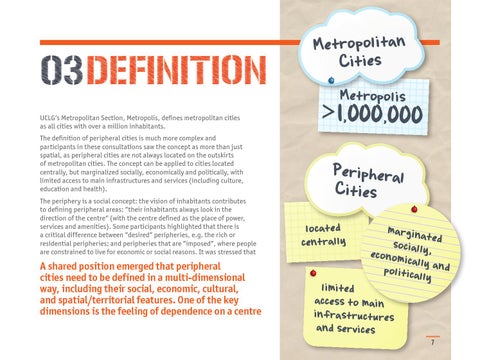
Metropolitan Cities UCLG’s Metropolitan Section, Metropolis, defines metropolitan cities as all cities with over a million inhabitants. The definition of peripheral cities is much more complex and participants in these consultations saw the concept as more than just spatial, as peripheral cities are not always located on the outskirts of metropolitan cities. The concept can be applied to cities located centrally, but marginalized socially, economically and politically, with limited access to main infrastructures and services (including culture, education and health). The periphery is a social concept: the vision of inhabitants contributes to defining peripheral areas: “their inhabitants always look in the direction of the centre” (with the centre defined as the place of power, services and amenities). Some participants highlighted that there is a critical difference between “desired” peripheries, e.g. the rich or residential peripheries; and peripheries that are “imposed”, where people are constrained to live for economic or social reasons. It was stressed that
A shared position emerged that peripheral cities need to be defined in a multi-dimensional way, including their social, economic, cultural, and spatial/territorial features. One of the key dimensions is the feeling of dependence on a centre
Metropolis , ,
> 1 000 000 Peripheral Cities located centrally
margina te socially, d economi cally political and ly
limited access to main infrastructures and services
7