Consultation
on the role of metropolitan and peripheral cities in the global agenda of Local and Regional Governments for the 21st Century
2
01
BACKGROUND
02
STARTING POINT
03
DEFINITION
04
THE CONSULTATION A) AIM B) PARTICIPANTS C) DAY ONE Metropolitan cities Peripheral cities
E) DAY TWO 3
4
UCLG
ambition
is a network of networks that advocates for local and regional governments on the world stage. This involves responding to a tightly packed international agenda, including the SDGs, Habitat III, Financing for Development and Climate Change processes and facilitating the Global Taskforce of local and Regional Governments for Post 2015 and Towards Habitat III
It is our ambition to voice the perspective of our constituency in all of these negotiations, providing feedback on documents discussed by national governments. However, we also know that we cannot just be a reactive force, responding to the priorities and calendar of the international community. Our members have mandated UCLG to develop a global agenda by and for local governments, including all territorial authorities, large and small, urban and rural. That’s why we’re working on a Global Agenda of Local and Regional Governments for the 21st Century. In order to do this, we are developing new, more inclusive, forms of dialogue and consultation.
a by d n e g a l a b lo Develop a gcal governments, and for log all territorial includin large and small, s, authoritiean and rural urb
It will be vital to identifys shared prioritie d and messages an build strategic alliances
STRATEGIC TOOLKIT
EXPLORING THE AGENDA
Building on the results of a brainstorming session with representatives of the UCLG Sections, Committees and academics in April of 2014, we developed a Strategic Toolkit to guide us through the essential ‘ingredients’ of our Global Agenda. As the Toolkit lays out, our agenda must have a strong, compelling narrative made up of:
Over the course of our work following international debates and actively participating in alliances with the international community, civil society and national governments, we have come to realise that one of the most important outcomes of the Post 2015 and the Habitat III agendas will be the roles that are set out for different actors.
• Principles, ambitions and dreams • Policy recommendations to make these dreams a reality • Examples of how these policies could be implemented on the ground
It is in this context that we are exploring the agenda from the perspective of different parts of our constituency: intermediary cities, peripheral cities, metropolitan cities, regions, rural areas and small municipalities. We have opened up our deliberations beyond our network of members, because we know that it will be vital to identify shared priorities and messages and build strategic alliances with other stakeholders, particularly civil society, in order to maximize the impact of the Agenda. Furthermore, we are documenting these consultations in order to provide ideas to partners that might be going through similar processes.
5
ee of The Committ of UCLG s ie it C l a r e h Perip around is made up of l cities a r e h ip r e p 0 0 2 Not all parts of our membership are starting from the same point in their contributions to the Global Agenda. Metropolitan cities and regions have a long history and experience in the international arena. Created in 1985, Metropolis is a global association of major metropolises that brings together 139 cities and metropolitan regions with more than a million inhabitants from all
Metropolis brings together 139 cities and more than a million inhabitants 6
over the world. Metropolis was one of the founding members of UCLG in 2004 and became the organization’s metropolitan section. Metropolis is also developing its own agenda for Habitat III and, as a member of UCLG, it will contribute to the Global Agenda of Local and Regional Governments and to the GOLD IV report with its own vision and proposals.
www.metropolis.org The international network of peripheral cities was created in 2003, becoming the Committee of Peripheral Cities of UCLG in 2004, led by the City of Nanterre (France) and the city of Canoas (Brazil).
Today, the Committee is made up of around 200 peripheral cities of large metropolises from 25 countries, particularly in Europe, Latin America and Africa. Its goal is the recognition of the social and political situations of peripheral cities at territorial, national and global level. The UCLG Committee on Social Inclusion, Participatory Democracy and Human Rights also participated actively in the dialogue. The Committee was created in 2004 within the Forum of Local Authorities for Social Inclusion, during the the World Social Forum. It aims to articulate a common voice for cities in UCLG on social inclusion, participatory democracy, human rights, and the right to the city, as well as to advise local governments on the design of these policies.
Metropolitan Cities UCLG’s Metropolitan Section, Metropolis, defines metropolitan cities as all cities with over a million inhabitants. The definition of peripheral cities is much more complex and participants in these consultations saw the concept as more than just spatial, as peripheral cities are not always located on the outskirts of metropolitan cities. The concept can be applied to cities located centrally, but marginalized socially, economically and politically, with limited access to main infrastructures and services (including culture, education and health). The periphery is a social concept: the vision of inhabitants contributes to defining peripheral areas: “their inhabitants always look in the direction of the centre” (with the centre defined as the place of power, services and amenities). Some participants highlighted that there is a critical difference between “desired” peripheries, e.g. the rich or residential peripheries; and peripheries that are “imposed”, where people are constrained to live for economic or social reasons. It was stressed that
A shared position emerged that peripheral cities need to be defined in a multi-dimensional way, including their social, economic, cultural, and spatial/territorial features. One of the key dimensions is the feeling of dependence on a centre
Metropolis , ,
> 1 000 000 Peripheral Cities located centrally
margina te socially, d economi cally political and ly
limited access to main infrastructures and services
7
Aim
Participants
day one
This consultation of metropolitan and peripheral cities had a dual aim:
Invitees were selected based on their knowledge of metropolitan and peripheral cities and their ability to contribute to a dynamic, open debate. UCLG sought to ensure a gender and regional balance in the group. Some invitees were long-term partners of UCLG, while others were contacts selected after a call for recommendations within the network. The final group was made up of over 40 participants, including elected local officials, practitioners, academics, and representatives of civil society.
During day one, metropolitan and peripheral cities worked separately. The day was composed of three stages. First, participants worked to i dentify and prioritize principles, ambitions and dreams of their cities. Then, they suggested policies that can help to make these dreams a reality. Finally, they gave examples of how these policies have been implemented on the ground in cities around the world. At the end of day one, in a plenary session, both groups explained the results of their debates.
To explore the concerns and priorities of this constituency in order to contribute to UCLG’s Global Agenda To build our network of metropolitan and peripheral cities and their allies and partners with a view to long-term collaboration, particularly in the communication and advocacy of the agenda 8
Participants Azzedine Hafif
METROPOLITAN CITIES Discussions on the aspirations of metropolitan cities fell into four main blocks
territorial planning and governance
decentralization, autonomy and multi-level governance
citizen participation
city as part of the commons
Participants agreed that the agenda of metropolitan cities should address their functional metropolitan regions*, which often spill over their official administrative boundaries. The aspiration is to create competitive, attractive, sustainable, and resilient metro area to improve the quality of live, and to encourage a sense of belonging to the metro area by those citizens who live in it. This includes the preservation of -and cooperation with- surrounding agricultural and natural areas, which play a major role in sustaining the larger metropolitan region. * A functional metropolitan region "should reflect the spatial organization of social and economic
Director of Land Management and Planning of the Urban Agency of Casablanca, the largest city and main port and industrial centre of Morocco.
Rahnatouca Sow Dieye Deputy Director of the Office of the Mayor of Dakar and African Regional Secretary for Metropolis.
Ulrich Graute Scientific Adviser at the Metropolis Initiative of the City of Berlin, Germany and is working with Metropolis on the preparation of its inputs to Habitat III.
Catherine Mantel Project Director at the European and International Relations Department of GDF Suez, a global energy provider and operator in the electricity, natural gas and energy sectors.
relations." (OECD)
9
Participants Carme Gual Via International Relations Coordinator of the Hàbitat Urbà department of Barcelona City Council, Spain, a member city of Metropolis.
Jorge Alberto Perez Jaramillo Director of the Planning for the City of Medellin. He is a visiting professor and lecturer at various conferences, seminars and courses on urbanization and urban planning.
territorial planning and governance There was a call for new integrated territorial governance structures to guarantee coordination, inclusion, sustainability, equality across this area, and to tackle social, generational and cultural/ethnic segregation. There was also a call for strategic planning in metropolitan regions (including a particular call for the use of Lean planning). These plans should be realistic and achievable, rather than utopian, with a focus on implementation. A ‘toolkit’ for strategic planning and financing at metro level was proposed and land use regulation, zoning, and the social use of land, were mentioned as possible mechanisms for increasing social inclusion and reducing segregation. In some countries, metropolitan agencies or institutions dedicated to the management or planning of metropolitan regions already exist. However, new legislation may be required in order to provide them with adequate mechanisms to plan, fund and coordinate territorial development. This would ensure policy coherence across the borders of the municipalities that make up the metropolitan area. Data pooling between local governments was mentioned as a possible tool to facilitate collaboration. However the question of institutional arrangements and supra-municipal metropolitan bodies was not discussed in detail.
Fabienne Perucca
decentralization, autonomy and multi-level governance
Programme Officer in the Local Government and Decentralization Unit of UN Habitat.
It was agreed that, in order to allow good governance of functional areas, metropolitan cities must be institutionally and financially sustainable.
Áurea Maria Queiroz D’Avanzo Technical Adviser in EMPLASA, the Company for Metropolitan Planning in São Paulo, Brazil.
10
In order to achieve this sustainability, metropolitan cities should be given stronger institutional and financial recognition by national governments and international institutions, for example, in line with their contributions to GDP. This makes political and financial decentralization and the empowerment of local authorities a priority for metro governments. Local leaders should be freed from constraints and given the capacity to raise and redistribute resources within metro areas. There was a call for effective multi-level governance (global, national, metropolitan, urban/local), as well as strong coalitions
for governance, cooperative and associative management. Decentralization would also allow cities to engage with other actors that set the urban agenda (be they traditional leaders, national governments). There was also questioning of the possibility of ‘true’ autonomy in a globalized economy with strong influence of global financial markets on local economies. Local governments should try to both engage with global investors and hold them accountable for their actions in their territories.
citizen participation Another ambition highlighted was that of liveable cities with citizen participation. One participant described this as a goal to create a metropolitan ‘agora’ for civic engagement.
As a basic condition, the agenda should call for local democracy with free fair and regular elections. Furthermore, participation in decision-making between elections should be encouraged at grassroots level, close to the people, particularly young people. Dialogue and interaction between informal workers and local authorities in developing countries was recommended in order to foster collective empowerment. It was pointed out that informal workers need support in order to be a dialogue partner for local authorities. It was agreed that increased transparency and accountability of city leaders to citizens could help to boost their credibility at local, national and international level.
cities as commons The final main theme in the debate in the morning of day one was the idea of cities as commons, a product of humanity to be enjoyed by all.
There was a call for local leaders and citizens to protect and value the urban commons, and for cities to be managed in common, building consensus from the bottom up. (e.g. the social production of public spaces, open innovation as a policy driver). This was linked to the goal of increasing citizen happiness and quality of life.
Participants Massimo Iezzoni Director General of the Montreal Metropolitan Community, the metropolitan institution responsible for the governance of Greater Montreal, Canada.
Augusto Barrera Mayor of Quito, Ecuador from 20092014 and former Co-President of UCLG. He currently coordinates the CITE Research Centre for Public Policy and Territory in FLACSO, Ecuador.
Susan Parnell Urban geographer in the Department of Environmental and Geographical Sciences at the University of Cape Town and is on the Executive Board of the African Centre for Cities.
Xavier Tiana i Casablancas Head of International Relations of the Metropolitan Area of Barcelona, Spain, a member city of Metropolis. 11
Participants
We need to develop a new concept of city that understands the city as a common good Hector Santcovsky
Alexey Novikov Dean of the Graduate School of Urban Studies and Planning in the National Research University Higher School of Economics, Russia.
Hector Santcovsky Director of Strategic Planning for the Metropolitan Area of Barcelona, Spain, a member city of Metropolis. He specializes in local, municipal and large metropolitan development and governance.
Other ambitions raised by a number of participants included:
Technology and innovation Fostering a data driven economy and tackling the digital divide, metropolitan clusters, new production methods (3D printing).
Social inclusion and mobility Reducing social segregation and ensuring equity in access to basic services (particularly public and/or affordable housing and transport), including for migrants.
Yao Yi
Environmental sustainability
Associate Professor of Sociology at the Guangzhou Academy of Social Sciences in Guangzhou, China.
Creating low carbon eco-cities and reduce urban environmental footprint through new models of urbanization and development, upgrading industrial systems, moving towards energy self-sufficiency, and using renewable energy sources.
Mike Bird Operations Manager at WIEGO, a global network focused on securing livelihoods for the working poor, especially women in the informal economy.
12
Tackling inequality Inclusive economic development that supports the livelihoods and decent work of the urban poor and recognizes the economic, social and cultural contributions of informal workers.
Given broad agreement on these goals, the following questions emerged:
• What is holding metropolitan cities back if we all agree? • What are the conditions for success? • What are our priorities among these ambitions?
One of the keys to the new type of cities will be a different approach to production patterns and the way youth understand their place in society Sunil Dubey
We cannot continue building the same type of cities. When I talk to colleagues in the Global South I want to scream: stop building cities for cars! It is not the future anymore. Our children will not want to drive! Building cities for people is an equity as well as a development issue Paul Lecroart
Participants Sunil Dubey Founding director of the Geneva Foundation for Governance and Public Policy. He is Liaison Officer for Metropolis and plays a leading role in developing its activities in South Asia.
Paul Lecroart Senior Urban Planner at the Urban Planning Agency for the Paris Ilede-France Region (IAU), a member city of Metropolis. He takes part in Futuribles International, a think tank on the future of cities.
Pilar Conesa Director of the Anteverti consultancy, based in Barcelona, Spain. She curates the Smart City Expo World Congress, an internationally renowned event organized annually in Barcelona.
Luis Fernando Economist from Medellin, Colombia.
13
'streams' from the debates
Policies
Competitive attractive, sustainable, resilient metro area
Realistic, achievable urban plans. Focus on implementation
Quito: territorial planning of metropolitan services, PDOT: compact, dense, integrated, centrality system
Decentralization and autonomy for metro governments
Financial autonomy
Marseille, France: common business tax
Metropolitan ‘agora’ of citizen participation
Youth participation in urban planning, open data
Montreal, Moscow, Seoul, Mexico: 4D city electronic referendum and complaint mechanisms "Metropolitan agora of Montreal"
Protect and value urban commons, managed in common
Cooperative management and running of public services
MedellĂn: metropolitan planning and administration instruments, metro and tram driven by university students (2000 students so far), adult education for street cleaners and waste collectors (30% in courses)
Decentralization allowing cities to engage with other actors that set the urban agenda
Multi-level governance frameworks
Casablanca: strategic steering committee of local government, national ministries, civil society
(traditional leaders, national governments)
14
Practices
Ambitions
Peripheral cities
Participants
The debate began with a discussion about the definition of peripheral cities (see above) and the differences between peripheral areas in developed and developing countries. The inhabitants of many peripheral cities arrived before the formal existence of the cities themselves, attracted by expected work opportunities and building informal settlements. In many less developed countries, informal settlements make up the majority of the metropolitan area. In many developed countries, deindustrialization and the development of peri-urban areas are redefining the functions and role of peripheral cities.
Social inclusion and cohesion: Inclusive cities Peripheral cities have an important role to play in the development of inclusive territories and provide special opportunities in this regard (for historical or social/ cultural reasons). They are confronted with challenges of social fragmentation and segregation. Participants stressed the following principles in relation to social inclusion:
• Sharing of social policies between central and local governments • Tackling segregation of all kinds : social, generational and spatial (as well as of minorities and immigrants) and addressing gentrification
• Quality basic services for all (especially mobility/transport); Customization/
• • • •
personalization of public services. Cultural diversity and access to culture for all identity, creativity and innovation for cultural, democratic/inclusive and economic development purposes (as well as heritage conservation) Social housing for all with emphasis on secure tenure and the prevention of evictions, neighbourhood renewal, slum upgrading and the integration of informal settlements) Recognition of the right of immigrants Address digital divide Food security
Deolinda Sidonia Gilberto Moiane Chief of Staff of Calisto Cossa, the Mayor of Matola, Mozambique.
Edson Eusebio Ussaca Councillor for the city of Matola, Mozambique.
Abdoulaye Thimbo Mayor of Pikine, a city of 874,062 inhabitants in Senegal. Pikine is peripheral to the city of Dakar and a member of the UCLG Committee on Peripheral Cities.
Rahmatouca Sow Dièye Deputy Chief of Staff of the Mayor of Dakar and Africa Regional Secretary of Metropolis.
15
Participants It is necessary to address segregation in large cities Antonio Aniesa
Antonio Aniesa
Works in the Cabinet of the President of Plaine Commune, France.
Jairo Jorge da Silva Mayor of Canoas, a city on the outskirts of Porto Alegre, Brazil. He co-chairs the UCLG Committee on Peripheral Cities. Canoas is involved in the UCLG Project for Improvement of the Capacities of Local Authorities of Brazil and Mozambique as Decentralized Cooperation Actors.
Fatimetou-Mint Abdelmalick Mayor of Tevragh-Zeina, Mauritania. She is the President of the REFELA network of local elected women and Co-President of the UCLG Commission on Gender Equality.
16
Participatory budgeting and the customization of public services are important tools to build the city for all Jairo Jorge da Silva
Decentralization and governance: an enabling environment for good governance and participation
Effective decentralization is a prerequisite Fatimetou-Mint Abdelmalick
It is the capacity for action of all peripheral cities that results in the birth of a metropolis Calisto Cossa Territorial governance: multi-polarity, territorial cohesion & solidarity, cooperation and multilevel governance The concepts of pluri-centrality or multi-polarity, meaning the reduction of cities’ distance from power and the inclusion of all territories in decision making and policies, is central for the governance (and local development) of peripheral cities.
Participants Calisto Cossa Mayor of Matola in Mozambique. The city participates in the UCLG Project for Improvement of the Capacities of Local Authorities of Brazil and Mozambique as Decentralized Cooperation Actors.
Renato Balbim
It is necessary to build centrality and complementarity into all the territories of a city Renato Balbim
We want to be a centre; there is an urgent need for pluricentralism
Geographer and planning expert based at the Research Institute on Applied Economics (IPEA), Brazil.
Patrick Jarry Mayor of Nanterre, a commune in the western suburbs of Paris, France. Mayor Jarry cochairs the UCLG Committee on Peripheral Cities.
Patrick Jarry 17
Participants
Cities and citizens need the right to the city and policentrality Calisto Cossa Participants mentioned a number of policies to promote inclusive metropolises:
• Cooperative cities (on the “1 city=1 vote”) as a precise type of inter-municipal
Sutrisno Mes Former city manager of Sleman, Indonesia. Professor Mes is currently lecturer in urban and regional planning at the University of Gadjah Mada.
Sylvie Ducatteau Councillor for International Affairs of Plaine Commune, France.
cooperation respectful of multi-polarity • Multilevel governance and cooperation local/regional/national (with the large range of declinations); Inter-municipal cooperation on precise policies (sectorial approach) or general decision making (territorial approach).
We need institutions to evolve, to be reformed, and we should build a liveable city Sylvie Ducatteau
We must have the same capacities in order to have the same quality of infrastructure in peripheries Renato Balbim 18
Local democracy – Democratic cities
Participants
There is a need for citizens to be more involved in local politics. Peripheral cities are the perfect place for participatory budgeting and planning and for exploring ways to “radicalize” or “democratize” democracy with new participation mechanisms (for citizens in general and women in particular.
We underestimate the necessity of reinventing governance in metropolitan areas in order to build democracy and reduce inequalities Patrick Jarry
Participants stressed the following principles in relation to participatory governance and accountability:
• Right to the city for all: based on the recognition of human rights, right to land, • • • • • •
to public transport, to coproduce the city in a sustainable way Co-responsibility: strong coalitions for governance, cooperative and associative management, with robust sustainability of the participatory mechanisms (long term and multi-sector participation) Participation in planning and in basic service evaluation and monitoring Institutionalization of participation with a significant proportion of the budget (not just a limited %) Digital democracy; open data Address corruption and increase transparency The empowerment of women (with local regulations where national ones do not exist) and gendered policies
Derek Antrobus Councillor and Assistant Mayor for Strategic Planning at Salford City Council, a city in the metropolitan region of Greater Manchester, UK.
Patrick Braouezec President of Plaine Commune, France. He is the first VicePresident of the UCLG Committee on Social Inclusion, Participatory Democracy and Human Rights.
19
Participants
Local finances Enabling environment for local finances: fiscal decentralization and local resources Adequate financing and fiscal competencies are necessary to allow peripheral cities to respond to citizens’ needs, especially for public services. The specific needs of peripheral cities, such as mobility, should be taken into consideration by national governments. Fiscal decentralization is a first step toward an enabling environment. Participants mentioned the following policies to support this enabling environment:
Djamel Sandid Works in the international relations department of the commune of Nanterre, France.
Juan Le Bas Secretary for Institutional Transparency and International Relations for the municipality of Morón, a city in the province of Buenos Aires, Argentina.
• Inter-municipal cooperation (pool of collective funds for territorial policies or sectorial financing)
• Local taxation with clear legal frameworks that empower local governments • • • •
(with tax reform and new laws if necessary) Environmental taxation Avoid perverse competition between cities Land added value taxation Control of local commitments of investors related to their activities, employment rules, taxes (so local governments have precise and rapid access to tax data from central governments and can count on the support of regional/national governments)
Local solidarity: redistribution Peripheral cities have a specific need for redistributive fiscal policies within territories. This could be done through national plans or regional cooperation, but territories must redistribute to address gaps, segregation and inequalities between cities.
20
Cities need spaces for redistribution, which means we need to think about adequate mechanisms, including finance redistribution, but also land redistribution
Participants
Agnès Deboulet
Strategic planning and land regulation: sustainable cities Strengthening strategic planning was stressed as a priority, both for ensuring a real territorialisation of planning in peripheral cities (going beyond traditional partners) and for joined up planning at metropolitan and/or regional level. Strategic development plans were recommended as a tool for strategic planning and financing. The connection between planning and solidarity/democracy was made in a discussion on participatory strategic planning.
It is essential to take into consideration connectivity between rural areas and metropolis and citizen participation when we speak about peripheries
Agnes Deboulet Professor of Sociology at the Habitat Research Centre, University of Paris 8, France.
Esther Mwaura founder of GROOTS, a network of women self-help groups and community organizations in Kenya. She is also a member of the Huairou Commission Coordinating Council.
Esther Mwaura
21
Participants
Land regulation is a core tool for peripheral cities to avoid speculation and support social housing, as well as for neighbourhood renewal, social housing and slum upgrading, and reducing urban sprawl. Participants stressed the following planning principles:
Abdel Salam El Khalil Vice President of Ghobeiry, a municipality in the south of Greater Beyrut and member of the UCLG Committee of Mayors of Lebanon.
Giovanni Allegretti Senior Researcher at the Centre for Social Studies of the Coimbra University, Portugal. He has worked on a number of publications with the UCLG Committee on Social Inclusion, Participatory Democracy and Human Rights and the International Observatory on Participatory Democracy.
22
• • • • • • • • •
Participation of all municipalities and territories in metropolitan planning Land use regulation Recuperation and valuing of public spaces Equal gender participation in planning Support citizen participation, including youth, in planning Address spatial inequalities in infrastructure and services Avoid dormitory cities Address urban sprawl in general Address environmental challenges
A special emphasis was put on protecting and valuing the urban commons (and participatory management and planning of the commons).
We should value public spaces and the commons Patrick Jarry
Local economic development and innovation
Participants
The core challenge is to have a competitive city/territory without competition between cities. This means cities with an enabling environment for entrepreneurship, business and investment (creation of decent jobs and sustainable activities) with minimum fiscal, labour, social and environmental norms. Sustainable development should be harmonious and human.
Cities must be attractive without competing with one another Antonio Aniesa Connectivity, mobility, technology and an enabling environment for economic activities and investments (entrepreneur labs and firms incubators, connection with research centres and universities, etc.) are necessary for cities to be competitive. The informal sector should be integrated through policy frameworks that support livelihoods for the urban poor and provide social and health insurance to all. Support should be given to endogenous development and to circular economies. Participants mentioned the following policies and practices:
Lorena Zarate President of the Habitat International Coalition. She has worked in close collaboration with the UN Special Rapporteur on the Right to Adequate Housing and the Office of the UN High Commissioner for Human Rights.
Deise Martins International Relations and Cooperation Director at the city of Canoas, Brazil.
• Industrial system upgrading for sustainability • Partnerships between private sector, university, civil society, media and local government • Social, labour and environmental charter to promote responsible and sustainable investment and business
23
Day two Day two began with a plenary session reviewing the results of the parallel debates from the previous day and a discussion of ‘missing’ issues. It was pointed out by a number of participants that the issue of gender had been largely absent from the discussions in the metropolitan cities group and not given enough emphasis in the peripheral cities group. Issues such as education for girls and women, and the particular vulnerability of poor women to the effects of climate change were highlighted. The question of city image was raised by Derek Antrobus, who pointed out the role of a city’s image, not only in its
24
ability to attract investment and compete nationally and globally, but also in how citizens see themselves and understand the opportunities open to them where they live.
Competitiveness vs social cohesion: towards new models of governance The current development model based on competitiveness between metropolitan areas is increasing inequalities between and within territories and populations. To promote more cohesion and solidarity between territories, we need to revise decentralization and development models. How can we design the institutional and decentralization framework for more cohesion within metropolitan regions, metropolitan cities and municipalities? There is a vital need for a serious debate about the management of metropolitan areas and the relationship between centres and peripheries based on the principle of pluri-centrality or multi-polarity. Patrick Braouzec introduced the principle
of “the right to centrality” to facilitate access to services and a quality of life for all. Renato Balbin and others participants defended the concept of the “right to the city” as more comprehensive.
Globalization deepens differences between territories and populations. Do we want solidarity between all territories and citizens or only within metro areas or at global level? Patrick Jarry
We shouldn’t think in terms of metropolitan cities and peripheries, but in terms of metropolitan areas, within which peripheral cities are included as equals
Pilar Conesa gave the example of l’Hospitaltet de Llobregat, a peripheral city which at first tried to distance itself from Barcelona to create its own identity, but now takes advantage of image of Barcelona to do the same, using its identity as an industrial region of forged through migration.
Antonio Aniesa
We need less government and more governance to improve the management of big cities
There was disagreement over whether it is useful to separate the agendas of metropolitan and peripheral cities. Augusto Barrera warned against assuming poverty is a peripheral phenomenon; in Latin American cities poverty is concentrated both in city centres and neigbourhoods in the periphery.
There was agreement that metropolitan and peripheral cities need to work together at the level of the metropolitan area, but the challenges to doing this when interests or priorities come into conflict was not problematized. The issue of the relationship between institutional boundaries and
Sunil Dubey
Peripheral cities need to work together at the level of the metropolitan area metropolitan areas was discussed from a number of angles. Sunil Dubey raised the issue of recentralization trends and the reduction in number of local government institutions (amalgamation), underway in Australia and other parts of the world in the search for efficiency. How can this narrative be countered? By emphasizing local governance rather than government institutions? Xavi Tiana pointed out that many new metropolitan institutions that are created for more efficiency or for administrative reasons, often lack the adequate legal powers to cover their peripheral areas. The proliferation of decision-making levels necessitates clear rules and shared responsibilities. In Europe, national and supranational institutions (the European Union) have also an impact on metropolitan governance. There was an agreement on the need for effective multi-level institutional arrangements to improve governance. 25
Consumption and production models With regard to consumption and production models, some participants argued that we need to think about economic growth differently, in terms of regulation and degrowth rather than GDP growth. We need to:
• Promote more endogenous development • Reduce environmental impact of cities • Reduce distance between work and house • Promote social and functional diversity in each territory, circular economies, urban agriculture • Reduce waste of resources 26
we need to think about economic growth differently We also need to reflect on the impact of economic evolution on people and their urban context: destruction of jobs (deindustrialization), delocalization of enterprises, the impact of new technologies - automatization and robotization-, and consider how to anticipate these phenomena. Josep Roig asked how local authorities can contribute to promote a business sector that is more accountable to the people. With regard services and infrastructures, access and quality should be universal, both to inhabitants of central and
peripheral areas. However, the amount of investments needed in metropolitan requires the revision of the financing mechanisms and the modalities of redistribution, and the mobilization of resources from public and private sector. Innovation is vital to adapt to changing times. We’re still using policies appropriate to the world as it was 40 years ago. While in some countries these innovations need to tackle access to basic services, in others they need to be targeted at personalizing services to citizen needs. In many cases, particularly in developing countries, co-production of services with communities could help to reduce the gaps in access.
Innovation vital to ada is to changingpt times
Local democracy in metropolitan areas Jairo Jorge raised the issue of the crisis of democracy and the disenchantment of citizens with politics. He called for a radicalization of democracy so that citizens can really participate in the decisions that affect them. We need to demystify authority and value collective intelligence. Similarly, Augusto Barrera called for cities “governed by people, by self-managed communities, rather than bureaucracies or leaders”. This requires empowered, educated citizens.
The need to promote the ‘right to the city’ was reintroduced by many participants. Susan Parnell stressed that this could be a key entry point in our advocacy at Habitat III and in supporting the urban SDG (Goal 11). Augusto Barrera warned against assuming that constitutional or legal rights guarantee anything on the ground. As an example he mention the case of Ecuador: while the inclusion of the ‘right to the city’ in the constitution was a great step, the principle needs to be developed and implemented, as well as widened to include new rights (transport, internet,
We need to demystify authority and value collective intelligence
public spaces). These essential goods must be managed and financed in a different way.
27
The right to the city isn’t another right. It is a radical vision that demands fundamental changes in the relationship between people and nature
Changes in conceptions of citizenship at territorial level, in the use of land and property, in planning and management, in production methods, in the economy, and in the management of the commons.
Lorena Zarate
The following diagram gives an example of the methodology:
Opportunity Democratic metropolitan governance
28
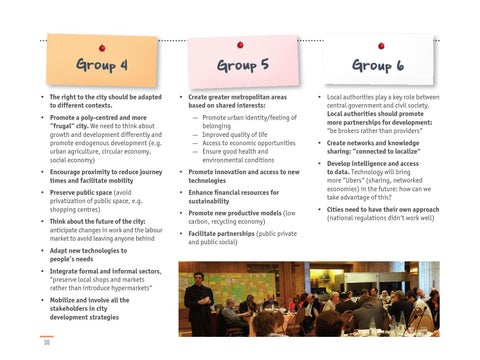
Finally, participants then broke up into mixed groups (of representatives of both metropolitan and peripheral cities) and worked on narratives for metropolitan areas based on the structure: Opportunity > Challenge > Choice
Challenge • Competencies • Relationship between different levels of government • Create spaces of agreement • Metropolitan identity • Financing • Powers in line with responsibilities
Choice Legal frameworks Financing frameworks Democratic participation Effective public administration mechanisms • Political and social consensus • • • •
Main narratives proposed by the groups Group 3
Group 1 • Ensure democratic metropolitan governance • Improve discussions and negotiations with other levels of government • Strengthen legal and financial frameworks in line with their responsibilities • Develop effective management instruments and promote participatory decision-making mechanisms for consensus building
Group 2 • Better governance (urban and metropolitan, including all urbanized areas) • Institutionalized cooperation based on an awareness that cities must work on common issues • Better and more equal redistribution of resources within metropolitan area
• New forms of cooperative and inclusive governance that transcend existing political institutions • Transform our cities to be more democratic, inclusive and sustainable • Recover the public role of planning and land management and put people at the centre of policy-making • To regulate land market, local authorities should prioritize social use of land and have adequate legal tools (ex. Prioritized areas for development, Brazil, use land banks, community land trusts) • A metropolitan authority should be powerful enough to challenge markets, face big enterprises and guide private investments. 29
Group 4 • The right to the city should be adapted to different contexts. • Promote a poly-centred and more “frugal” city. We need to think about growth and development differently and promote endogenous development (e.g. urban agriculture, circular economy, social economy)
Group 5 • Create greater metropolitan areas based on shared interests: —— Promote urban identity/feeling of belonging —— Improved quality of life —— Access to economic opportunities —— Ensure good health and environmental conditions
• Encourage proximity to reduce journey times and facilitate mobility
• Promote innovation and access to new technologies
• Preserve public space (avoid privatization of public space, e.g. shopping centres)
• Enhance financial resources for sustainability
• Think about the future of the city: anticipate changes in work and the labour market to avoid leaving anyone behind • Adapt new technologies to people’s needs • Integrate formal and informal sectors, “preserve local shops and markets rather than introduce hypermarkets” • Mobilize and involve all the stakeholders in city development strategies 30
• Promote new productive models (low carbon, recycling economy) • Facilitate partnerships (public private and public social)
Group 6 • Local authorities play a key role between central government and civil society. Local authorities should promote more partnerships for development: “be brokers rather than providers” • Create networks and knowledge sharing: “connected to localize” • Develop intelligence and access to data. Technology will bring more “Ubers” (sharing, networked economies) in the future: how can we take advantage of this? • Cities need to have their own approach (national regulations didn’t work well)
Some other key issues discussed
VS • The market assures the best allocation resources • There is a tension between competitiveness and social justice
ing g n e l l a h C es v i t a r r a n
Counter narratives • City should respond to peoples’ demands, local governments must challenge states to regulate markets and ensure redistributive mechanisms to foster social development
• It is necessary to base metropolitan development on principles other than competitiveness between territories. Minimum social conditions are needed in all territories (in terms of social and labour rights, land regulation, environmental standards), so that a ‘race to the bottom’ is avoided • Local authorities should promote a charter oblige private enterprises to engage with local communities, train local workers, support social housing and cultural infrastructures. However, local authorities have few powers and need the support of regional and central governments • Establish new forums for dialogue with local stakeholders to strengthen transparency and trust. Public-social partnerships and encouraging corporate social responsibility plans may be useful
The session closed with a presentation of the next steps: How metropolitan and peripheral cities can contribute their own agendas to the global agenda of local and regional governments for Habitat III? The participants were asked to contribute their knowledge and experiences to this process during the coming months. 31
Carrer Aviny贸, 15 08002 Barcelona - Spain Telf: +34 933 428 750 Fax +34 933 428 760 info@uclg.org
www.uclg.org
Contribution to the
Supported by the
32
METROPOLITAN AND PERIPHERAL CITIES