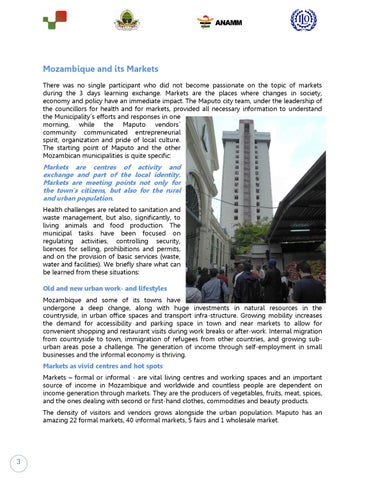
Mozambique and its Markets There was no single participant who did not become passionate on the topic of markets during the 3 days learning exchange. Markets are the places where changes in society, economy and policy have an immediate impact. The Maputo city team, under the leadership of the councillors for health and for markets, provided all necessary information to understand the Municipality´s efforts and responses in one morning, while the Maputo vendors´ community communicated entrepreneurial spirit, organization and pride of local culture. The starting point of Maputo and the other Mozambican municipalities is quite specific:
Markets are centres of activity and exchange and part of the local identity. Markets are meeting points not only for the town’s citizens, but also for the rural and urban population. Health challenges are related to sanitation and waste management, but also, significantly, to living animals and food production. The municipal tasks have been focused on regulating activities, controlling security, licences for selling, prohibitions and permits, and on the provision of basic services (waste, water and facilities). We briefly share what can be learned from these situations: Old and new urban work- and lifestyles Mozambique and some of its towns have undergone a deep change, along with huge investments in natural resources in the countryside, in urban office spaces and transport infra-structure. Growing mobility increases the demand for accessibility and parking space in town and near markets to allow for convenient shopping and restaurant visits during work breaks or after-work. Internal migration from countryside to town, immigration of refugees from other countries, and growing suburban areas pose a challenge. The generation of income through self-employment in small businesses and the informal economy is thriving. Markets as vivid centres and hot spots Markets – formal or informal - are vital living centres and working spaces and an important source of income in Mozambique and worldwide and countless people are dependent on income generation through markets. They are the producers of vegetables, fruits, meat, spices, and the ones dealing with second or first-hand clothes, commodities and beauty products. The density of visitors and vendors grows alongside the urban population. Maputo has an amazing 22 formal markets, 40 informal markets, 5 fairs and 1 wholesale market.
3