Introduction It was a great learning event between local city governments of the South, bringing together Mozambique, South Africa and Brazil. The City of Maputo together with UCLG, Cities Alliance, ILO, with the support of the Norwegian Ministry of Foreign Affairs hosted the event. The invited Municipalities, INGOs and NGOs and representatives of the private sector explored in depth the topic proposed by the city of Maputo:
“Hygiene, Health and Markets� Markets face manifold challenges: not only in terms of regulations, design, construction and maintenance, hygiene, health and waste management, but also in terms of economic and ecological sustainability, formal and informal work and income generation, skills, education and gender. Markets can be considered the crystallization in that they provide testing point for the Millennium Development Goals. They provide an ideal ground for multi-fold partnerships between cities, institutions, the private sector, and NGOs.
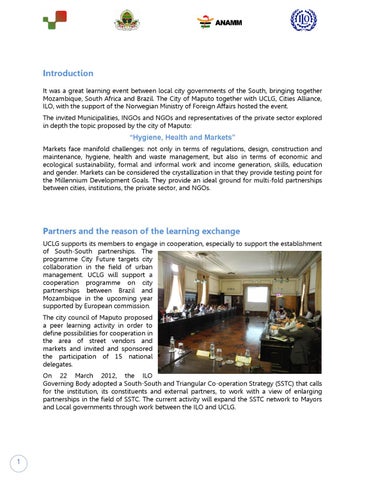
Partners and the reason of the learning exchange UCLG supports its members to engage in cooperation, especially to support the establishment of South-South partnerships. The programme City Future targets city collaboration in the field of urban management. UCLG will support a cooperation programme on city partnerships between Brazil and Mozambique in the upcoming year supported by European commission. The city council of Maputo proposed a peer learning activity in order to define possibilities for cooperation in the area of street vendors and markets and invited and sponsored the participation of 15 national delegates. On 22 March 2012, the ILO Governing Body adopted a South-South and Triangular Co-operation Strategy (SSTC) that calls for the institution, its constituents and external partners, to work with a view of enlarging partnerships in the field of SSTC. The current activity will expand the SSTC network to Mayors and Local governments through work between the ILO and UCLG.
1