Project Inspiration from Brazil
All towns and cities are different – and so are their urban solutions. However, seeing what others do is always inspirational.’ Richard Dobson, NGO Asiye eTafuleni
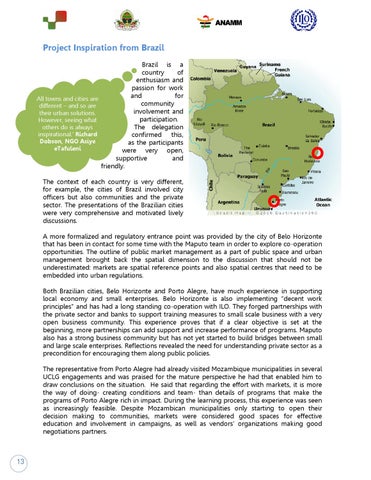
Brazil is a country of enthusiasm and passion for work and for community involvement and participation. The delegation confirmed this, as the participants were very open, supportive and friendly.
The context of each country is very different, for example, the cities of Brazil involved city officers but also communities and the private sector. The presentations of the Brazilian cities were very comprehensive and motivated lively discussions. A more formalized and regulatory entrance point was provided by the city of Belo Horizonte that has been in contact for some time with the Maputo team in order to explore co-operation opportunities. The outline of public market management as a part of public space and urban management brought back the spatial dimension to the discussion that should not be underestimated: markets are spatial reference points and also spatial centres that need to be embedded into urban regulations. Both Brazilian cities, Belo Horizonte and Porto Alegre, have much experience in supporting local economy and small enterprises. Belo Horizonte is also implementing “decent work principles” and has had a long standing co-operation with ILO. They forged partnerships with the private sector and banks to support training measures to small scale business with a very open business community. This experience proves that if a clear objective is set at the beginning, more partnerships can add support and increase performance of programs. Maputo also has a strong business community but has not yet started to build bridges between small and large scale enterprises. Reflections revealed the need for understanding private sector as a precondition for encouraging them along public policies. The representative from Porto Alegre had already visited Mozambique municipalities in several UCLG engagements and was praised for the mature perspective he had that enabled him to draw conclusions on the situation. He said that regarding the effort with markets, it is more the way of doing- creating conditions and team- than details of programs that make the programs of Porto Alegre rich in impact. During the learning process, this experience was seen as increasingly feasible. Despite Mozambican municipalities only starting to open their decision making to communities, markets were considered good spaces for effective education and involvement in campaigns, as well as vendors’ organizations making good negotiations partners.
13