International Labour Organization The United Nations and its specialized agency, the International Labour Organization (ILO), stand for universal principles that can be applied in any context and country. In the market environment, vulnerable groups are women, but also extremely poor people and children that still suffer inequalities need to be highlighted. In a developmental approach, the ILO is keen to work hand in hand with UCLG, not only raising awareness and lobbying for local economic development and decent jobs, but also sharing the feasible solutions that cities provide, sometimes with surprisingly small budgets resulting in very innovative solutions.
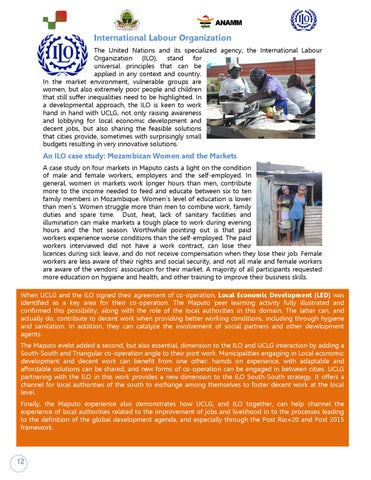
An ILO case study: Mozambican Women and the Markets A case study on four markets in Maputo casts a light on the condition of male and female workers, employers and the self-employed. In general, women in markets work longer hours than men, contribute more to the income needed to feed and educate between six to ten family members in Mozambique. Women´s level of education is lower than men´s. Women struggle more than men to combine work, family duties and spare time. Dust, heat, lack of sanitary facilities and illumination can make markets a tough place to work during evening hours and the hot season. Worthwhile pointing out is that paid workers experience worse conditions than the self-employed. The paid workers interviewed did not have a work contract, can lose their licences during sick leave, and do not receive compensation when they lose their job. Female workers are less aware of their rights and social security, and not all male and female workers are aware of the vendors’ association for their market. A majority of all participants requested more education on hygiene and health, and other training to improve their business skills. When UCLG and the ILO signed their agreement of co-operation, Local Economic Development (LED) was identified as a key area for their co-operation. The Maputo peer learning activity fully illustrated and confirmed this possibility, along with the role of the local authorities in this domain. The latter can, and actually do, contribute to decent work when providing better working conditions, including through hygiene and sanitation. In addition, they can catalyze the involvement of social partners and other development agents. The Maputo evebt added a second, but also essential, dimension to the ILO and UCLG interaction by adding a South-South and Triangular co-operation angle to their joint work. Municipalities engaging in Local economic development and decent work can benefit from one other: hamds on experience, with adaptable and affordable solutions can be shared, and new forms of co-operation can be engaged in between cities. UCLG partnering with the ILO in this work provides a new dimension to the ILO South-South strategy. It offers a channel for local authorities of the south to exchange among themselves to foster decent work at the local level. Finally, the Maputo experience also demonstrates how UCLG, and ILO together, can help channel the experience of local authorities related to the improvement of jobs and livelihood in to the processes leading to the definition of the global development agenda, and especially through the Post Rio+20 and Post 2015 framework.
12