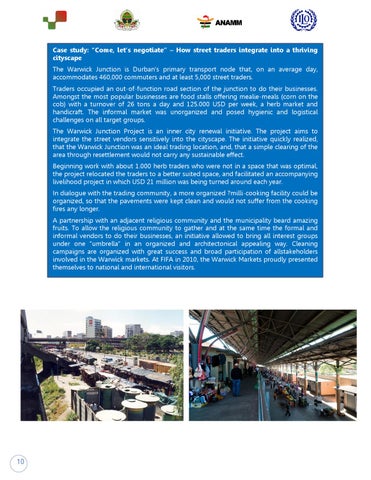
Case study: “Come, let’s negotiate” – How street traders integrate into a thriving cityscape The Warwick Junction is Durban’s primary transport node that, on an average day, accommodates 460,000 commuters and at least 5,000 street traders. Traders occupied an out-of-function road section of the junction to do their businesses. Amongst the most popular businesses are food stalls offering mealie-meals (corn on the cob) with a turnover of 26 tons a day and 125.000 USD per week, a herb market and handicraft. The informal market was unorganized and posed hygienic and logistical challenges on all target groups. The Warwick Junction Project is an inner city renewal initiative. The project aims to integrate the street vendors sensitively into the cityscape. The initiative quickly realized, that the Warwick Junction was an ideal trading location, and, that a simple clearing of the area through resettlement would not carry any sustainable effect. Beginning work with about 1.000 herb traders who were not in a space that was optimal, the project relocated the traders to a better suited space, and facilitated an accompanying livelihood project in which USD 21 million was being turned around each year. In dialogue with the trading community, a more organized ?milli-cooking facility could be organized, so that the pavements were kept clean and would not suffer from the cooking fires any longer. A partnership with an adjacent religious community and the municipality beard amazing fruits. To allow the religious community to gather and at the same time the formal and informal vendors to do their businesses, an initiative allowed to bring all interest groups under one “umbrella” in an organized and architectonical appealing way. Cleaning campaigns are organized with great success and broad participation of allstakeholders involved in the Warwick markets. At FIFA in 2010, the Warwick Markets proudly presented themselves to national and international visitors.
10