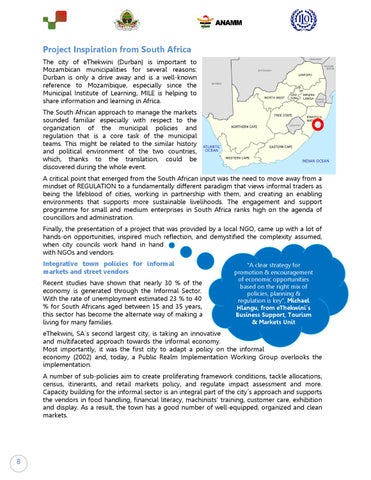
Project Inspiration from South Africa The city of eThekwini (Durban) is important to Mozambican municipalities for several reasons: Durban is only a drive away and is a well-known reference to Mozambique, especially since the Municipal Institute of Learning, MILE is helping to share information and learning in Africa. The South African approach to manage the markets sounded familiar especially with respect to the organization of the municipal policies and regulation that is a core task of the municipal teams. This might be related to the similar history and political environment of the two countries, which, thanks to the translation, could be discovered during the whole event. A critical point that emerged from the South African input was the need to move away from a mindset of REGULATION to a fundamentally different paradigm that views informal traders as being the lifeblood of cities, working in partnership with them, and creating an enabling environments that supports more sustainable livelihoods. The engagement and support programme for small and medium enterprises in South Africa ranks high on the agenda of councillors and administration. Finally, the presentation of a project that was provided by a local NGO, came up with a lot of hands-on opportunities, inspired much reflection, and demystified the complexity assumed, when city councils work hand in hand with NGOs and vendors. Integrative town policies for informal markets and street vendors Recent studies have shown that nearly 30 % of the economy is generated through the Informal Sector. With the rate of unemployment estimated 23 % to 40 % for South Africans aged between 15 and 35 years, this sector has become the alternate way of making a living for many families.
“A clear strategy for promotion & encouragement of economic opportunities based on the right mix of policies, planning & regulation is key”, Michael Hlangu, from eThekwini´s Business Support, Tourism & Markets Unit
eThekwini, SA´s second largest city, is taking an innovative and multifaceted approach towards the informal economy. Most importantly, it was the first city to adapt a policy on the informal economy (2002) and, today, a Public Realm Implementation Working Group overlooks the implementation. A number of sub-policies aim to create proliferating framework conditions, tackle allocations, census, itinerants, and retail markets policy, and regulate impact assessment and more. Capacity building for the informal sector is an integral part of the city´s approach and supports the vendors in food handling, financial literacy, machinists’ training, customer care, exhibition and display. As a result, the town has a good number of well-equipped, organized and clean markets.
8