52
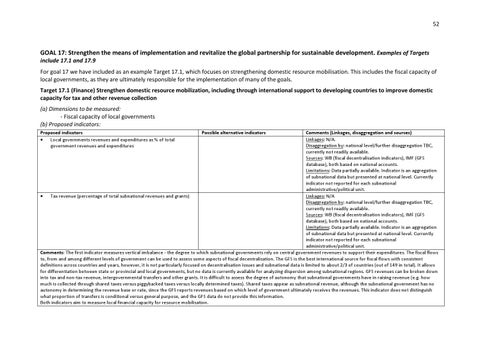
GOAL 17: Strengthen the means of implementation and revitalize the global partnership for sustainable development. Examples of Targets include 17.1 and 17.9 For goal 17 we have included as an example Target 17.1, which focuses on strengthening domestic resource mobilisation. This includes the fiscal capacity of local governments, as they are ultimately responsible for the implementation of many of the goals. Target 17.1 (Finance) Strengthen domestic resource mobilization, including through international support to developing countries to improve domestic capacity for tax and other revenue collection (a) Dimensions to be measured: - Fiscal capacity of local governments (b) Proposed indicators: Proposed indicators  Local governments revenues and expenditures as % of total government revenues and expenditures
Possible alternative indicators
Comments (Linkages, disaggregation and sources) Linkages: N/A. Disaggregation by: national level/further disaggregation TBC, currently not readily available. Sources: WB (fiscal decentralisation indicators), IMF (GFS database), both based on national accounts. Limitations: Data partially available. Indicator is an aggregation of subnational data but presented at national level. Currently indicator not reported for each subnational administrative/political unit. Linkages: N/A  Tax revenue (percentage of total subnational revenues and grants) Disaggregation by: national level/further disaggregation TBC, currently not readily available. Sources: WB (fiscal decentralisation indicators), IMF (GFS database), both based on national accounts. Limitations: Data partially available. Indicator is an aggregation of subnational data but presented at national level. Currently indicator not reported for each subnational administrative/political unit. Comments: The first indicator measures vertical imbalance - the degree to which subnational governments rely on central government revenues to support their expenditures. The fiscal flows to, from and among different levels of government can be used to assess some aspects of fiscal decentralisation. The GFS is the best international source for fiscal flows with consistent definitions across countries and years, however, it is not particularly focused on decentralisation issues and subnational data is limited to about 2/3 of countries (out of 149 in total). It allows for differentiation between state or provincial and local governments, but no data is currently available for analyzing dispersion among subnational regions. GFS revenues can be broken down into tax and non-tax revenue, intergovernmental transfers and other grants. It is difficult to assess the degree of autonomy that subnational governments have in raising revenue (e.g. how much is collected through shared taxes versus piggybacked taxes versus locally determined taxes). Shared taxes appear as subnational revenue, although the subnational government has no autonomy in determining the revenue base or rate, since the GFS reports revenues based on which level of government ultimately receives the revenues. This indicator does not distinguish what proportion of transfers is conditional versus general purpose, and the GFS data do not provide this information. Both indicators aim to measure local financial capacity for resource mobilisation.