50
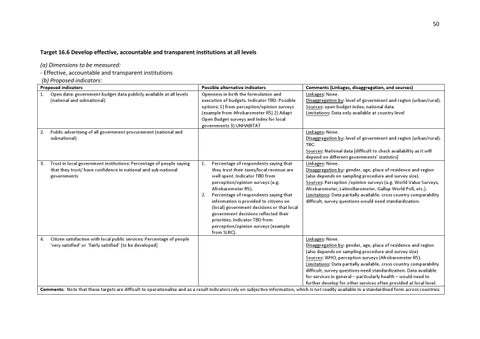
Target 16.6 Develop effective, accountable and transparent institutions at all levels (a) Dimensions to be measured: - Effective, accountable and transparent institutions (b) Proposed indicators: Proposed indicators 1. Open data: government budget data publicly available at all levels (national and subnational)
2.
Public advertising of all government procurement (national and subnational)
3.
Trust in local government institutions: Percentage of people saying that they trust/ have confidence in national and sub-national governments
Possible alternative indicators Openness in both the formulation and execution of budgets. Indicator TBD. Possible options: 1) from perception/opinion surveys (example from Afrobarometer R5) 2) Adapt Open Budget surveys and Index for local governments 3) UNHABITAT
1.
2.
4.
Citizen satisfaction with local public services: Percentage of people 'very satisfied' or 'fairly satisfied' [to be developed]
Percentage of respondents saying that they trust their taxes/local revenue are well spent. Indicator TBD from perception/opinion surveys (e.g. Afrobarometer R5). Percentage of respondents saying that information is provided to citizens on (local) government decisions or that local government decisions reflected their priorities. Indicator TBD from perception/opinion surveys (example from SLRC).
Comments (Linkages, disaggregation, and sources) Linkages: None. Disaggregation by: level of government and region (urban/rural). Sources: open budget index, national data Limitations: Data only available at country level
Linkages: None. Disaggregation by: level of government and region (urban/rural). TBC. Sources: National data [difficult to check availability as it will depend on different governments’ statistics] Linkages: None. Disaggregation by: gender, age, place of residence and region (also depends on sampling procedure and survey size). Sources: Perception /opinion surveys (e.g. World Value Surveys, Afrobarometer, LatinoBarometer, Gallup World Poll, etc.). Limitations: Data partially available, cross country comparability difficult, survey questions would need standardization.
Linkages: None. Disaggregation by: gender, age, place of residence and region (also depends on sampling procedure and survey size) Sources: WHO, perception surveys (Afrobarometer R5). Limitations: Data partially available, cross country comparability difficult, survey questions need standardization. Data available for services in general – particularly health – would need to further develop for other services often provided at local level. Comments: Note that these targets are difficult to operationalise and as a result indicators rely on subjective information, which is not readily available in a standardised form across countries.