48
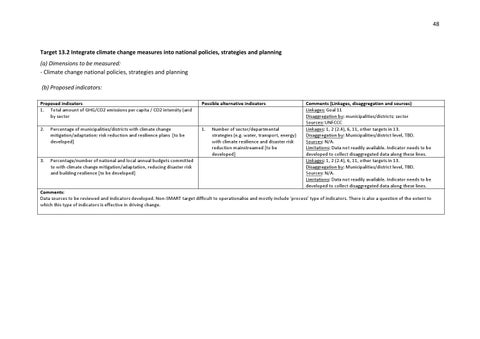
Target 13.2 Integrate climate change measures into national policies, strategies and planning (a) Dimensions to be measured: - Climate change national policies, strategies and planning (b) Proposed indicators: Proposed indicators 1. Total amount of GHG/CO2 emissions per capita / CO2 intensity (and by sector
Possible alternative indicators
2.
Percentage of municipalities/districts with climate change mitigation/adaptation; risk reduction and resilience plans [to be developed]
1.
3.
Percentage/number of national and local annual budgets committed to with climate change mitigation/adaptation, reducing disaster risk and building resilience [to be developed]
Number of sector/departmental strategies (e.g. water, transport, energy) with climate resilience and disaster risk reduction mainstreamed [to be developed]
Comments (Linkages, disaggregation and sources) Linkages: Goal 11 Disaggregation by: municipalities/districts; sector Sources: UNFCCC Linkages: 1, 2 (2.4), 6, 11, other targets in 13. Disaggregation by: Municipalities/district level, TBD. Sources: N/A. Limitations: Data not readily available. Indicator needs to be developed to collect disaggregated data along these lines. Linkages: 1, 2 (2.4), 6, 11, other targets in 13. Disaggregation by: Municipalities/district level, TBD. Sources: N/A. Limitations: Data not readily available. Indicator needs to be developed to collect disaggregated data along these lines.
Comments: Data sources to be reviewed and indicators developed. Non-SMART target difficult to operationalise and mostly include ‘process’ type of indicators. There is also a question of the extent to which this type of indicators is effective in driving change.