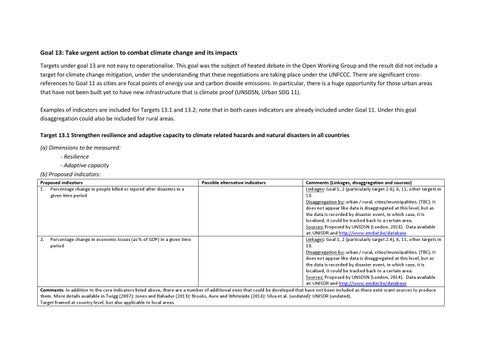
Goal 13: Take urgent action to combat climate change and its impacts Targets under goal 13 are not easy to operationalise. This goal was the subject of heated debate in the Open Working Group and the result did not include a target for climate change mitigation, under the understanding that these negotiations are taking place under the UNFCCC. There are significant crossreferences to Goal 11 as cities are focal points of energy use and carbon dioxide emissions. In particular, there is a huge opportunity for those urban areas that have not been built yet to have new infrastructure that is climate proof (UNSDSN, Urban SDG 11). Examples of indicators are included for Targets 13.1 and 13.2; note that in both cases indicators are already included under Goal 11. Under this goal disaggregation could also be included for rural areas. Target 13.1 Strengthen resilience and adaptive capacity to climate related hazards and natural disasters in all countries (a) Dimensions to be measured: - Resilience - Adaptive capacity (b) Proposed indicators: Proposed indicators 1. Percentage change in people killed or injured after disasters in a given time period
Possible alternative indicators
Comments (Linkages, disaggregation and sources) Linkages: Goal 1, 2 (particularly target 2.4), 6, 11, other targets in 13. Disaggregation by: urban / rural, cities/municipalities. (TBC). It does not appear like data is disaggregated at this level, but as the data is recorded by disaster event, in which case, it is localised, it could be tracked back to a certain area. Sources: Proposed by UNSDSN (London, 2014). Data available at: UNISDR and http://www.emdat.be/database 2. Percentage change in economic losses (as % of GDP) in a given time Linkages: Goal 1, 2 (particularly target 2.4), 6, 11, other targets in period 13. Disaggregation by: urban / rural, cities/municipalities. (TBC). It does not appear like data is disaggregated at this level, but as the data is recorded by disaster event, in which case, it is localised, it could be tracked back to a certain area. Sources: Proposed by UNSDSN (London, 2014). Data available at: UNISDR and http://www.emdat.be/database Comments: In addition to the core indicators listed above, there are a number of additional ones that could be developed that have not been included as there exist scant sources to produce them. More details available in Twigg (2007); Jones and Bahadur (2013); Brooks, Aure and Whiteside (2014); Silva et al. (undated); UNISDR (undated). Target framed at country level, but also applicable to local areas.