46
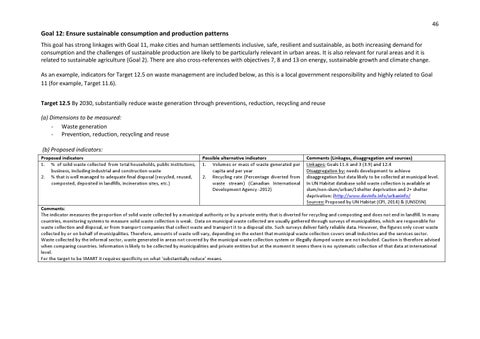
Goal 12: Ensure sustainable consumption and production patterns This goal has strong linkages with Goal 11, make cities and human settlements inclusive, safe, resilient and sustainable, as both increasing demand for consumption and the challenges of sustainable production are likely to be particularly relevant in urban areas. It is also relevant for rural areas and it is related to sustainable agriculture (Goal 2). There are also cross-references with objectives 7, 8 and 13 on energy, sustainable growth and climate change. As an example, indicators for Target 12.5 on waste management are included below, as this is a local government responsibility and highly related to Goal 11 (for example, Target 11.6). Target 12.5 By 2030, substantially reduce waste generation through preventions, reduction, recycling and reuse (a) Dimensions to be measured: - Waste generation - Prevention, reduction, recycling and reuse (b) Proposed indicators: Proposed indicators 1. % of solid waste collected from total households, public institutions, business, including industrial and construction waste 2. % that is well managed to adequate final disposal (recycled, reused, composted, deposited in landfills, incineration sites, etc.)
Possible alternative indicators 1. Volumes or mass of waste generated per capita and per year 2. Recycling rate (Percentage diverted from waste stream) (Canadian International Development Agency -2012)
Comments (Linkages, disaggregation and sources) Linkages: Goals 11.6 and 3 (3.9) and 12.4 Disaggregation by: needs development to achieve disaggregation but data likely to be collected at municipal level. In UN Habitat database solid waste collection is available at slum/non-slum/urban/1shelter deprivation and 2+ shelter deprivation: (http://www.devinfo.info/urbaninfo/ Sources: Proposed by UN Habitat (CPI, 2014) & (UNSDSN)
Comments: The indicator measures the proportion of solid waste collected by a municipal authority or by a private entity that is diverted for recycling and composting and does not end in landfill. In many countries, monitoring systems to measure solid waste collection is weak. Data on municipal waste collected are usually gathered through surveys of municipalities, which are responsible for waste collection and disposal, or from transport companies that collect waste and transport it to a disposal site. Such surveys deliver fairly reliable data. However, the figures only cover waste collected by or on behalf of municipalities. Therefore, amounts of waste will vary, depending on the extent that municipal waste collection covers small industries and the services sector. Waste collected by the informal sector, waste generated in areas not covered by the municipal waste collection system or illegally dumped waste are not included. Caution is therefore advised when comparing countries. Information is likely to be collected by municipalities and private entities but at the moment it seems there is no systematic collection of that data at international level. For the target to be SMART it requires specificity on what ‘substantially reduce’ means.