43 managed to adequate final disposal (recycled, reused, deposited in landfills, composted, etc.)
waste recycled (UNSDSN, 2014) 2. Share of waste collected by the city and adequately disposed either in sanitary landfills, incineration sites or in regulated recycling facilities (UN Habitat, CPI, 2014) 3. Recycling rate (Percentage diverted from waste stream) (Canadian International Development Agency -2012)
comparable data. Sources: TBC. Information is likely to be collected by municipalities and private entities but at the moment it seems there is no systematic collection of that data at international level (at least readily available online).
Comments: Consider the use of a low carbon indicator as the PWC 2011 Low Carbon Economy Indicator. Urban development and urban planning is closely linked to the decarbonizing process. While many are specifically related to energy efficiency (See McKinsey & Company’s greenhouse gas abatement cost curves), abundant de-carbonising opportunities also exist around construction processes and building materials (low carbon alternatives), transportation and urban resource management (energy, water and waste production and management). For water quality, see goal 6. UNSDSN proposes: Water quality index (index), City Biodiversity Index (index) UN Habitat (CPI, 2014) include: Share of Protected Area in Natural Systems that Provide Water to the City and Number of monitoring stations for air quality
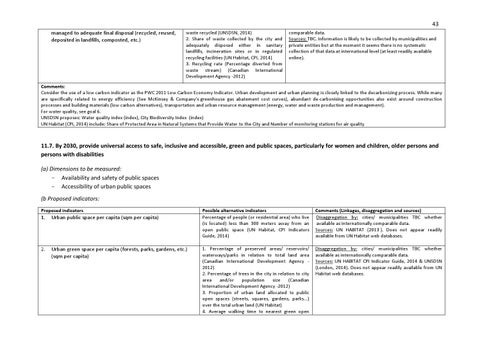
11.7. By 2030, provide universal access to safe, inclusive and accessible, green and public spaces, particularly for women and children, older persons and persons with disabilities (a) Dimensions to be measured: - Availability and safety of public spaces - Accessibility of urban public spaces (b Proposed indicators: Proposed indicators
1.
Urban public space per capita (sqm per capita)
2.
Urban green space per capita (forests, parks, gardens, etc.) (sqm per capita)
Possible alternative indicators Percentage of people (or residential area) who live (is located) less than 300 meters away from an open public space (UN Habitat, CPI Indicators Guide, 2014)
Comments (Linkages, disaggregation and sources) Disaggregation by: cities/ municipalities TBC whether available as internationally comparable data. Sources: UN HABITAT (2013 ). Does not appear readily available from UN Habitat web databases.
1. Percentage of preserved areas/ reservoirs/ waterways/parks in relation to total land area (Canadian International Development Agency 2012) 2. Percentage of trees in the city in relation to city area and/or population size (Canadian International Development Agency -2012) 3. Proportion of urban land allocated to public open spaces (streets, squares, gardens, parks...) over the total urban land (UN Habitat) 4. Average walking time to nearest green open
Disaggregation by: cities/ municipalities TBC whether available as internationally comparable data. Sources: UN HABITAT CPI Indicator Guide, 2014 & UNSDSN (London, 2014). Does not appear readily available from UN Habitat web databases.