42 London, 2014) Comments: Links with Goal 13, particularly targets 13.1
Additional indicators that look at capacity of local governments and poor and vulnerable communities to react and cope with natural disasters could be considered. These are not currently available (in a way that is internationally comparable). a. % change in proportion of women and individuals from marginalised sections represented within local and government decision-making bodies b. % of national and local annual development budgets committed to reducing disaster risk and building resilience c. %/number of people covered by appropriate risk reduction investment (infrastructure and capacity) in place to priority climate related (and other) disasters d. % of municipalities/districts with risk reduction and resilience plans e. % of schools with climate resilience and DRR mainstreamed into curricula. f. Number of sector/departmental strategies (e.g. water, transport, energy) with climate resilience and disaster risk reduction mainstreamed.
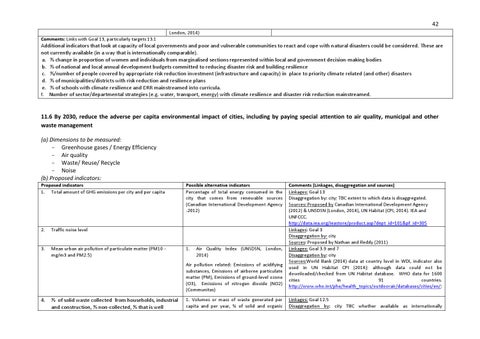
11.6 By 2030, reduce the adverse per capita environmental impact of cities, including by paying special attention to air quality, municipal and other waste management (a) Dimensions to be measured: - Greenhouse gases / Energy Efficiency - Air quality - Waste/ Reuse/ Recycle - Noise (b) Proposed indicators: Proposed indicators 1. Total amount of GHG emissions per city and per capita
2.
Traffic noise level
3.
Mean urban air pollution of particulate matter (PM10 mg/m3 and PM2.5)
Possible alternative indicators Percentage of total energy consumed in the city that comes from renewable sources (Canadian International Development Agency -2012)
1.
Air Quality Index (UNSDSN, London, 2014)
Air pollution related: Emissions of acidifying substances, Emissions of airborne particulate matter (PM), Emissions of ground-level ozone (O3), Emissions of nitrogen dioxide (NO2) (Communitas)
4.
% of solid waste collected from households, industrial and construction, % non-collected, % that is well
1. Volumes or mass of waste generated per capita and per year, % of solid and organic
Comments (Linkages, disaggregation and sources) Linkages: Goal 13 Disaggregation by: city; TBC extent to which data is disaggregated. Sources: Proposed by Canadian International Development Agency (2012) & UNSDSN (London, 2014), UN Habitat (CPI, 2014). IEA and UNFCCC. http://data.iea.org/ieastore/product.asp?dept_id=101&pf_id=305 Linkages: Goal 3 Disaggregation by: city Sources: Proposed by Nathan and Reddy (2011) Linkages: Goal 3.9 and 7 Disaggregation by: city Sources:World Bank (2014) data at country level in WDI, indicator also used in UN Habitat CPI (2014); although data could not be downloaded/checked from UN Habitat database. WHO data for 1600 cities in 91 countries. http://www.who.int/phe/health_topics/outdoorair/databases/cities/en/; Linkages: Goal 12.5 Disaggregation by: city TBC whether available as internationally