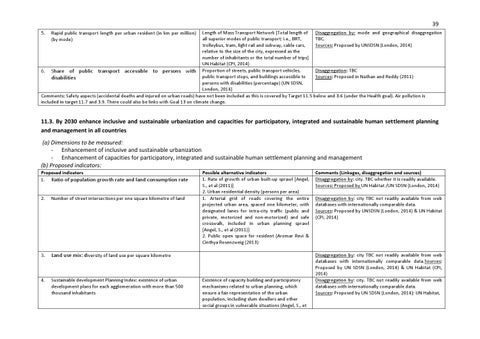
39 Length of Mass Transport Network [Total length of Disaggregation by: mode and geographical disaggregation all superior modes of public transport; i.e., BRT, TBC. trolleybus, tram, light rail and subway, cable cars, Sources: Proposed by UNSDSN (London, 2014) relative to the size of the city, expressed as the number of inhabitants or the total number of trips] UN Habitat (CPI, 2014) Disaggregation: TBC 6. Share of public transport accessible to persons with Proportion of streets, public transport vehicles, public transport stops, and buildings accessible to Sources: Proposed in Nathan and Reddy (2011) disabilities persons with disabilities (percentage) (UN SDSN, London, 2014) Comments: Safety aspects (accidental deaths and injured on urban roads) have not been included as this is covered by Target 11.5 below and 3.6 (under the Health goal). Air pollution is included in target 11.7 and 3.9. There could also be links with Goal 13 on climate change.
5.
Rapid public transport length per urban resident (in km per million) (by mode)
11.3. By 2030 enhance inclusive and sustainable urbanization and capacities for participatory, integrated and sustainable human settlement planning and management in all countries (a) Dimensions to be measured: - Enhancement of inclusive and sustainable urbanization - Enhancement of capacities for participatory, integrated and sustainable human settlement planning and management (b) Proposed indicators: Proposed indicators 1. Ratio of population growth rate and land consumption rate
2.
Number of street intersections per one square kilometre of land
3.
Land use mix: diversity of land use per square kilometre
4.
Sustainable development Planning Index: existence of urban development plans for each agglomeration with more than 500 thousand inhabitants
Possible alternative indicators 1. Rate of growth of urban built-up sprawl [Angel, S., et al (2011)] 2. Urban residential density (persons per area) 1. Arterial grid of roads covering the entire projected urban area, spaced one kilometer, with designated lanes for intra-city traffic (public and private, motorized and non-motorized) and safe crosswalk, included in urban planning sprawl [Angel, S., et al (2011)] 2. Public open space for resident (Aromar Revi & Cinthya Rosenzweig (2013)
Existence of capacity building and participatory mechanisms related to urban planning, which ensure a fair representation of the urban population, including slum dwellers and other social groups in vulnerable situations (Angel, S., et
Comments (Linkages, disaggregation and sources) Disaggregation by: city. TBC whether it is readily available. Sources: Proposed by UN Habitat /UN SDSN (London, 2014) Disaggregation by: city TBC not readily available from web databases with internationally comparable data. Sources: Proposed by UNSDSN (London, 2014) & UN Habitat (CPI, 2014)
Disaggregation by: city TBC not readily available from web databases with internationally comparable data.Sources: Proposed by UN SDSN (London, 2014) & UN Habitat (CPI, 2014) Disaggregation by: city. TBC not readily available from web databases with internationally comparable data. Sources: Proposed by UN SDSN (London, 2014); UN Habitat,