38
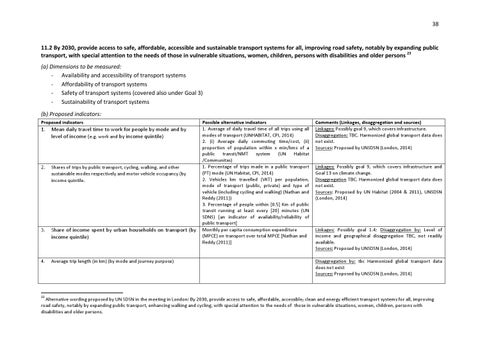
11.2 By 2030, provide access to safe, affordable, accessible and sustainable transport systems for all, improving road safety, notably by expanding public transport, with special attention to the needs of those in vulnerable situations, women, children, persons with disabilities and older persons 23 (a) Dimensions to be measured: - Availability and accessibility of transport systems - Affordability of transport systems - Safety of transport systems (covered also under Goal 3) - Sustainability of transport systems (b) Proposed indicators: Proposed indicators
1.
Mean daily travel time to work for people by mode and by level of income (e.g. work and by income quintile)
2.
Shares of trips by public transport, cycling, walking, and other sustainable modes respectively and motor vehicle occupancy (by income quintile.
3.
Share of income spent by urban households on transport (by income quintile)
4.
Average trip length (in km) (by mode and journey purpose)
23
Possible alternative indicators 1. Average of daily travel time of all trips using all modes of transport (UNHABITAT, CPI, 2014) 2. (i) Average daily commuting time/cost, (ii) proportion of population within x min/kms of a public transit/NMT system (UN Habitat /Communitas) 1. Percentage of trips made in a public transport (PT) mode (UN Habitat, CPI, 2014) 2. Vehicles km travelled (VKT) per population, mode of transport (public, private) and type of vehicle (including cycling and walking) (Nathan and Reddy (2011)) 3. Percentage of people within [0.5] Km of public transit running at least every [20] minutes (UN SDNS) [an indicator of availability/reliability of public transport] Monthly per capita consumption expenditure (MPCE) on transport over total MPCE [Nathan and Reddy (2011)]
Comments (Linkages, disaggregation and sources) Linkages: Possibly goal 9, which covers infrastructure. Disaggregation: TBC. Harmonized global transport data does not exist. Sources: Proposed by UNSDSN (London, 2014)
Linkages: Possibly goal 9, which covers infrastructure and Goal 13 on climate change. Disaggregation TBC. Harmonized global transport data does not exist. Sources: Proposed by UN Habitat (2004 & 2011), UNSDSN (London, 2014)
Linkages: Possibly goal 1.4; Disaggregation by: Level of income and geographical disaggregation TBC, not readily available. Sources: Proposed by UNSDSN (London, 2014) Disaggregation by: tbc Harmonized global transport data does not exist Sources: Proposed by UNSDSN (London, 2014)
Alternative wording proposed by UN SDSN in the meeting in London: By 2030, provide access to safe, affordable, accessible, clean and energy efficient transport systems for all, improving road safety, notably by expanding public transport, enhancing walking and cycling, with special attention to the needs of those in vulnerable situations, women, children, persons with disabilities and older persons.