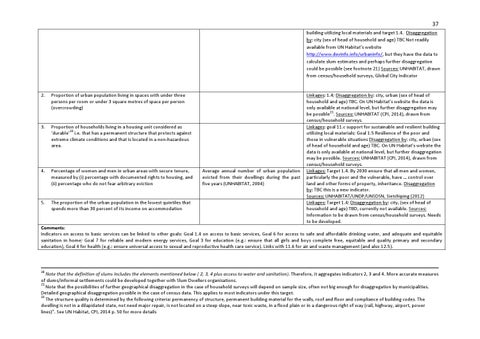
37 building utilizing local materials and target 1.4. Disaggregation by: city (sex of head of household and age) TBC Not readily available from UN Habitat’s website http://www.devinfo.info/urbaninfo/, but they have the data to calculate slum estimates and perhaps further disaggregation could be possible (see footnote 21) Sources: UNHABITAT, drawn from census/household surveys, Global City Indicator
2.
Proportion of urban population living in spaces with under three persons per room or under 3 square metres of space per person (overcrowding)
3.
Proportion of households living in a housing unit considered as 22 ‘durable’ i.e. that has a permanent structure that protects against extreme climate conditions and that is located in a non-hazardous area.
4.
Percentage of women and men in urban areas with secure tenure, measured by (i) percentage with documented rights to housing, and (ii) percentage who do not fear arbitrary eviction
5.
The proportion of the urban population in the lowest quintiles that spends more than 30 percent of its income on accommodation
Average annual number of urban population evicted from their dwellings during the past five years (UNHABITAT, 2004)
Linkages: 1.4; Disaggregation by: city, urban (sex of head of household and age) TBC. On UN Habitat’s website the data is only available at national level, but further disaggregation may 21 be possible . Sources: UNHABITAT (CPI, 2014), drawn from census/household surveys. Linkages: goal 11.c support for sustainable and resilient building utilizing local materials; Goal 1.5 Resilience of the poor and those in vulnerable situations Disaggregation by: city, urban (sex of head of household and age) TBC. On UN Habitat’s website the data is only available at national level, but further disaggregation may be possible. Sources: UNHABITAT (CPI, 2014), drawn from census/household surveys. Linkages: Target 1.4. By 2030 ensure that all men and women, particularly the poor and the vulnerable, have … control over land and other forms of property, inheritance. Disaggregation by: TBC this is a new indicator. Sources: UNHABITAT/UNDP/UNSDSN, Sietchiping (2012) Linkages: Target 1.4; Disaggregation by: city, (sex of head of household and age) TBD, currently not available. Sources: Information to be drawn from census/household surveys. Needs to be developed.
Comments: Indicators on access to basic services can be linked to other goals: Goal 1.4 on access to basic services, Goal 6 for access to safe and affordable drinking water, and adequate and equitable sanitation in home; Goal 7 for reliable and modern energy services, Goal 3 for education (e.g.: ensure that all girls and boys complete free, equitable and quality primary and secondary education), Goal 4 for health (e.g.: ensure universal access to sexual and reproductive health care service). Links with 11.6 for air and waste management (and also 12.5).
20
Note that the definition of slums includes the elements mentioned below ( 2, 3, 4 plus access to water and sanitation). Therefore, it aggregates indicators 2, 3 and 4. More accurate measures of slums/informal settlements could be developed together with Slum Dwellers organisations. 21 Note that the possibilities of further geographical disaggregation in the case of household surveys will depend on sample size, often not big enough for disaggregation by municipalities. Detailed geographical disaggregation possible in the case of census data. This applies to most indicators under this target. 22 The structure quality is determined by the following criteria: permanency of structure, permanent building material for the walls, roof and floor and compliance of building codes. The dwelling is not in a dilapidated state, not need major repair, is not located on a steep slope, near toxic waste, in a flood plain or in a dangerous right of way (rail, highway, airport, power lines)”. See UN Habitat, CPI, 2014 p. 50 for more details