28
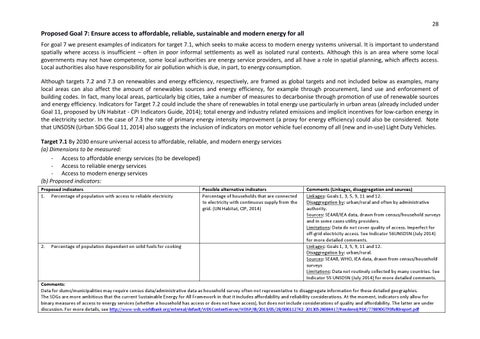
Proposed Goal 7: Ensure access to affordable, reliable, sustainable and modern energy for all For goal 7 we present examples of indicators for target 7.1, which seeks to make access to modern energy systems universal. It is important to understand spatially where access is insufficient – often in poor informal settlements as well as isolated rural contexts. Although this is an area where some local governments may not have competence, some local authorities are energy service providers, and all have a role in spatial planning, which affects access. Local authorities also have responsibility for air pollution which is due, in part, to energy consumption. Although targets 7.2 and 7.3 on renewables and energy efficiency, respectively, are framed as global targets and not included below as examples, many local areas can also affect the amount of renewables sources and energy efficiency, for example through procurement, land use and enforcement of building codes. In fact, many local areas, particularly big cities, take a number of measures to decarbonise through promotion of use of renewable sources and energy efficiency. Indicators for Target 7.2 could include the share of renewables in total energy use particularly in urban areas (already included under Goal 11, proposed by UN Habitat - CPI Indicators Guide, 2014); total energy and industry related emissions and implicit incentives for low-carbon energy in the electricity sector. In the case of 7.3 the rate of primary energy intensity improvement (a proxy for energy efficiency) could also be considered. Note that UNSDSN (Urban SDG Goal 11, 2014) also suggests the inclusion of indicators on motor vehicle fuel economy of all (new and in-use) Light Duty Vehicles. Target 7.1 By 2030 ensure universal access to affordable, reliable, and modern energy services (a) Dimensions to be measured: - Access to affordable energy services (to be developed) - Access to reliable energy services - Access to modern energy services (b) Proposed indicators: Proposed indicators 1. Percentage of population with access to reliable electricity
2.
Percentage of population dependent on solid fuels for cooking
Possible alternative indicators Percentage of households that are connected to electricity with continuous supply from the grid. (UN Habitat, CIP, 2014)
Comments (Linkages, disaggregation and sources) Linkages: Goals 1, 3, 5, 9, 11 and 12. Disaggregation by: urban/rural and often by administrative authority. Sources: SE4All/IEA data, drawn from census/household surveys and in some cases utility providers. Limitations: Data do not cover quality of access. Imperfect for off-grid electricity access. See Indicator 56UNSDSN (July 2014) for more detailed comments. Linkages: Goals 1, 3, 5, 9, 11 and 12. Disaggregation by: urban/rural. Sources: SE4All, WHO, IEA data, drawn from census/household surveys Limitations: Data not routinely collected by many countries. See Indicator 55 UNSDSN (July 2014) for more detailed comments.
Comments: Data for slums/municipalities may require census data/administrative data as household survey often not representative to disaggregate information for these detailed geographies. The SDGs are more ambitious that the current Sustainable Energy for All Framework in that it includes affordability and reliability considerations. At the moment, indicators only allow for binary measures of access to energy services (whether a household has access or does not have access), but does not include considerations of quality and affordability. The latter are under discussion. For more details, see http://www-wds.worldbank.org/external/default/WDSContentServer/WDSP/IB/2013/05/28/000112742_20130528084417/Rendered/PDF/778890GTF0full0report.pdf