26
2.
Percentage of population using an adequate sanitation facility.
3.
Percentage of population living in households whose excreta are safely managed.
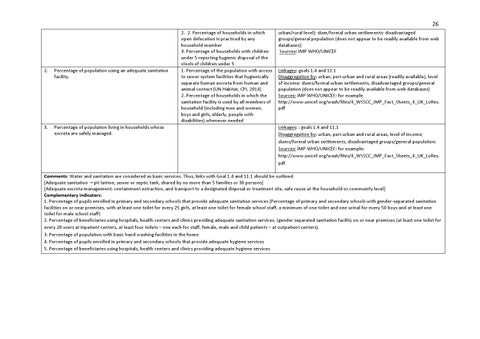
2. 2. Percentage of households in which open defecation is practiced by any household member 3. Percentage of households with children under 5 reporting hygienic disposal of the stools of children under 5 1. Percentage of the population with access to sewer system facilities that hygienically separate human excreta from human and animal contact (UN Habitat, CPI, 2014) 2. Percentage of households in which the sanitation facility is used by all members of household (including men and women, boys and girls, elderly, people with disabilities) whenever needed
urban/rural level); slum/formal urban settlements; disadvantaged groups/general population (does not appear to be readily available from web databases); Sources: JMP WHO/UNICEF
Linkages: goals 1.4 and 11.1 Disaggregation by: urban, peri-urban and rural areas (readily available), level of income; slums/formal urban settlements, disadvantaged groups/general population (does not appear to be readily available from web databases) Sources: JMP WHO/UNICEF; for example http://www.unicef.org/wash/files/4_WSSCC_JMP_Fact_Sheets_4_UK_LoRes. pdf
Linkages: : goals 1.4 and 11.1 Disaggregation by: urban, peri-urban and rural areas, level of income; slums/formal urban settlements, disadvantaged groups/general population; Sources: JMP WHO/UNICEF; for example: http://www.unicef.org/wash/files/4_WSSCC_JMP_Fact_Sheets_4_UK_LoRes. pdf
Comments: Water and sanitation are considered as basic services. Thus, links with Goal 1.4 and 11.1 should be outlined. [Adequate sanitation = pit latrine, sewer or septic tank, shared by no more than 5 families or 30 persons] [Adequate excreta management: containment extraction, and transport to a designated disposal or treatment site, safe reuse at the household or community level] Complementary indicators: 1. Percentage of pupils enrolled in primary and secondary schools that provide adequate sanitation services (Percentage of primary and secondary schools with gender-separated sanitation facilities on or near premises, with at least one toilet for every 25 girls, at least one toilet for female school staff, a minimum of one toilet and one urinal for every 50 boys and at least one toilet for male school staff) 2. Percentage of beneficiaries using hospitals, health centers and clinics providing adequate sanitation services. (gender separated sanitation facility on or near premises (at least one toilet for every 20 users at inpatient centers, at least four toilets – one each for staff, female, male and child patients – at outpatient centers). 3. Percentage of population with basic hand washing facilities in the home 4. Percentage of pupils enrolled in primary and secondary schools that provide adequate hygiene services 5. Percentage of beneficiaries using hospitals, health centers and clinics providing adequate hygiene services