22 5.
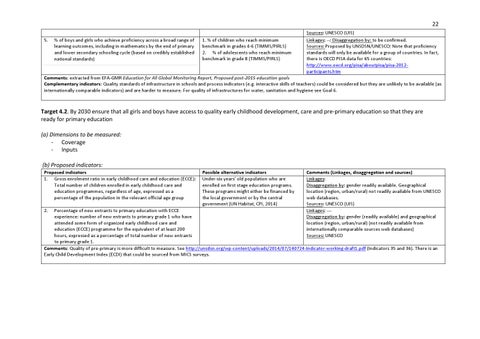
% of boys and girls who achieve proficiency across a broad range of learning outcomes, including in mathematics by the end of primary and lower secondary schooling cycle (based on credibly established national standards)
1. % of children who reach minimum benchmark in grades 4-6 (TIMMS/PIRLS) 2. % of adolescents who reach minimum benchmark in grade 8 (TIMMS/PIRLS)
Sources: UNESCO (UIS) Linkages: --; Disaggregation by: to be confirmed. Sources: Proposed by UNSDSN/UNESCO; Note that proficiency standards will only be available for a group of countries. In fact, there is OECD PISA data for 65 countries: http://www.oecd.org/pisa/aboutpisa/pisa-2012participants.htm
Comments: extracted from EFA-GMR Education for All Global Monitoring Report, Proposed post-2015 education goals Complementary indicators: Quality standards of infrastructure in schools and process indicators (e.g. interactive skills of teachers) could be considered but they are unlikely to be available (as internationally comparable indicators) and are harder to measure. For quality of infrastructures for water, sanitation and hygiene see Goal 6.
Target 4.2. By 2030 ensure that all girls and boys have access to quality early childhood development, care and pre-primary education so that they are ready for primary education (a) Dimensions to be measured: - Coverage - Inputs (b) Proposed indicators: Proposed indicators 1. Gross enrolment ratio in early childhood care and education (ECCE): Total number of children enrolled in early childhood care and education programmes, regardless of age, expressed as a percentage of the population in the relevant official age group 2.
Possible alternative indicators Under-six years’ old population who are enrolled on first stage education programs. These programs might either be financed by the local government or by the central government (UN Habitat, CPI, 2014)
Comments (Linkages, disaggregation and sources) Linkages: Disaggregation by: gender readily available. Geographical location (region, urban/rural) not readily available from UNESCO web databases. Sources: UNESCO (UIS) Linkages: --Disaggregation by: gender (readily available) and geographical location (region, urban/rural) (not readily available from internationally comparable sources web databases) Sources: UNESCO
Percentage of new entrants to primary education with ECCE experience: number of new entrants to primary grade 1 who have attended some form of organized early childhood care and education (ECCE) programme for the equivalent of at least 200 hours, expressed as a percentage of total number of new entrants to primary grade 1. Comments: Quality of pre-primary is more difficult to measure. See http://unsdsn.org/wp-content/uploads/2014/07/140724-Indicator-working-draft1.pdf (Indicators 35 and 36). There is an Early Child Development Index (ECDI) that could be sourced from MICS surveys.