21
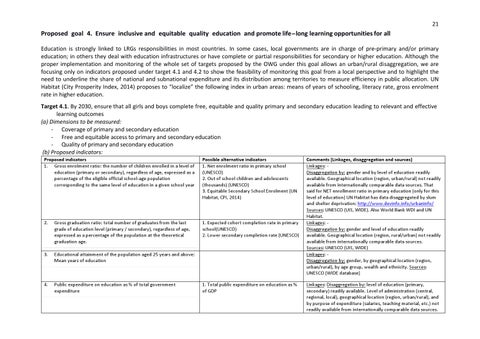
Proposed goal 4. Ensure inclusive and equitable quality education and promote life-long learning opportunities for all Education is strongly linked to LRGs responsibilities in most countries. In some cases, local governments are in charge of pre-primary and/or primary education; in others they deal with education infrastructures or have complete or partial responsibilities for secondary or higher education. Although the proper implementation and monitoring of the whole set of targets proposed by the OWG under this goal allows an urban/rural disaggregation, we are focusing only on indicators proposed under target 4.1 and 4.2 to show the feasibility of monitoring this goal from a local perspective and to highlight the need to underline the share of national and subnational expenditure and its distribution among territories to measure efficiency in public allocation. UN Habitat (City Prosperity Index, 2014) proposes to “localize� the following index in urban areas: means of years of schooling, literacy rate, gross enrolment rate in higher education. Target 4.1. By 2030, ensure that all girls and boys complete free, equitable and quality primary and secondary education leading to relevant and effective learning outcomes (a) Dimensions to be measured: - Coverage of primary and secondary education - Free and equitable access to primary and secondary education - Quality of primary and secondary education (b) Proposed indicators: Proposed indicators 1. Gross enrolment ratio: the number of children enrolled in a level of education (primary or secondary), regardless of age, expressed as a percentage of the eligible official school-age population corresponding to the same level of education in a given school year
Possible alternative indicators 1. Net enrolment ratio in primary school (UNESCO) 2. Out of school children and adolescents (thousands) (UNESCO) 3. Equitable Secondary School Enrolment (UN Habitat, CPI, 2014)
2.
Gross graduation ratio: total number of graduates from the last grade of education level (primary / secondary), regardless of age, expressed as a percentage of the population at the theoretical graduation age.
1. Expected cohort completion rate in primary school(UNESCO) 2. Lower secondary completion rate (UNESCO)
3.
Educational attainment of the population aged 25 years and above: Mean years of education
4.
Public expenditure on education as % of total government expenditure
1. Total public expenditure on education as % of GDP
Comments (Linkages, disaggregation and sources) Linkages: Disaggregation by: gender and by level of education readily available. Geographical location (region, urban/rural) not readily available from internationally comparable data sources. That said for NET enrollment ratio in primary education (only for this level of education) UN Habitat has data disaggregated by slum and shelter deprivation: http://www.devinfo.info/urbaninfo/ Sources: UNESCO (UIS, WIDE). Also World Bank WDI and UN Habitat. Linkages: Disaggregation by: gender and level of education readily available. Geographical location (region, rural/urban) not readily available from internationally comparable data sources. Sources: UNESCO (UIS, WIDE) Linkages: Disaggregation by: gender, by geographical location (region, urban/rural), by age group, wealth and ethnicity. Sources: UNESCO (WIDE database) Linkages: Disaggregation by: level of education (primary, secondary) readily available. Level of administration (central, regional, local), geographical location (region, urban/rural), and by purpose of expenditure (salaries, teaching material, etc.) not readily available from internationally comparable data sources.