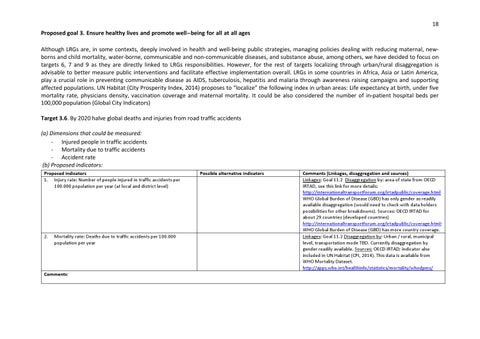
18 Proposed goal 3. Ensure healthy lives and promote well-being for all at all ages Although LRGs are, in some contexts, deeply involved in health and well-being public strategies, managing policies dealing with reducing maternal, newborns and child mortality, water-borne, communicable and non-communicable diseases, and substance abuse, among others, we have decided to focus on targets 6, 7 and 9 as they are directly linked to LRGs responsibilities. However, for the rest of targets localizing through urban/rural disaggregation is advisable to better measure public interventions and facilitate effective implementation overall. LRGs in some countries in Africa, Asia or Latin America, play a crucial role in preventing communicable disease as AIDS, tuberculosis, hepatitis and malaria through awareness raising campaigns and supporting affected populations. UN Habitat (City Prosperity Index, 2014) proposes to “localize� the following index in urban areas: Life expectancy at birth, under five mortality rate, physicians density, vaccination coverage and maternal mortality. It could be also considered the number of in-patient hospital beds per 100,000 population (Global City Indicators) Target 3.6. By 2020 halve global deaths and injuries from road traffic accidents (a) Dimensions that could be measured: - Injured people in traffic accidents - Mortality due to traffic accidents - Accident rate (b) Proposed indicators: Proposed indicators 1. Injury rate: Number of people injured in traffic accidents per 100.000 population per year (at local and district level)
2.
Mortality rate: Deaths due to traffic accidents per 100.000 population per year
Comments:
Possible alternative indicators
Comments (Linkages, disaggregation and sources) Linkages: Goal 11.2 Disaggregation by: area of state from OECD IRTAD, see this link for more details: http://internationaltransportforum.org/irtadpublic/coverage.html WHO Global Burden of Disease (GBD) has only gender as readily available disaggregation (would need to check with data holders possibilities for other breakdowns). Sources: OECD IRTAD for about 29 countries (developed countries) http://internationaltransportforum.org/irtadpublic/coverage.html; WHO Global Burden of Disease (GBD) has more country coverage. Linkages: Goal 11.2 Disaggregation by: Urban / rural, municipal level, transportation mode TBD. Currently disaggregation by gender readily available. Sources: OECD IRTAD; indicator also included in UN Habitat (CPI, 2014). This data is available from WHO Mortality Dataset. http://apps.who.int/healthinfo/statistics/mortality/whodpms/