14
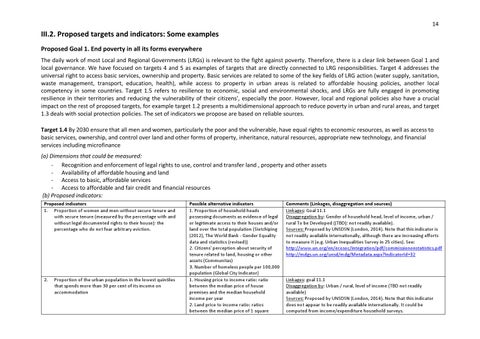
III.2. Proposed targets and indicators: Some examples Proposed Goal 1. End poverty in all its forms everywhere The daily work of most Local and Regional Governments (LRGs) is relevant to the fight against poverty. Therefore, there is a clear link between Goal 1 and local governance. We have focused on targets 4 and 5 as examples of targets that are directly connected to LRG responsibilities. Target 4 addresses the universal right to access basic services, ownership and property. Basic services are related to some of the key fields of LRG action (water supply, sanitation, waste management, transport, education, health), while access to property in urban areas is related to affordable housing policies, another local competency in some countries. Target 1.5 refers to resilience to economic, social and environmental shocks, and LRGs are fully engaged in promoting resilience in their territories and reducing the vulnerability of their citizens’, especially the poor. However, local and regional policies also have a crucial impact on the rest of proposed targets, for example target 1.2 presents a multidimensional approach to reduce poverty in urban and rural areas, and target 1.3 deals with social protection policies. The set of indicators we propose are based on reliable sources. Target 1.4 By 2030 ensure that all men and women, particularly the poor and the vulnerable, have equal rights to economic resources, as well as access to basic services, ownership, and control over land and other forms of property, inheritance, natural resources, appropriate new technology, and financial services including microfinance (a) Dimensions that could be measured: - Recognition and enforcement of legal rights to use, control and transfer land , property and other assets - Availability of affordable housing and land - Access to basic, affordable services - Access to affordable and fair credit and financial resources (b) Proposed indicators: Proposed indicators 1. Proportion of women and men without secure tenure and with secure tenure (measured by the percentage with and without legal documented rights to their house); the percentage who do not fear arbitrary eviction.
2.
Proportion of the urban population in the lowest quintiles that spends more than 30 per cent of its income on accommodation
Possible alternative indicators 1. Proportion of household heads possessing documents as evidence of legal or legitimate access to their houses and/or land over the total population (Sietchiping (2012), The World Bank - Gender Equality data and statistics (revised)) 2. Citizens' perception about security of tenure related to land, housing or other assets (Communitas) 3. Number of homeless people per 100,000 population (Global City Indicator) 1. Housing price to income ratio: ratio between the median price of house premises and the median household income per year 2. Land price to income ratio: ratios between the median price of 1 square
Comments (Linkages, disaggregation and sources) Linkages: Goal 11.1 Disaggregation by: Gender of household head, level of income, urban / rural To be Developed ((TBD); not readily available). Sources: Proposed by UNSDSN (London, 2014). Note that this indicator is not readily available internationally, although there are increasing efforts to measure it (e.g. Urban Inequalities Survey in 25 cities). See: http://www.un.org/en/ecosoc/integration/pdf/commissiononstatistics.pdf http://mdgs.un.org/unsd/mdg/Metadata.aspx?IndicatorId=32
Linkages: goal 11.1 Disaggregation by: Urban / rural, level of income (TBD not readily available) Sources: Proposed by UNSDSN (London, 2014). Note that this indicator does not appear to be readily available internationally. It could be computed from income/expenditure household surveys.