#local4actioN #regions4action
Š 2017 UCLG All rights reserved. No part of this book may be reprinted or reproduced or utilized in any form or by any electronic, mechanical or other means, now known or hereafter invented, including photocopying and recording, or in any information storage or retrieval system, without permission in writing from the publishers. United Cities and Local Governments CitÊs et Gouvernements Locaux Unis Ciudades y Gobiernos Locales Unidos Avinyó 15 08002 Barcelona www.uclg.org Disclaimers The terms used concerning the legal status of any country, territory, city or area, or of its authorities, or concerning delimitation of its frontiers or boundaries, or regarding its economic system or degree of development do not necessarily reflect the opinion of United Cities and Local Governments. The analysis, conclusions and recommendations of this report do not necessarily reflect the views of all the members of United Cities and Local Governments. This document has been produced with the financial assistance of the European Union. The contents of this document are the sole responsibility of UCLG and can under no circumstances be regarded as reflecting the position of the European Union.
Graphic design: studi-k All photos are property of the authors and were published under Creative Commons license (http://creativecommons.org/licenses/). Some rights reserved.
CONTENtS Abbreviations
6
01
8
Statement of the Local and Regional Government Constituency
02 Summary
10
03 Introduction
13
3.1
Local and regional governments around the world
14
04
Methodology and process of preparation of the report
19
05
Policy and enabling environment
20
5.1
Creating ownership of the SDGs
20
5.1.1
Participation of LRGs in the consultation process for the VNR
20
5.1.2
The role of LRG associations and networks in awareness-raising and ownership
22
5.1.3
The role of national governments and international partners in the mobilization of LRGs
28
5.2
Incorporation of the SDGs in national and local policies and strategies
29
5.3
Incorporation of LRGs in national institutional frameworks for the implementation and follow-up of the SDGs
37
5.3.1
LRG involvement in institutional mechanisms for the implementation of the 2030 Agenda
37
5.3.2
Monitoring, reporting and review
40
5.4
06
07
Thematic analysis by goals and targets
43
5.4.1
Goal 1: End poverty in all its forms everywhere
43
5.4.2
Goal 2: End hunger, achieve food security and improved nutrition and promote sustainable agriculture
48
5.4.3
Goal 5: Achieve gender equality and empower all women and girls
51
5.4.4
Goal 14: Conserve and sustainably use the oceans, seas and marine resources for sustainable development
53
Means of implementation
56
6.1
Proposals to strengthen sub-national governance and capacities in the VNRs
56
6.2
How could the localizing process be effectively financed?
58
Conclusions, recommendations and next steps
62
7.1
65
Next steps
Abbreviations A AAAA – Addis Ababa Action Agenda for Financing for Development ABEMA – Associação Brasileira de Entidades Estaduais de Meio Ambiente (Brazilian Association of State Administrations for the Environment) ABM – Associação Brasileira de Municípios (Brazilian Association of Municipalities) ACCC – Asociación de Ciudades Capitales de Colombia (Association of Colombian Capital Cities) AChM – Asociación Chilena de Municipios (Chilean Association of Municipalities) ACOBOL – Asociación de Consejalas de Bolivia (Association of Women Councilors of Bolivia) ADDCN – Association of District Development Committees of Nepal ADEKSI – Asosiasi DPRD Kota Seluruh Indonesia (Indonesian Municipal Councils Association) ADKASI – Asosiasi DPRD Kabupaten Seluruh Indonesia (Association of Regency Governments of Indonesia) AFCCRE – Association française du Conseil des Communes et Régions d’Europe (French Association of the CEMR-CCRE) AICCRE – Associazione Italiana per il Consiglio dei Comuni e delle Regioni d’Europa (Italian Association of the CEMRCCRE) AIMF – Association internationale des Maires francophones (International Association of French-speaking Mayors)
CIMES – County Integrated Monitoring and Evaluation Systems (Kenya) CLGF – Commonwealth Local Government Forum CLP – Consejos Locales de Pesca (Local Fishing Councils, Uruguay) CNCS – Consiglio Nazionale per la Cooperazione allo Sviluppo (National Council for Development Cooperation, Italy) CNM – Confederação Nacional de Municípios (Brazilian National Association of Municipalities) CODI – Community Organizations Development Institute (Thailand) CoG – Council of Governors (Kenya) COMURES – Corporación de Municipalidades de la República de El Salvador (Association of Municipalities of the Republic of El Salvador) CONAGO – Conferencia Nacional de Gobernadores (National Conference of Governors, Mexico) CONAMM – Conferencia Nacional de Municipios de México (Mexican National Conference of Municipalities) CONGOPE – Consorcio de Gobiernos Autónomos Provinciales del Ecuador (Association of Autonomous Provincial Governments of Ecuador) CPI – City Prosperity Index CSOs – Civil society organizations
ALGWA – Australian Local Government Women’s Association
CUF – Cités Unies France (French United Cities)
AME – Asociación de Municipalidades Ecuatorianas (Association of Ecuadorian Municipalities)
D
ANCB – Association Nationale des Communes du Bénin (National Association of Municipalities of Benin)
DAK – Dana Alokasi Khusus (Special Allocation Fund, Indonesia)
ANCI – Associazione Nazionale dei Comuni Italiani (National Association of Italian Municipalities) ANMP – Associação Nacional de Municípios Portugueses (National Association of Portuguese Municipalities) APEKSI – Asosiasi Pemerintah Kota Seluruh Indonesia (Association of Indonesian Municipalities) APKASI – Asosiasi Pemerintah Kabupaten Seluruh Indonesia (Association of District Governments of Indonesia)
DLT – Deutscher Landkreistag (German Association of Rural Districts) DNP – Departamento Nacional de Planeación (National Planning Department, Colombia) DST – Deutscher Städtetag (German Association of Cities) DStGB - Deutsche Städte- und Gemeindebund (Federation of German Cities and Municipalities)
APPSI – Asosiasi Pemerintah Provinsi Seluruh Indonesia (Association of Provincial Governments of Indonesia)
F
AsviS – Alleanza per lo Sviluppo Sostenibile (Alliance for Sustainable Development, Italy)
FAM – Federación Argentina de Municipios (Argentinian Federation of Municipalities)
AVCB – Association Ville et Communes de Bruxelles (Association of the City and the Municipalities of the Brussels-Capital Region)
FCM – Federación Colombiana de Municipios (Colombian Federation of Municipalities)
B BALA – Botswana Association of Local Authorities BAPPEDA – Badan Perencana Pembangunan Daerah (Provincial Development Planning Agency, Indonesia)
C CEMR-CCRE – Council of European Municipalities and Regions-Conseil des Communes et Régions d’Europe CICID – Comité interministériel de la coopération internationale et du développement (Inter-Ministerial Committee for International Cooperation and Development, France)
6
CIDP – County Integrated Development Plan (Kenya)
FLACMA - Federación Latinoamericana de Ciudades, Municipios y Asociaciones de Gobiernos Locales (Latin American Federation of Cities, Municipalities and Local Government Associations) FND – Federación Nacional de Departamentos (National Federation of Provinces, Colombia) FNP – Frente Nacional de Prefeitos (National Organization of Mayors, Brazil)
G GAOK – Governors’ Association of Korea GDP – Gross Domestic Product GHG – Greenhouse gases GTF – Global Taskforce of Local and Regional Governments
H
P
HDI – Human Development Index HLPF – High-Level Political Forum
PCD – Plan Communal de Développement (Communal Development Plan, Benin)
I
R
ICSD – Inter-Departmental Commission for Sustainable Development (Belgium)
REFELA – Réseau des Femmes Elues Locales d’Afrique (Network for Locally Elected Women of Africa)
ICT – Information and communication technology IMA-Stadt – Interministerieller Arbeitskreis Nachhaltige Stadtentwicklung (Inter-Ministerial Working Group on Sustainable Urban Development, Germany) IPO – Interprovinciaal Overleg (Association of Provinces of the Netherlands) IULA – International Union of Local Authorities
RICD – Rede Intermunicipal de Cooperação para o Desenvolvimento (Inter-Municipal Network of Cooperation and Development, Portugal) RPJMD – Rencana Pembangunan Jangka Menengah Daerah (Regional Medium-Term Development Plan, Indonesia)
S SALGA – South African Local Government Association
K
SDGs – Sustainable Development Goals
KIMO – Kommunenes Internasjonale Miljøorganisasjon (Local Authorities International Environmental Organization)
SKEW – Servicestelle Kommunen in der Einen Welt (Service Agency Communities in One World, Germany)
KL – Kommunernes Landsforening (Local Government Association of Denmark)
SKL – Sveriges Kommuner och Landsting (Municipalities and County Councils of Sweden)
L
U
LAG 21 NRW – Landesarbeitsgemeinschaft Agenda 21 Nordrhein-Westfalen (State Work Community on Agenda 21 for North-Rhine Westphalia, Germany)
UCCI – Unión de Ciudades Capitales Iberoamericanas (Union of Ibero-American Capital Cities)
LCP – League of Cities of the Philippines
UCLG ASPAC – United Cities and Local Governments of Asia Pacific
LCSD – Local Councils for Sustainable Development (Republic of Korea) LGAs – Local and regional government associations LGD – Local Government Division (Bangladesh) LMP – League of Municipalities of the Philippines
UCLGA – United Cities and Local Governments of Africa
UCLG Eurasia – United Cities and Local Governments of Eurasia UCLG-MEWA – United Cities and Local Governments of Middle East and West Asia
LPP – League of Provinces of the Philippines
UCT – Union des Communes du Togo (Union of Municipalities of Togo)
LRGs – Local and Regional Governments
ULAP – Union of Local Authorities of the Philippines
LSAK – Local Sustainability Alliance of Korea
UNCDF – United Nations Capital Development Fund
M
UNDESA – United Nations Department of Economic and Social Affairs
MDGs – Millennium Development Goals
UNDP – United Nations Development Programme
MPA – Maritime Protected Area
UNGL – Unión Nacional de Gobiernos Locales (National Union of Local Governments, Costa Rica)
MuAN – Municipal Association of Nepal
N
UN-Habitat – United Nations Human Settlements Programme UPGP – Union Parishad Governance Project (Bangladesh)
NALAG – National Association of Local Authorities of Ghana
UVCW – Union des Villes et Communes de Wallonie (Union of Cities and Municipalities of Walloon)
NEDA – National Economic and Development Authority (Indonesia)
UvW – Unie van Waterschappen (Dutch Water Authorities)
NGOs – Non-Governmental Organizations NITI Aayog – National Institution for Transforming India Nrg4SD – Network of Regional Governments for Sustainable Development
O
UZGP – Upazila Governance Project (Bangladesh)
V VNG – Vereniging van Nederlandse Gemeenten (Association of Dutch Municipalities) VNR – Voluntary National Review
ODA – Official Development Assistance
VVSG – Vereniging van Vlaamse Steden en Gemeenten (Association of Flemish Cities and Towns)
ORU-Fogar – Organisation des Régions Unies-Forum Global des Associations Régionales (Organization of United Regions – Global Forum of Regional Associations)
W
OSSAP-SDGs – Office of the Senior Special Assistant to the President on the SDGs (Nigeria)
WICI – Women in Cities International
7
01
Statement of the Local and Regional Government Constituency Local and regional governments around the world consider the 2030 Agenda a once in a generation opportunity to trigger a true universal transformation. We are committed to contribute to the achievement of the SDGs through our day-to-day work as the level of government that is closest to citizens. The achievement of the Sustainable Development Goals will not be possible without their full ownership at local level and by civil society. With this conviction, city, local and regional government networks are developing global, regional and national systems of ‘localization’ to contribute to awareness raising, alignment of work plans, learning exchange and local monitoring and reporting. The networks gathered in the Global Taskforce are convinced that only the full involvement of subnational governments at country level, and the recognition of the efforts of the constituency globally, can guarantee the achievement of the ambitious global goals. The political representatives of the World Assembly of Local and Regional Governments have further expressed the need to ensure implementation of the New Urban Agenda in order to achieve the SDGs. Following the model of the Voluntary National Reviews presented by Member States our local, regional and global networks have undertaken a global initiative assessing the level of involvement of our constituency in the monitoring process. There are around 400,000 local and subnational governments in the countries that have presented Voluntary National Reviews in the 2016 and 2017 HLPF, representing over 5.2 billion people. If adequate resources, competencies and ownership are ensured, their ability to reach local communities, play a catalytic role in local development and provide many of the basic services and rights related to the 17 Goals will be enormous. At the moment, only 38 of the 63 national reviews analysed in this document mention subnational government participation in monitoring mechanisms. Stronger partnerships will be necessary at all levels to trigger the kind of buy-in needed to make the 2030 Agenda a success. Clearer recognition of sub-national governments’ role in policy making and change will be decisive. Sub-national governments need to be better integrated in the institutional mechanisms – high level councils, consultative committees, etc. – that are responsible for the coordination and follow-up of the SDGs. A clear example of the effect of this deficit of local government participation can be seen in the case of SDG 5. Just 12 VNRs included data on the proportion of women elected to local government, despite this being a proposed indicator with which to measure women’s ‘full and effective participation and equal opportunities’ as per SDG target 5.5.
8
The integrated approach of the SDGs offers the opportunity to explore innovative strategies and relationships to reinforce the dialogue and collaborative approaches between all spheres of government. This is not only indispensable for the achievement of the SDGs but also provides an unprecedented opportunity to update governance mechanisms and make them fit for purpose to make societies more resilient and able to face the challenges of the future. The policy coherence and cross-level, transversal means of implementation demanded by SDG 17.4 require a change of mind-set which can only be triggered by the harmonization of development plans between the national and sub-national levels. National governments should consider ambitious legal and administrative reforms to facilitate multilevel governance, strengthen sub-national governments’ capacities and reduce the different institutional gaps (administrative, fiscal, and political). Progressive and effective decentralization should be at the core of the creation of an ‘enabling environment’ for sub-national governments, and for the localization of the SDGs. The financing of the localization of the SDGs deserves specific attention but is not sufficiently covered in the VNRs. Intergovernmental frameworks will be needed that adequately empower, fund and incentivize subnational governments. Finally, our constituency would like to call on the HLPF to pay specific attention to localization of the agenda. Reporting from a local perspective and show-casing what is being done can be truly enriching and provide visibility that rewards local governments that are implementing the SDGs and foster local involvement where they are not. We are aware that the journey towards the achievement of the SDGs has just begun and that results will not be immediate, we are also not able to predict the urgencies that will be faced by our communities in this changing world. We know, however, that whatever the challenge local needs must be at the heart of our work and must complement national policies and global visions. We hope our efforts can be properly acknowledged and harnessed. In the meantime, allow us to reiterate the commitment of our organized constituency, which is ready to guarantee the wellbeing of our communities by contributing to the achievement of the Global Goals that unite us.
9
02
Summary BACKGROUND This report provided evidence of the current and potential role of local and regional governments (LRG) in the ‘localization’ of the Sustainable Development Goals (SDGs). It complements the Voluntary National Reports (VNRs) submitted by 65 Member States and UN agencies to the High Level Political Forum (HLPF) in 2016 and 2017 with information provided directly by local and regional governments (LRGs) from 30 countries. The report – the first of an annual series coinciding with national reports to the HLPF – pays particular attention to the growing involvement of LRG in the dissemination and adaptation of the SDGs at local level. In a majority of the countries that have reported to the HLPF in 2016 and 2017, LRGs are in charge of key policy areas relating to the achievement of SDGs 1, 2, 3, 5, 9 and 14.
GOOD PRACTICES Local governments are developing multidimensional, territorialized and pro-poor policies LRGs are fostering strong partnerships with organized communities to ensure secure land tenure, upgrade slums, provide access to basic public services, and create better job opportunities. ‘Territorialized alimentary systems’ are contributing to improve production, processing, transport and consumption of food (e.g., the 100 Local Initiatives for Responsible and Sustainable Eating).
Associations of LRG play a significant role in raising awareness of the SDGs. In many countries LRG associations have created fora, developed outreach campaigns, drafted charters, organized regional ‘tours’ on the SDGs, been active in mapping initiatives by LRGs and fostering exchange, and provided training and communication resources. Many metropolitan areas and regions are making significant progress and have already become drivers of positive change. The role of global associations of LRGs is also crucial in ensuring the widespread commitment to the SDGs.
‘Be Counted’ campaign for better data on the proportion of women elected to local office LRGs associations have launched the ‘Be Counted’ campaign for the development of better and more reliable data on women’s representation in local government in line with indicator 5.5.1. In the VNR, 12 countries made the effort to include data on this question. Peru was the only country to include data on the proportion of women in its national parliament, local governments and mayoralties.
10
LESSONS LEARNED Stronger efforts are needed to involve LRGs in the VNR consultation processes and in the new institutional frameworks for SDGs implementation and follow-up LRGs have been involved in the reporting process and the preparation of VNRs in at least 38 countries (58%) and 27 countries have included LRGs in high-level decision-making or consultation mechanisms created for the coordination and follow-up of the SDGs. However, many countries have still not involved local governments in the review process and in the national consultation mechanisms. High-level political support is necessary in order to foster local buy-in and ownership. New and innovative strategies should be explored and tested to create a stronger institutional frameworks and new channels for dialogue and coordination that may allow LRG to raise their profile in the process and foster their active involvement in the achievement of the goals.
Bottom-up localization works better than top-down approaches The VNRs of over 20 countries point out ‘localization’ is a positive way to involve sub-national governments in the alignment process. Colombia is an outstanding example of successful nationallocal collaboration in support of the localization process. With the support of national government, local authorities in 32 departments and 31 departmental capital cities adopted local development plans that include SDGs localized targets. However, many countries don’t take subnational levels into consideration or conceive localization as a top-down process in which the SDGs passively ‘trickle down’ to LRGs. Approaches revolving too strongly around a top-down decision-making process can ultimately feed the misconception of the SDGs being an external burden or imposition, hindering local participation and restraining the richness and vision of local initiatives.
11
RECOMMENDATIONS Implement decentralization to create an ‘enabling environment’ for LRGs The creation of a truly ‘enabling environment’ for the localization of the SDGs requires stronger commitment from national governments and the international community. Consistent with SDG 16’s call for effective, accountable and transparent institutions, 19 VNRs singled out decentralization as a crucial challenge in the implementation of the SDGs. 11 more referred to the need to strengthen local governance. LRGs stress that weak or incomplete decentralization have been major obstacles for the implementation of the MDGs. National governments should adopt ambitious reforms and inter-governmental frameworks that empower LRGs.
Adopt territorial approaches to public investment The reform of sub-national financing systems will be instrumental to achievement of the SDGs. In line with the Addis Ababa Action Agenda for financing of development (paragraph 34), national governments should develop and adopt inter-governmental frameworks that ensure sub-national governments with adequate resources to fulfil their tasks and responsibilities. Local revenue generation, fiscal transfers, access to long-term finance for LRGs should likewise be enhanced. International development funds, including ODA, should be better channelled to support local investments in basic infrastructures and services, particularly in less developed countries.
Facilitate bottom-up monitoring supported by disaggregated data Only 27 countries seem to have made specific reference to the need for disaggregated data in their reviews. National governments should explore how LRGs could contribute to the collection of data and indicators, and let them take part in the monitoring process. National governments should consider how to maximize the benefits of current initiatives in this regard, such as any innovative experiences in partnership with LRGs, civil society and communities.
Support international knowledge exchange and peer-to-peer learning between LRGs Sub-national authorities have a long tradition of international collaboration to strengthen LRGs’ capacities and support development projects. The universal breadth of the SDGs makes it easier and more valuable for LRGs around the world to share experiences and learn from practices and knowledge of other countries and territories, especially at a more decentralized level. National governments and international institutions should support these initiatives to strengthen decentralized cooperation.
Give LRGs a seat at the “reporting” table Localization remains a pending issue in the HLPF agenda, with no relevant place for LRG to reporting from a local perspective or showcase what is being done. This could turn into a missed opportunity to enhance the visibility of successful examples and to prompt greater and better local participation. The efforts of LRGs to organize, collaborate and deliver informed inputs must be acknowledged as part of the regular and institutional processes of monitoring and reporting of the HLPF.
12
03
INTRODUCTION The aim of this report is to collect and report evidence of the actual, effective bottom-up involvement of local authorities and stakeholders in the ‘localization’ of the Sustainable Development Goals (SDGs). While the vision and commitments of the 2030 Agenda were adopted and accepted by the national governments and the international community, the ‘localization’ of this and the other global agendas should allow all levels of governance, from the national through the local, to work together and collaborate in order to translate these commitments into concrete local policies, initiatives and actions. ‘Localization’ will give the opportunity to territories, cities and communities to play their part in the fight against poverty and the achievement of sustainable development for all. What local and regional governments do in their daily practice and interactions with their citizens and communities, moreover, has enormous repercussions on the change and improvements needed to actually implement the goals and achieve their objectives. It is essential, therefore, to provide local and regional governments with an ‘enabling environment’ to put their inhabitants’ priorities and needs at the centre of national policies and strategies to promote sustainable development. If the SDGs can provide an effective framework for the enhancement of sub-national development, local and regional governments around the world can support the implementation of the SDGs via consistent, effective and truly co-owned bottom-up actions and commitments. This report will complement the information submitted by Member States and UN agencies every year by compiling and analysing information provided directly by local and regional governments (LRGs) and their associations that are contributing to the achievement of the global agendas and, in particular, the SDGs. The report compares firsthand information and data produced by sub-national governments and their partners around the world with the information sent by national governments, UN agencies and other stakeholders.
“The SDGs will only be implemented effectively if they are embedded into national and local processes and actions. National and local ownership and commitment will thus determine their success. Therefore, the success with implementing SDGs will be entrenching them in national and sub-national strategies, plans and policies and ensuring bottom up processes for implementation.” South African Local Government Association (SALGA) reply to UCLG questionnaire
This report – a first attempt at this kind of yearly analysis – pays particular attention to the growing involvement of local and regional governments in the dissemination and adaptation of the SDGs at various sub-national levels. At the same time, it collects concrete experiences and practices of LRGs in the implementation of the SDGs through endogenous, inclusive dynamics that are thematically related to the goals assessed in the 2017 cycle. By doing so, the report develops a repository of local knowledge and best practices that may mobilize even more communities and sub-national governments, strengthening the co-ownership of the SDGs while also increasing significantly the opportunities for mutual learning.
13
3.1. LOCAL AND REGIONAL GOVERNMENTS AROUND THE WORLD Local and regional governments (LRGs) are a fundamental feature of the modern organization of states and society. Over the last few decades, most countries in all regions of the world have undertaken a whole array of policy reforms giving sub-national governments a diverse spectrum of powers, competences and autonomy. LRGs, as the level of government closest to the population, are often the first point of contact for citizens and communities with the state and are therefore best able to understand the needs and demands of their inhabitants. Local and regional governments everywhere are in charge of key policy areas that affect the daily lives of citizens: health, education, access to basic services such as water and sanitation, transport and waste management, urban and territorial planning, access to infrastructures, environmental and territorial resilience, local economic development, cultural development, and social inclusion. All these responsibilities, and many others, are among the core tasks of many local governments around the world (see Table 2).
“Local authorities play a significant role in implementing the 2030 Agenda within their territory, through a set of initiatives that, in respect of their local autonomy, undoubtedly contributes to the implementation process at the national level, as a result of proximity and concrete action.” Republic of Portugal’s Main Message to the 2017 HLPF
Decentralized local authorities are, at the same time, policy-makers, implementers and investors. They can also contribute as connecting hubs, facilitators and catalysts of sustainable development, linking global, national and local levels together and involving citizens and communities as drivers of bottom-up change in their territories. Comprehensive participation across the whole community may determine whether the localization of the SDGs is successful or not. By enabling local democracy and direct participation in local decision-making, LRGs can become the critical levers that ensure a full understanding and a larger co-ownership of the SDGs and their implementation. In the context of promoting prosperity for all, principles of economic, social, environmental and cultural sustainability are inextricably linked to territorial cohesion – a concept now widely recognized as the new paradigm of territorial development. Social, cultural, environmental and economic inequalities must be tackled through strategies and normative actions that build on equality and opportunity, both within and between territories.
Empowered local governments, able to fulfil their responsibilities, are essential for the achievement of the global goals and agendas. This commitment and ambition are shared by sub-national authorities all over the world. Nonetheless, today the picture of local and regional governments in the 65 countries that have either submitted or committed to submit a Voluntary National Review (VNR) on the implementation of the SDGs to the HLPF in 2016 (22 countries reporting) and 2017 (44 countries, but Togo presented two consecutive reviews in both years) is still extremely diverse.
14
34
119
153
Kenya
TOTAL LRGs
TOTAL LRGs
0
MUNICIPAL LEVEL
MUNICIPAL LEVEL
U
INTERMEDIATE LEVEL
INTERMEDIATE LEVEL
Afghanistan
REGIONAL-STATE LEVEL
REGIONAL-STATE LEVEL
REPORTING COUNTRY
FEDERAL OR UNITARY
REPORTING COUNTRY
FEDERAL OR UNITARY
Table 1. Local governments in the 65 countries reporting to the HLPF in 2016 and 2017*.
U
0
0
47
47
Argentina
F
24
0
2,279
2,303
Luxembourg
U
0
0
105
105
Azerbaijan
U
1
90
1,607
1,698
Madagascar
U
22
119
1,579
1,720
Bangladesh
U
8
64
490
562
Malaysia
F
13
0
149
162
Belarus
U
6
118
112
236
Maldives
U
0
0
21
21
Belgium
F
6
10
589
605
Mexico
F
32
0
2,456
2,488
Belize
U
8
31
189
228
Monaco
U
0
0
1
1
Benin
U
0
0
77
77
Montenegro
U
0
0
23
23
Botswana
U
0
16
82
98
Morocco
U
12
75
1,503
1,590
Brazil
F
27
0
5,568
5,595
Nepal
F
7
75
744
826
Chile
U
15
0
345
360
Netherlands
U
12
0
390
402
China
U
31
334
2,852
3,217
Nigeria
F
37
0
774
811
Colombia
U
33
0
1,101
1,134
Norway
U
18
0
428
446
Costa Rica
U
0
0
82
82
Panama
U
13
0
66
79
Cyprus
U
0
0
906
906
Peru
U
25
0
1,866
1,891
Czech Republic
U
14
0
6,258
6,272
Philippines
U
81
1,594
42,028
43,703
Denmark
U
5
0
98
103
Portugal
U
2
0
308
310
Egypt
U
27
0
371
398
Qatar
U
0
0
7
7
El Salvador
U
0
0
262
262
Republic of Korea
U
17
0
228
245
Estonia
U
0
0
213
213
Samoa
U
0
0
11
11
Ethiopia
F
11
0
770
781
Sierra Leone
U
4
14
149
167
Finland
U
1
0
313
314
Slovenia
U
0
0
212
212
France
U
13
99
36,529
36,641
Sweden
U
21
0
290
311
Georgia
U
2
0
76
78
Switzerland
F
26
0
2,294
2,320
Germany
F
16
402
11,092
11,510
Tajikistan
U
4
0
79
83
Guatemala
U
0
0
334
334
Thailand
U
76
209
2,232
2,517
Honduras
U
0
0
298
298
Togo**
U
6
30
354
390
India
F
35
0
257,000
257,035
Turkey
U
81
0
1,397
1,478
Indonesia
U
34
0
514
548
Uganda
U
112
0
196
308
Iran
U
31
429
1,057
1,517
Uruguay
U
19
0
89
108
Italy
U
20
107
8,047
8,174
Venezuela
F
24
335
1,136
1,495
Japan
U
47
0
1,741
1,788
Zimbabwe
U
10
0
86
96
Jordan
U
0
0
94
94 1,089
4,185
402,713
407,987
Totals
* Countries reporting in 2016 are highlighted in bold. ** Togo submitted a VNR both in 2016 and in 2017. Source: information obtained from local government associations; UCLG, OECD, and AFD (2016), Subnational Governments around the World. Structure and finance. NB.: Table 1 includes elected sub-municipal authorities in India and the Philippines at the level of districts (both urban and rural) and villages. Out of the 257,000 local governments recorded in India, only 4,571 are urban, while 252,249 are rural. Among rural authorities, 608 are zila parishad (districts), 6,614 are panchayat samaiti (blocks), and 245,027 are gram panchayat (villages). In the Philippines, sub-municipal divisions such as barangays exist in both urban and rural contexts. In the former, they tend to coincide with city neighbourhoods, and are governed by an elected local authority. In total, there are 144 cities, 1,490 municipalities, and about 42,000 barangays.
15
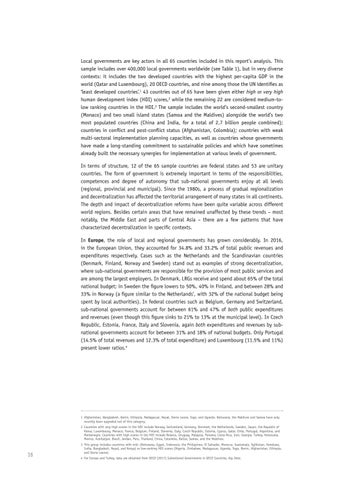
Local governments are key actors in all 65 countries included in this report’s analysis. This sample includes over 400,000 local governments worldwide (see Table 1), but in very diverse contexts: it includes the two developed countries with the highest per-capita GDP in the world (Qatar and Luxembourg), 20 OECD countries, and nine among those the UN identifies as ‘least developed countries’.1 43 countries out of 65 have been given either high or very high human development index (HDI) scores,2 while the remaining 22 are considered medium-tolow ranking countries in the HDI.3 The sample includes the world’s second-smallest country (Monaco) and two small island states (Samoa and the Maldives) alongside the world’s two most populated countries (China and India, for a total of 2.7 billion people combined); countries in conflict and post-conflict status (Afghanistan, Colombia); countries with weak multi-sectoral implementation planning capacities, as well as countries whose governments have made a long-standing commitment to sustainable policies and which have sometimes already built the necessary synergies for implementation at various levels of government. In terms of structure, 12 of the 65 sample countries are federal states and 53 are unitary countries. The form of government is extremely important in terms of the responsibilities, competences and degree of autonomy that sub-national governments enjoy at all levels (regional, provincial and municipal). Since the 1980s, a process of gradual regionalization and decentralization has affected the territorial arrangement of many states in all continents. The depth and impact of decentralization reforms have been quite variable across different world regions. Besides certain areas that have remained unaffected by these trends – most notably, the Middle East and parts of Central Asia – there are a few patterns that have characterized decentralization in specific contexts. In Europe, the role of local and regional governments has grown considerably. In 2016, in the European Union, they accounted for 34.8% and 33.2% of total public revenues and expenditures respectively. Cases such as the Netherlands and the Scandinavian countries (Denmark, Finland, Norway and Sweden) stand out as examples of strong decentralization, where sub-national governments are responsible for the provision of most public services and are among the largest employers. In Denmark, LRGs receive and spend about 65% of the total national budget; in Sweden the figure lowers to 50%, 40% in Finland, and between 28% and 33% in Norway (a figure similar to the Netherlands’, with 32% of the national budget being spent by local authorities). In federal countries such as Belgium, Germany and Switzerland, sub-national governments account for between 61% and 47% of both public expenditures and revenues (even though this figure sinks to 21% to 13% at the municipal level). In Czech Republic, Estonia, France, Italy and Slovenia, again both expenditures and revenues by subnational governments account for between 31% and 18% of national budgets. Only Portugal (14.5% of total revenues and 12.3% of total expenditure) and Luxembourg (11.5% and 11%) present lower ratios.4
1 Afghanistan, Bangladesh, Benin, Ethiopia, Madagascar, Nepal, Sierra Leone, Togo, and Uganda. Botswana, the Maldives and Samoa have only recently been upgraded out of this category. 2 Countries with very high scores in the HDI include Norway, Switzerland, Germany, Denmark, the Netherlands, Sweden, Japan, the Republic of Korea, Luxembourg, Monaco, France, Belgium, Finland, Slovenia, Italy, Czech Republic, Estonia, Cyprus, Qatar, Chile, Portugal, Argentina, and Montenegro. Countries with high scores in the HDI include Belarus, Uruguay, Malaysia, Panama, Costa Rica, Iran, Georgia, Turkey, Venezuela, Mexico, Azerbaijan, Brazil, Jordan, Peru, Thailand, China, Colombia, Belize, Samoa, and the Maldives.
16
3 This group includes countries with mid- (Botswana, Egypt, Indonesia, the Philippines, El Salvador, Morocco, Guatemala, Tajikistan, Honduras, India, Bangladesh, Nepal, and Kenya) or low-ranking HDI scores (Nigeria, Zimbabwe, Madagascar, Uganda, Togo, Benin, Afghanistan, Ethiopia, and Sierra Leone). 4 For Europe and Turkey, data are obtained from OECD (2017) Subnational Governments in OECD Countries, Key Data.
Table 2. A breakdown of responsibilities across sub-national levels of government. REGIONAL LEVEL
INTERMEDIARY LEVEL
Heterogeneous and more or less extensive responsibilities depending on whether it is a federal or unitary country
Specialized and more limited responsibilities of supra-municipal interest
Services of regional interest:
An important role of assistance towards small municipalities
• Secondary/higher education and professional training • Spatial planning • Regional economic development and innovation • Health (secondary care and hospitals) • Social affairs (e.g., employment services training, inclusion, support to special groups, etc.) • Environmental protection • Social housing • Public order and safety (e.g., regional police, civil protection) • Local government supervision (in federal countries)
May exercise responsibilities delegated by regions and central government Responsibilities determined by the functional level and the geographic area: • Secondary or specialized education • Supra-municipal social and youth welfare • Secondary roads and publics transport • Environment
MUNICIPAL LEVEL A wide range of responsibilities: • General clause of competence • Eventually, additional allocations by the law Community services: • Education (nursery schools, preelementary and primary school) • Urban planning and management • Local utility networks (water, sewerage, waste, hygiene, etc.) • Primary and preventive healthcare • Recreation (sport and culture) • Public order and safety (municipal police, fire brigades) • Local economic development, tourism, trade affairs • Environment (green areas) • Social housing • Administrative and permit services
Source: OECD (2016) OECD Regions at a Glance 2016.
In Africa, various waves of decentralization have swept Northern African and Sub-Saharan countries since the 1990s. According to a 2015 study, while there was an overall improvement of policy and enabling environments to include and empower local governments, critical differences between countries persist.5 The ratio of local revenues as part of total public revenues gives a first approximation to the weight of local government’s role in national budgets. It varies from 40% in Nigeria (although only 18.4% for municipalities) to 24.3% in Kenya (where the last round of reforms created counties as the main decentralized tier of government), and to 1% in Togo, where progress on decentralization has been marginal. Countries like Uganda (19.2%) or Morocco (15.1%) have experienced progress in decentralization reform, while in Benin and Zimbabwe local governments still account for a very low percentage of national government budgets (6.7% and 7.8% respectively).6 In Botswana, finally, local authorities receive up to 95% of their revenues from the central government. Diversity is even greater in the Asian context. Decentralization reforms in South-East Asia have brought about major institutional innovations for local policy-making and management. While Indonesia and the Philippines experimented, at the end of last century, a rapid decentralization process – known as the ‘big bang’ –, in Thailand the process developed gradually, at a slower pace, over a couple of decades. Local governments’ revenues amount to 42.6% of total national budget in Indonesia, 22.7% in the Philippines, and 18.7% in Thailand. In India, despite a series
5 UCLGA and Cities Alliance, Assessing Institutional Environment of Local Governments in Africa, http://www.localafrica.org/en/component/k2/ item/633-assessing-the-institutional-environment-of-local-governments-in-africa-2015,-2nd-edition. 6 Source for Africa, Asia and Latin America: OECD and UCLG (2016), Subnational Governments around the World – Structure and Finance. All data from 2013.
17
of constitutional reforms, decentralization is largely concentrated at the state tier (sub-national governments at this level concentrated 64.5% of public revenues). Japan and the Republic of Korea have empowered sub-national governments through processes of administrative reform (local government revenues amount to 49.2% of national budget in Japan and 42.1% in Korea). China is one of the most decentralized countries at the administrative and financial levels: subnational governments manage 85% and 53.3% of public expenditures and revenues, respectively. In Malaysia, a federal state, local revenues are particularly low (just 3.4% of national budget) if compared to other federal countries, mostly due to an inconsistent history of decentralization. Nepal, after the adoption of the new constitution that recognize local governments (September 2015), is carrying out in 2017 the first local governments elections in 19 years. Latin America is now reaping the benefits of a 30-year-long wave of decentralization that has built on the democratization of participatory processes at the local level. Positive spill-overs of this empowerment of citizen participation have slowly and steadily elicited a transfer of both policy competences and financial capabilities from the central to the local level of government. This process, however, varies significantly from one country to another. In federal countries – Argentina, Brazil, and Mexico – sub-national governments account for between 56% and 43% of total national revenues, but only between 22% and 7.5% when only municipalities are taken into consideration. In unitary countries, the ratio between local and national government revenues range from 38% in Colombia to 4%-5% in Central America, where most states are still largely centralized (e.g., in Costa Rica and Guatemala, even though the ratio jumps to 10.2% in El Salvador and 11.8% in Honduras). Other unitary countries in Latin America rank halfway these extremes, e.g., 18.8% in Peru or 14% in Chile, where decentralization in the meantime has steadily slowed down to a halt. In Middle East and West Asia, Turkey’s municipalities have been granted significant competences for public services and local development. Fiscal decentralization, however, is still limited. Municipalities account for 10.7% of total national expenditures and receive 10.8% of total public revenues. In other countries of the region, decentralization processes are either limited or stalled. In Jordan, for example, local governments access 6.1% of total national revenues and account for 5.8% of total public expenditures. Finally, decentralization trends around the world, beyond regional contexts, have certainly strengthened the international profile of local and regional governments, boosting their ability to engage in global networks, pool resources and adopt a shared vision when facing common challenges and looking for common solutions.
Passers-by next to the entry of the HLPF in New York, 2016 (photo: UNDP/Flickr.com)
18
04
Methodology and process of preparation of the report This report is based on first-hand information collected by networks of local and regional governments (LRGs) and the analysis of the Voluntary National Reviews (VNRs) and the VNR summaries (Main Messages) submitted by national governments to the HLPF in both 2016 and 2017.7 The structure of the report translates the VNR guidelines – first issued as an annex to the UN Secretary General’s report on follow-up and review of the SDGs at the global level – into a blueprint for LRGs to use when reporting about the localization of the Goals. The report’s guidelines were accompanied by a questionnaire on the involvement and engagement of LRGs. The questionnaire was circulated through the UCLG network in all regions, and focused specifically on the involvement of LRGs in: a) the drafting of the VNR by the national government; b) enhanced national dialogue, initiatives and programmes on the implementation of the SDGs and the monitoring of this process; and c) in the development of LRG-driven initiatives at the local level, related or aiming to the implementation of the global goals. UCLG has received responses from LRGs and LRG associations from 30 countries worldwide, mostly part of the 65 countries that have reported (or committed to do so) to the HLPF in 2016 and 2017, and has also collected relevant information from international networks (see Table 3 on page 21 below). The aim of this exercise was to provide as large and comprehensive an overview as possible of the involvement of LRGs in the implementation process and, at the same time, verify and complement the information provided by national governments through the data, knowledge and experiences reported directly by sub-national levels. This task was especially useful in those cases in which VNRs mentioned local and regional governments and their participation in the process (see Figure 1), so as to include the perspective of LRGs and assess whether and to what extent the commitment to localize the SDGs and the process of implementation was ultimately fulfilled. Except when clearly stated otherwise, all the information presented in this report is extracted from the VNRs, Main Messages or the LRG reports submitted directly to UCLG. Most questionnaires were answered by officials within local government associations – often from technical departments and/or mobilizing experts (e.g., responses from the South African Local Governments Association, SALGA) – or in consultation with partners such as NGOs (e.g., Argentina and Brazil) or international agencies (e.g., UNDP in Costa Rica). In a few cases in which local government associations were asked by their national governments to present a report as part of the VNR drafting process, the associations have also shared with UCLG these documents or a working summary (e.g., Belgium, Denmark, the Netherlands and Sweden). In other cases (e.g., Ecuador), the associations have also consulted national institutions and agencies that have contributed directly to the national reporting process.
7 This report was finalized on July 6, 2017. To this date, 22 VNRs had been published for the 2016 HLPF, and 28 for the 2017 HLPF, alongside 14 Main Messages summing up the key contents of yet unpublished VNRs. Two countries – Guatemala and Italy – had not submitted any document.
19
05
Policy and enabling environment 5.1 CREATING OWNERSHIP OF THE SDGs The successful implementation of the SDGs will depend on strong mobilization of all stakeholders and the creation of truly shared ownership of the goals. With only a few exceptions, however, SDGs have just begun to make their way into the plans and agendas of local and regional governments around the world. Generally, LRGs and local government networks with a history of commitment to the achievement of the Millennium Development Goals (MDGs), Local Agenda 21 or a positive track record in international cooperation have supported the new global agendas more enthusiastically than those LRGs that had not been active on similar topics in the past. Accordingly, many of the LRGs and LRG associations that have contributed information and data to this report see the SDGs as an opportunity to strengthen local development and sustainability, while also supporting national and international solidarity. Many other LRGs around the world, however, still see the SDGs as something detached from or irrelevant to their agenda. It is necessary, therefore, to deploy a strong awareness-raising effort that may help mobilize LRGs around the SDGs and their targets and, at the same time, make them aware that several goals can already be achieved through the ordinary work that local and regional administrations do in their territories and with their communities on a daily basis.8 Making the SDGs not just a matter for the sustainable development community or for specialized administrations or focal points, but rather a comprehensive quest for all stakeholders and a shared political initiative supported by large socio-political alliances and all types of local actors, is one of the key challenges of this agenda. It is crucial, in this regard, that local governments do not perceive this as a ‘top-down’ external imposition with no adequate resources provided in support, but rather that they foster real ownership of the goals and embody this vision of the future in their actions and initiatives.
5.1.1 Participation of LRGs in the consultation process for the VNR About 38 (58%) of the 63 countries that have reported before July 6, 2017, mention that LRGs were included in the consultation process leading to the published VNR (Figure 1). The degree of participation of LRGs in such processes, however, is extremely diverse. The case of the Netherlands stands out; the national government itself requested that the national association of local and regional government contribute directly to a section on local governments and the SDGs in a report that was presented in May 2017 to the national parliament. National associations of LRGs in Denmark, Norway and Sweden were also asked to submit reports to be included in national reviews. The degree of participation of LRGs in national reviewing processes also has to be assessed in light of the institutional mechanisms available for such dialogue, as well as the ‘quality’ of the interactions actually taking place between different levels of government. In a few countries, LRGs could count on pre-existing mechanisms of cooperation (e.g., Norway), national councils on sustainable development (e.g., Estonia), or newer mechanisms established expressly for the follow-up of SDG implementation (e.g., the inter-ministerial and non-governmental Core Working Group for the SDGs in Nigeria; for more examples, see also Section 5.2.2 below).
20
8 UCLG (2016) The Sustainable Development Goals, What Local Governments Need to Know, the document is available online at this address: https://www.uclg.org/sites/default/files/the_sdgs_what_localgov_need_to_know_0.pdf.
Figure 1. Map of LRG participation in the consultation processes for the VNRs/Main Messages*.
Involvement of LRGs in the VNR/Main Message Full participation of LRGs in the process Participation only at the region/state/county level Partial involvement of LRGs in the process LRGs are just mentioned in the document No mention of LRGs altogether Information not yet available
* Countries in gray have not reported or committed to report in 2016 or 2017.
In many cases, however, it was necessary to adapt or design ad hoc strategies for consultation. Some of these dialogues took place via multiple instruments (e.g., workshops, fora, hearings, interviews, etc.) that often lasted several months (e.g., in Germany and Japan) and were conducted either at the national level or distributed across the country’s different regions or territories (e.g., Argentina, Chile, Indonesia, the Philippines and Togo) with varying degree of participation and engagement. In other cases, consultation was concentrated in fewer events with limited participation (as in France). In many federal countries, cross-level dialogues involved primarily representatives from federated units – such as states or provinces (e.g., Nigeria). Even in unitary countries such as Kenya, it was mostly county governors who were involved the most in the consultations. Some countries operated their consultations only via questionnaires and focused interviews (Costa Rica), while in other countries the process included written reports and an open consultation online (e.g., France), combined with workshops and validation meetings (e.g., Nigeria). In several countries, finally, the consultation process was combined with public awareness-raising campaigns (printed materials, online and social media platforms). In Belgium, for example, eight different organizations (representing, among others, NGOs, the private sector, and local authorities) have been promoting SDGs through the many activities of the SDG Voices campaign.
21
In many other countries, however, local and regional governments have not been fully involved in the consultation and drafting processes. A few national reviews did mention national or regional fora or workshops as participation channels, but several of them targeted civil society in particular (e.g., El Salvador, Jordan, the Republic of Korea and Uruguay) and the participation of local governments remained marginal or limited to a narrow group of municipalities and cities, to the extent that national associations perceived that they had not been adequately included in the consultation (e.g., in Argentina, Chile, El Salvador, Indonesia, and Uruguay). In certain cases, finally, the conditions and requirements to participate – deadlines to submit documents and reports to be included in the review, for example – were so constraining that they curbed the participation of LRGs and their associations (e.g., in Portugal). Consultation processes deemed inadequate, contested or fragmented or with an insufficient representation of local governments are ranked as ‘weak’ (light green in the map). This approach had consequences for the public stance of LRGs and their associations: in France, for example, several associations wrote to the government criticizing the lack of consideration of local governments and their particular experiences and practices in national reviews; in Indonesia and Turkey, associations stated overtly that they had not been involved at all in the process; in the Philippines, local governments received, through the associations gathered within the Union of Local Authorities of the Philippines (ULAP), governmental ‘briefings’, but were not involved in an actual dialogue. In a few other cases, due to either the weakness or the lack of a national association of local governments, it was not possible to verify whether actual cooperation occurred, and to what extent (e.g., Bangladesh). Some countries recognized that the participation of sub-national governments required the creation of adequate participation channels, and that this process was still at a fledgling stage (as in Argentina). Others relied on local governments’ participation at a later stage of the process (e.g., Georgia). Finally, particularly in Eastern Europe and Central and South-East Asia, many countries have neither involved nor mentioned local governments at all (marked in red in the map), and the reviewing process has remained fully centralized. The 19 countries that have not involved LRGs in the consultation but do mention them as part of the overall picture of SDG implementation in their countries, however, have been marked in light yellow in the map.
5.1.2 The role of LRG associations and networks in awareness-raising and ownership The role of LRG associations and networks has so far been decisive to improve outreach to, and the mobilization of, local and regional governments. Within the framework of their activities, congresses and national fora, many associations have organized political debates on the SDGs. In Brazil, for example, 7,000 local elected officials participated in the national congress of the National Confederation of Brazilian Municipalities (CNM). In Germany, the national association has drafted a charter to express the support of local governments to the process of SDG implementation (see Box 1), while one in every five Flemish municipalities has signed the Global Goals, Local Focus declaration, sponsored by the regional association of local governments, VVSG. In the Netherlands, the national association has involved LRGs via a number of dedicated campaigns (e.g., the Municipalities4GlobalGoals campaign, see also
22
Box 2 below).9 The Finnish association organized regional ‘tours’ on the SDGs in collaboration with the 2030 Agenda Coordination Secretariat at the national level. Many other associations have been intensively active in this regard, mapping initiatives by LRGs and fostering exchange (Sweden), promoting workshops (Botswana) and training activities (Togo), and communication on various media, magazines, and web-based portals and resources (e.g., Belgium, Denmark and the city of Seoul, in the Republic of Korea) to further engage their members. Table 3 presents a quick overview of the type of actions that LRGs and their associations and networks have been promoting all around the world.
Charters, declarations and the support of LRGs to the localization of the SDGs
BOX 1
The 2030 Agenda for Sustainable Development, Building Sustainability at the Local Level in Germany The “2030 Agenda for Sustainable Development” declaration, signed by German municipalities, calls on the “federal and state governments to: involve local authorities and their representatives as equals when developing strategies to achieve the SDGs” and “to create frameworks to enable” their participation, including funds to compensate the financial burden faced by local authorities when implementing international obligations. The declaration defines 13 initiatives through which municipalities can make a special contribution to the ‘localization’ of the SDGs in three main areas: 1) information and awareness-raising among citizens; 2) networking and lobbying activities to build broad local alliances of stakeholders; and 3) translating the 2030 Agenda to the local level, linking both existing and new measures and strategies for social, environmental, economic, political and cultural sustainability in all areas of municipal activity (fostering, among other things, a welcoming culture for the reception of migration flows).
BOX 2
The Global Goals Municipal Campaign in the Netherlands A growing number of Dutch municipalities take part in the Municipalities4GlobalGoals campaign. They have raised awareness about the SDGs within their communities, facilitated the participation of local stakeholders, analyzed their own policies and budgets to align them with the SDGs, and exchanged practices with other municipalities – both within and outside of the Netherlands. VNG International, the international cooperation agency of the Association of Dutch Municipalities, has drawn up a ‘Menu of Inspiration’, which provides municipalities with ideas on actions they can take for each of the SDGs. Through a ‘Time Capsule’, which is travelling around the country, mayors and their citizens, schools, municipal councils and other stakeholders can express their wish towards 2030 and engage in an open dialogue about what the municipality needs to do to achieve the SDGs and a sustainable future. The campaign, finally, also carries out negotiation and advocacy actions aimed at national ministries, and works with companies, development and environmental organizations.
9 More information on the campaign is available online at this address: https://vng.nl/onderwerpenindex/internationaal/gemeenten4globalgoals.
23
National associations (such as the SKL in Sweden or Denmark’s KL) are also developing strategic visions and programmes that build extensively on internal initiatives to guarantee awareness and engagement with the SDGs. Others are working to secure funding or embed the SDGs into their strategic outlook for the future (e.g., the UNGL in Costa Rica) or directly into their governance structure: already in 2016, in South Africa, SALGA aligned its internal working groups with each of the SDGs, and the national association of Benin (ANCB) created a special thematic commission on the goals. Many national networks and associations are supporting their members in the integration of the SDGs into local policies, sometimes in partnership with UN agencies (see Section 5.1.3 below). They have done so through training activities (e.g., in Colombia), guidelines and roadmaps (the example of Brazil is relevant, in this regard,10 while at the global level the GTF has disseminated a Roadmap for Localizing the SDGs),11 portals and other resources for knowledge exchange and the delivery of innovative solutions to implementation problems.12 Several associations, for example in Belgium and the Netherlands, have already developed pilot programmes likely to make a contribution to the localization of the SDGs (see Section 5.2 below). In several countries, on the other hand, the mobilization of local governments has been fostered through strategic alliances with other partners. In Germany, the Service Agency Communities in One World (SKEW) has carried out a number of working sessions of localization support (in North-Rhine Westphalia in February 2017), while LAG 21 NRW has been advising 15 German municipalities on local strategies for the implementation of the SDGs. In France, the Agenda 21 association is planning an SDG-themed ‘tour de France’ in partnership with the Association of French Regions from 2017 to 2019. In the Republic of Korea, the Local Sustainability Alliance of Korea (LSAK) has been providing its members – that include a number of different stakeholders – with a platform where also local governments can share knowledge and information and better integrate the SDGs into their policies and programmes. The initiative builds on the successful experience of the Local Councils for Sustainable Development (LCSD), a large network of local governments and civil society organizations established already in 1995. Among the broad spectrum of communication initiatives carried out by local governments to make the SDGs more accessible and comprehensible, many have focused on the involvement and engagement of society and citizens at large. These have included municipal newsletters, activities in schools, libraries and cultural centres, information evenings open to all citizens, even film festivals on the SDGs (as in Iran), or special dedicated publications (e.g., in Belgium and Sweden, see Box 3). UCLG and the Flemish organization of local governments, VVSG, for example, have created a series of animated movies on the SDGs. In Portugal, the Inter-Municipal Network for Cooperation and Development (RICD), with a membership of 20 municipalities, has organized a travelling exposition on the SDGs and their localization that has been roving the country since 2016. The above-mentioned SDG Voices programme in Belgium, for instance, counts on the support of a very diverse consortium of eight partners – ranging from a retail supermarket company to a municipality, to several big and small NGOs – delivering information on the SDGs and their implementation at the local level to their respective audiences.13
10 See also the Guía para Localización de ODS en Municipios Brasileños, available online at this address: http://www.cnm.org.br/cms/biblioteca/ ODS-Objetivos_de_Desenvolvimento_Sustentavel_nos_Municipios_Brasileiros.pdf, and the Guía para la Integración de los Objetivos de Desarrollo Sostenible en Municipios Brasileños, available online at this address: http://www.br.undp.org/content/dam/brazil/docs/ODS/guiaintegracao-ods-2017.pdf. 11 See: GTF, UNDP and UN-Habitat (2016) Roadmap for Localizing the SDGs, available online at this address: http://www.gtf2016.org/singlepost/2016/06/28/Roadmap-for-achieving-the-SDGs-at-local-level.
24
12 See for instance the Localizing the SDGs platform (available online at this address: http://www.localizingthesdgs.org/), jointly developed by UNDP, UN-Habitat and the GTF. 13 See Belgium’s VNR for the 2017 HLPF, page 71.
The Instagram Competition in Ljungby, Sweden
BOX 3
Large signs with the 17 global goals were set up in the Swedish municipality of Ljungby. Residents were invited to take a picture in front of the signs and post it on Instagram with the hashtag #globalamålenljungby. The competition was advertised on social media and in the local and regional press. An award ceremony took place every week for a month: the prizes consisted of fair trade products or cinema and bath entrances. The fair trade rewards were put together in collaboration with Fairtrade City Ljungby. The SDGs lightened up also the traditional candlelit St. Lucy’s Procession on December 12. Politicians, executives and civil servants from the Ljungby municipality gathered in a forest, each person impersonating a Goal based on their work specialization. Each representative read a rhyme about his goal. The procession proceeded to visit several public places around the cities, which had been decorated with fact cards about the Goals. Source: report from the Association of Swedish Municipalities (SKL)
Local governments also participate in various platforms and initiatives in collaboration with civil society organizations, the private sector, professional organizations, and many other stakeholders. The Belgian SDG Charter was signed, among many other stakeholders and governmental bodies, also by 73 municipalities. The Netherlands SDG Charter has 110 signatories, including large private companies, civil society organizations and the association of local governments, promoting cross-sector partnerships. Finland’s Civil Society Commitment: The Finland We Want 2050 is a multi-stakeholder platform for the 2030 Agenda supported by the Finnish government. Its partners include over 400 institutions between CSOs, local governments, companies and business organizations, trade unions, academia and several high-level personalities. In Italy, the national association of municipalities (ANCI) has participated in and supported a bottom-up process of evaluation and monitoring of the SDGs: this process was led by the Italian Alliance for Sustainable Development (ASviS), a consortium of over 160 partners, including civil society organizations, foundations, academia, trade unions, associations of gender, ethnic and religious minorities, governmental agencies, and international cooperation bodies. In several countries, LRGs have been proactive drivers of the localization process while their national governments are still defining their overall strategy (e.g., Catalonia, the Valencian Community and the Basque Country in Spain) or – perhaps more importantly – even when their national government is actually withdrawing from international agreements and commitments, as it is the case with the 323 mayors in the United States that have already pledged to uphold the Paris Agreement and the country’s greenhouse gas commitments, under the mantle of the Mayors’ National Climate Action Agenda.14
14 See for more information: https://medium.com/@ClimateMayors/climate-mayors-commit-to-adopt-honor-and-uphold-paris-climate-agreement-goalsba566e260097.
25
Many metropolitan areas and regions are also moving faster than other urban communities. Durban, Jakarta, Quito, Madrid, Rio de Janeiro and Seoul, for instance, are all looking to align their strategic plans with the SDGs. At the territorial level, 31 provinces in China, provinces in the Republic of Korea or the Riau province in Indonesia, several provinces and states in Argentina, Brazil, India, and Mexico, regions in France, 11 Länder in Germany, several counties in Kenya are all taking initiatives to integrate the SDGs in their local strategies. Networks of regions such as Nrg4SD and ORU-Fogar stand out for their initiatives and advocacy on biodiversity preservation, climate action and sustainable development.15 Many cities, moreover, have been significantly involved in international networks that support initiatives in specific areas (such as C40 on climate change,16 or ICLEI on sustainability).17 Others are supporting pilot localization initiatives: the Commonwealth Local Government Forum (CLGF) is doing so in Rwanda. Other cities are promoting training activities and outreach – the Union of Ibero-American Capital Cities (UCCI), for example, or the International Association of French-Speaking Mayors (AIMF). Worldwide, 7,000 cities and 280 regions and provinces have signed the Covenant of Mayors for Climate and Energy, which promotes decarbonized and resilient cities and sustainable and affordable energy.18 Global networks of local and regional governments, such as UCLG and its regional sections (UCLG Africa, UCLG ASPAC, CEMR-CCRE, UCLG Eurasia, FLACMA, and UCLG-MEWA), as well as Metropolis, the global network of metropolitan cities, have also increasingly put the ‘localization agenda’ at the centre of their strategies, promoting the Local Action 2030 campaign (and the #Local4Action hashtag on social media), developing the global web platform ‘Localizing the SDGs’19 together with UNDP and UN-Habitat, and designing a training module on the global goals. On the other hand, several national associations are still inadequately informed or mobilized about the global agendas and the relevance of their impact on the local level. As a consequence, these networks have generally been unable to raise awareness and stimulate the participation of local governments in the process of SDG localization.
15 Nrg4SD has over 50 members from the regional level, and has developed a Roadmap on the Regional Implementation of the 2030 Agenda. International advocacy, decentralized cooperation and peer networks have been an extremely valuable resource for regional governments. In collaboration with ORU-Fogar, Nrg4SD has recently published a report on SDGs at the Subnational Level: Regional Governments in the Voluntary National Reviews, available online at this address: http://www.nrg4sd.org/sdgs-subnational-level-regional-governments-voluntary-nationalreviews/. 16 C40 network, for instance, gathers today – under the leadership of large world-level metropolises – over 90 cities facilitating dialogue, exchange of knowledge and information, and advocacy on core issues of environmental sustainability and urban resilience. Since 2011, C40 cities have undertaken or planned over 9,800 actions, 30% of which are based on city-to-city cooperation. 17 ICLEI – Local Governments for Sustainability is a global network of over 1,000 local governments, specializing in advocacy and knowledge exchange on sustainability, procurement, and climate change action. ICLEI has sponsored the creation of the Carbonn Climate Registry, a reporting platform for cities, towns and regions to enhance transparency, accountability and reliable data collection on emissions, climate action and environmental protection: the programme currently involves 943 entities from 82 countries, representing 725 million inhabitants and showcasing about 6,300 mitigation and adaptation actions.
26
18 The Covenant of Mayors for Climate and Energy is the result of the unification of two pre-existing networks: the Covenant of Mayors, a European network of cities supported by the European Commission, and the Compact of Mayors, created by Bloomberg, C40, ICLEI and UCLG. The Covenant supports today over 5,100 action plans to reduce CO2 emissions by 28% by 2020 and about 40% by 2030, thus linking its action to the achievement of Goals 7, 11 and 13. 19 The platform is accessible online at this address: http://www.localizingthesdgs.org.
•
•
•
•
•
•
•
•
Chile
AChM
•
South Africa
SALGA
•
•
•
•
•
Colombia
FCM ACCC FND With support of the DNP
•
•
•
•
•
Costa Rica
UNGL
•
Ecuador
AME CONGOPE
•
El Salvador
COMURES
•
Mexico
CONAMM CONAGO
•
•
Congreso de Intendentes
•
•
FLACMA Mercociudades
•
•
Union of Municipalities of Turkey
•
•
UCLG MEWA
•
•
•
ANCB
Botswana
BALA
•
•
Council of Governors
•
•
•
•
SALGA
•
•
•
UCT
•
•
UCLG Africa
•
•
South Africa Togo Regional Level
Nepal* Philippines Republic of Korea Regional Level
ADEKSI ADKASI APEKSI APPSI APKASI
•
•
• •
ADDCN MuAN
forthcoming
• •
forthcoming
ULAP LCP LMP LPP
•
•
GAOK Seoul City
•
•
•
•
UCLG ASPAC
•
•
•
•
UCLG EURASIA
•
•
• •
•
Turkey
Belgium
AVBC VVSG UVCW
•
•
Denmark
Danske Regioner KL
•
•
France
Régions de France AFCCRE CUF Committee 21
•
•
Germany
DST DLT DStGB
•
Italy
ANCI** AICCRE
Portugal Sweden Regional Level
•
•
•
in progress
in progress
•
•
•
MEWA
EUROPE
Netherlands
Uruguay Regional Level
EURASIA Regional Level
Argentina
•
ASIA-PACIFIC
Indonesia
NATIONAL GOV’T INITIATIVES
Brazil
LATIN AMERICA
Benin
Kenya
SPECIAL INITIATIVES OR PROJECTS
PUBLICATIONS (BULLETINS, BROCHURES)
•
COUNTRY
TRAINING, KNOWLEDGESHARING PROGRAMMES
DECLARATIONS, FORA, DEBATES
•
AFRICA
CAMPAIGNING
REPORTING INSTITUTIONS FAM ABM ABEMA CNM FNP
NATIONAL GOV’T INITIATIVES
SPECIAL INITIATIVES OR PROJECTS
TRAINING, KNOWLEDGESHARING PROGRAMMES
CAMPAIGNING
PUBLICATIONS (BULLETINS, BROCHURES)
DECLARATIONS, FORA, DEBATES
COUNTRY
REPORTING INSTITUTIONS
Table 3. Local government initiatives in the framework of the ‘localization of the SDGs’.
•
•
•
•
•
•
Regional Level
•
•
GLOBAL TASK FORCE OF LOCAL AND REGIONAL GOVERNMENTS
•
•
forthcoming
•
•
VNG IPO UvW
•
•
•
ANMP RICD***
•
•
•
SKL
•
•
•
CEMR/ PLATFORMA
•
•
•
•
•
•
•
•
•
•
•
AIMF
•
•
C40
•
•
•
•
•
CLGF
•
•
•
•
•
ICLEI
•
•
•
•
•
Nrg4SD
•
•
•
•
•
UCCI
•
•
UCLG
•
•
•
• •
•
•
•
* Nepal has organized its first elections in 19 years in all local government units in May and June 2017. ADCCN will be providing technical capacitation o newly-elected officials and staff, both on the SDGs and on other relevant global processes. ** ANCI collaborates with ASviS (Alliance for Sustainable Development), which includes stakeholders, CSOs and LRGs. *** For Portugal, Rede intermunicipal de Cooperaçao para el Desenvolvimento. Source: Reports from local governments’ associations. Only countries reporting to the HLPF in 2016 and 2017 have been included in the elaboration of the Table.
27
5.1.3 The role of national governments and international partners in the mobilization of LRGs In many countries in the sample, political initiative by national governments is still essential. Wherever this impulse transforms into a nation-wide commitment and political will to include all stakeholders and governance levels, the localization process has been significantly easier. For example, in those cases in which the national government has actively promoted outreach and campaigning aimed at local governments (e.g., Finland’s ‘regional tours’ on the SDGs, coorganized with cities and regions), supported the adoption of covenants or agreements for implementation (e.g., the National Pact the on the achievement of the SDGs adopted in Costa Rica on 9 September 2016, or the agreements at the provincial level in Argentina), organized workshops aimed specifically at local governments (e.g., in Togo), fostered policy alignment between the SDGs and local development plans (e.g., in Colombia and South Africa), or ensured the proactive involvement of LRG associations in monitoring and follow-up processes (e.g., in Belgium, Denmark and Sweden, as mentioned above), participation of LRGs and local stakeholders has been notably higher. Especially in countries with a more centralized system of government, action by national government is usually the main driver of LRG participation. In Jordan, the government presented a roadmap to foster ownership of the SDGs at the sub-national level (i.e., governorates and municipalities). In Madagascar, the government supported an awarenessraising campaign through the media – Madagate – aimed specifically at the local level. On the other hand, in many countries several UN agencies have also played a very important role to support the participation of local and regional governments. UNDP, in particular, is working with national LRG associations in various countries in Africa, Asia and Latin America, supporting awareness-raising efforts via fora and workshops (e.g., Ethiopia and Uganda), dedicated programmes and training (e.g., Bangladesh, Costa Rica, and Honduras) or assisting regions and municipalities in the elaboration of their local plans and making them compatible with the SDGs (in Brazil, Ecuador or Mexico, for example, in the states of Chiapas and Jalisco). The UNDP-ART initiative and UN-Habitat, which in partnership with the Global Taskforce have co-led the UN dialogues on the localization of the SDGs worldwide, have also contributed to the dissemination of the localization approach in various regions. As a consequence of these efforts, several bilateral cooperation schemes and multilateral development banks are now considering the localization approach as a key strategic tool to convert their global agendas into sub-national initiatives and actions, thus improving policy coordination by adopting multi-level coordination and governance systems.20 It is worth noting that, in many countries of this sample, political pressures or electoral agendas have somewhat delayed the process of integration of the SDGs into local political agendas (in France, Portugal or Nepal, for example). On the other hand, in other countries political change within the institutions has actually been an opportunity to promote the alignment of policy with the SDGs in new governmental plans and strategy – e.g., in Brazil and Colombia. As this section has shown, global outreach awareness-raising efforts are still quite limited. Among the 65 reporting countries, SDG awareness among local and regional governments is high and consistent in Europe (and, in particular, in Northern Europe and Germany) and Latin America (Brazil and Colombia stand out in this regard). Strong awareness is limited to only a
28
20 Asian Development Bank, ‘Localizing Global Agendas in Multilevel Governance Systems’, The Governance Brief, Issue 30, 2017.
Street view of downtown Medellín (photo: Iván Erre Jota/Flickr.com)
few countries in Africa (Benin, Kenya, and Togo) and Asia (Indonesia and Korea). Ultimately, despite some positive results, even the more optimistic data on SDG ownership, awareness at the local level, and alignment with national and local plans, should be read with caution.
5.2 INCORPORATION OF THE SDGS IN NATIONAL AND LOCAL POLICIES AND STRATEGIES In their efforts to support the implementation of the SDGs, many countries are making significant progress in revising their strategic priorities, adapting them to the SDGs, and mainstreaming the goals into their national plans and institutional frameworks. One weakness of the otherwise successful Millennium Development Goals, in fact, was a systematic lack of alignment between the agenda and national development plans. Many countries are specifically working to avoid this pitfall in their work to implement the 2030 Agenda and the SDGs. The ways they have approached this issue have been very diverse. The VNRs provide, to a certain extent, a measurement – weighed by contexts and their different institutional realities – of the responsibilities and tasks that LRGs are expected to undertake for the implementation of the SDGs. Certain countries consider LRGs as key policy actors given their enhanced responsibilities and their proximity to the territory and their communities (e.g., Sweden and Nigeria). Others (e.g., Ethiopia) treat local government’s level as mere ‘implementation agents’. In many countries, finally, where administrative structures are traditionally more centralized, local and regional governments are hardly mentioned in the process. Several countries have revised their existing national sustainable development strategies, putting increased emphasis on social and economic dimensions of plans that had previously had an environmental focus.21 Other countries have developed brand new action plans aiming at the implementation of the 2030 Agenda,22 or integrated specific SDGs into their policies and strategies.23 Most countries, and several less developed countries in particular, have been adapting their development plans and strategic visions to the SDGs.24
21 This group of countries could include Estonia, Finland, Germany, Montenegro, the Republic of Korea and Switzerland. 22 See for instance the examples of China and Norway. 23 In the Netherlands, for example. 24 This larger group of countries includes Bangladesh, Belarus, Belize, Botswana, Costa Rica, Czech Republic, Ethiopia, Indonesia, Kenya, Mexico, Panama, Peru, the Philippines, Tajikistan, Uganda and Zimbabwe.
29
Introducing the goals into national plans, however, will not be enough to achieve the goals of the 2030 Agenda: the Agenda must also be fully integrated into local and regional development plans as well. Many VNRs and Main Messages do acknowledge that the local level must be involved in the planning and implementation processes at all stages. 20 countries, for instance, call for the ‘localization’ of the SDGs – or equivalent approaches – as a way to involve sub-national governments in the ‘alignment’ process.25 Other 15 countries that invoke decentralization as a condition to support implementation at the sub-national level could also be added to this group,26 as well as those countries that have a long-standing tradition of multi-level dialogue, or those countries that refer more generally to a need for vertical coherence in their planning process.27 As a general rule, planning and alignment methods have been extremely diverse according to the level of decentralization and the institutional culture and tradition in each country. This has led to a mixed sample in which certain local governments are given a certain degree of autonomy according to the principle of subsidiarity, while others rather ‘receive’ more top-down policies designed at the central level. The case of Colombia stands out for its efforts to align its current national development plan (for the 2014-2018 period) with the SDGs by involving local and intermediate governments directly in the process. Taking advantage of municipal and departmental elections, the national government encouraged the newly elected local authorities to adopt, during their mandates, local development plans based on the integration of the SDGs. Local governments identified priority goals for each of their territories, fostering local mobilization and participation. As a result, in 32 departments and 31 departmental capital cities local development plans included 33 and 34 SDG targets respectively out of 110 ‘localizable’ targets in total. Specifically, 67% of the objectives identified by the local development plan of the city of Bogotá and 73% of the objectives of Medellin’s plan were aligned with the SDGs.28 Several other national governments have advanced, with other methods, in the attempt to align local development plans with the SDGs. In China, for example, 31 between provinces, autonomous regions and municipalities are elaborating their own five-year plans in accordance with the blueprint of the Chinese government’s 13th Five-Year Plan – which China’s VNR mentions as already aligned with the 2030 Agenda.29 Other cities and counties have drafted local roadmaps and annual plans following the same principles. In Egypt, with an ever more ‘top-down’ approach, it is the central government itself that – through the General Organization of Physical Planning – draws up General Strategic Plans for governorates and cities to pilot SDG implementation policies and initiatives (in Qena, for instance). Bottom-up approaches, conversely, have let local governments walk a long way on the road towards the integration of the SDGs in their plans and policies. Although at different speeds, LRGs in all regions have improved their position in this regard.
25 Localization or analogous concepts are mentioned as key challenges for implementation in the reviews of Argentina, Bangladesh, Brazil, Chile, Colombia, Egypt, Iran, Jordan, Kenya, Malaysia, Mexico, the Philippines, Samoa, Sierra Leone, Tajikistan and Uganda. Turkey mentions the need to “integrate the SDGs at all levels”, also through regional plans. The Czech Republic, finally, suggests to “mainstream the SDGs into regional and local policies”. Nepal and Nigeria also recommends to “mainstream SDGs into provincial and local level planning”. 26 Benin, Ethiopia, Germany, Honduras, India, Indonesia, Madagascar, Panama, Peru, Portugal, Switzerland, Togo, Uganda, and Uruguay. Morocco refers to ‘regionalization’. 27 Most European countries – and in particular Northern European ones – have a longer tradition of dialogue and concertation across different levels of governance. Other countries, outside of the list of note 24, that refer to stronger coordination include Azerbaijan and China. 28 Most mentions referred to the objectives of sustainable ‘green’ growth (Goals 7, 13, 14 and 15), the reduction of inequalities (Goal 10), health and well-being (Goal 3), peace (Goal 16) and gender equality (Goal 5). References were also made to innovation and competitiveness (Goal 9), water management and sanitation (Goal 6), employment and decent work (Goal 8) and housing policies (Goal 11). All the information was provided by Colombia’s National Department of Planning (DNP). A presentation (in Spanish) on this subject, Incorporación de los ODS en los Planes de Desarrollo de Departamentos y Ciudades Capitales, 2016-2019, is available online at this address: https:// colaboracion.dnp.gov.co/CDT/Sinergia/Documentos/ODS_en_los_PDT.PDF.
30
29 National Plan on Implementation of the 2030 Agenda for Sustainable Development, page 12. The document, published in September 2016, can be accessed online at this address: http://www.fmprc.gov.cn/mfa_eng/zxxx_662805/W020161014332600482185.pdf
Figure 2. Progress of SDG localization in China (2016).
Source: Yuning Gao, Tsinghua University (presented at the Workshop of the Asian Development Bank on Localizing Global Agenda, Manila, 27-29 September 2016)
In Europe, several Belgian municipalities – such as Bornem, Gent, Ternat, Heist-op-den-Berg – have already reviewed their multi-annual plans for consistency with the SDGs. The Flemish and Walloon regional governments have already updated their plans to align them with the SDGs. The Flemish association of municipalities, moreover, in collaboration with the regional administration, is supporting 20 municipalities for pilot tests on the integration of the SDGs into their local financial and strategic plans. In Germany, 11 Länder out of 16 have already developed their own regional strategies or are in the process of doing so.30 German cities are moving in the same direction: Bremen, Hannover and Ludwigsburg, for example, have initiated a process to localize the SDGs in their communities (see Box 4, with more examples from other European countries). In Sweden, the national association of municipalities submitted for consideration in the country’s VNR 40 examples to show to what extent local and regional governments had integrated the SDGs in their strategies, multiannual plans and daily initiatives in different areas (as well as in the activities of the public companies they owned) – in particular in the fields of health, education, accessibility, energy, social policies, and environmental protection (see Box 4).31
30 Some Länder have identified the SDGs as programmatic priorities (e.g., Rhineland-Palatinate, North Rhine-Westphalia); others have been working on new strategies to include the Goals (e.g., Berlin, Saarland); and others are integrating the Goals in their existing plans and programmes. 31 The report by SKL, the Swedish national association of municipalities, mentions the examples of Ale, Alingsås, Älvsbyn, Åtvidaberg, Botkyrka, Danderyd, Gislaved, Härryda, Hässleholm, Heby, Helsingborg, Huddinge, Karlskrona, Kungsbacka, Lerum, Ljungby, Luleå, Lund, Malmö, Nyköping, Nynäshamn, Örnsköldsvik, Östersund, Sävsjö, Sigtuna, Sollentuna, Sörmland, Stockholm, Strängnäs, Trollhättan, Trelleborg, Tyresö, Upplands Väsby Uppsala, Värnamo, and Växjö. The regions cited for their involvement are Gotland, Kalmar County, Örebro County, and Sörmland.
31
Localizing the SDGs at city level: a few European examples
BOX 4
Hannover (Germany) In March 2016, the City Council committed to implement the 2030 Agenda at the local level and, in June 2016, adopted the “My Hannover 2030” strategy. 12 goals, 41 sub-goals and a total of 85 related sustainable development indicators are being used to draft the “1st Sustainability Report”, which will be presented by the end of 2017. More information is available online at this address: http://www.hannovernachhaltigkeit.de. Malmö (Sweden) In September 2015, Malmö signed a declaration to support the 2030 Agenda. By spring of 2016. the city had already linked its own local goals to the SDGs and introduced them into the city budget in 2017 as part of its regular activities. Malmö committed to reduce economic and social inequalities, increase gender equality, foster urban planning measures that give fair access to housing, seek sustainable energy solutions and mitigate climate change effects. More innovative projects are being implementing in socially-deprived areas (e.g., South Sofielund). The city, moreover, has integrated the SDGs in its international cooperation frameworks, in special partnership with local governments in Africa and China. Saint-Fons (France) With the support of an NGO and the technical assistance of the Lyon Urban Planning Agency, the municipality of Saint-Fons (17,000 inhabitants within Lyon’s metropolitan area) has tested a “new approach” using the SDGs as the framework to assess its own development plans. The municipality faces core vulnerabilities due to precarious and energy-poor households, marginalized in unattractive or risk-prone areas with high unemployment rates and inadequate transit and services, yet embedded in an attractive, competitive and innovative metropolitan area such as Lyon. According to a first assessment, 72% of planned local goals and actions were aligned with SDGs. The municipality hopes that the updated strategic vision towards 2030 and the improved alignment of its measures with the SDGs may lead to the creation of local identity, core values and a more coherent linkage with metropolitan policies. Utrecht (the Netherlands) The City of Utrecht has a long-standing tradition when it comes to sustainability: it was declared the first Dutch ‘human rights city’ in 2012, it ranks high in the National Monitor of Sustainable Cities and already has sustainable procurement policies in effect. Once the city explicitly embraced the SDGs as a framework for sustainability policy in the area, a myriad of local stakeholders, companies and societal actors and organizations followed its lead. Utrecht, moreover, has already set ambitious new targets: in 2018, it aims to have the Netherlands’ lowest unemployment rate; it wants to expand the number of solar panels from 4,000 in 2015 to 15,000 in 2020; and it wants 75% of its citizens to be familiar with the SDGs by 2030. The city, finally, has also developed local indicators and baselines
As mentioned above, the three Dutch associations of decentralized authorities (municipal, provincial and water boards) wrote a chapter in the report that the Dutch government presented to the Parliament in May 2017. Their chapter reviews the main tasks, roles and mandates of the three authorities in relation to the SDGs. Their mandate covers the social dimension (reducing poverty, inclusive education, healthy lives, and social inclusion), the economic dimension (sustainable production and consumption, work opportunities), physical
32
and natural environment (energy transition, climate adaptation, sustainable water and urban management, natural conservation), and governance and partnerships (demands to the public sector, citizen participation, and international cooperation). The report shows that, besides those municipalities that have explicitly embraced the SDGs,32 there are many more that have developed activities and pilots related to sustainable development, regional cooperation and direct democracy. The recently issued ‘joint investment agenda’ of the municipalities, provinces and water authorities is an example of intensive administrative collaboration.33 Together, the three levels spend EUR 28 billion per year in investments. They have committed to opt, wherever possible, for energy neutral, climate-proof and circular economy solutions. The chapter emphasizes that progress in all pillars requires a conducive legal, policy and fiscal environment at both the national and the EU level. Local governments, moreover, will have to make greater efforts to ensure policy coherence and progress in sensitive areas such as gender equality and the conservation of biodiversity. Many other cities and regions all over Europe (in the Czech Republic, Denmark, Estonia, France, Italy, Luxembourg, Montenegro, Norway, Portugal and Switzerland) that had successfully developed local Agenda 21 schemes or local sustainable policies are now transitioning towards the adoption of the SDG framework. In the North Denmark region, Copenhagen, Gladsaxe and Sondeborg adopted the so-called ‘4-17-42’ approach: a scheme based on the 4 pillars of environment, economy, society and culture, coupled with the 17 SDGs and 42 key actions. In France, the department of Gironde and several municipalities stand out for their efforts in the integration of the SDGs in local initiatives (see the example of Saint-Fons in Box 4), while many more French municipalities (with Paris among them) are currently promoting sustainability and climate change mitigation agendas. In Portugal, the cities of Cascais and Funchal – among the first to embrace the SDGs as a policy framework – are now building a platform to map all SDG-related initiatives in the country. Many more, all over Europe, have been involved in various sustainability actions, from fair trade to energy transition, from the reduction of social inequalities to smart cities, resilience and climate change mitigation agendas.
Bikes In Utrecht, the Netherlands (photo: Alex Proimos/Flickr.com)
32 The following cities in Netherland have expressed explicit committment with the SDGs: Utrecht, Oss, Langedijk, Tilburg, Terneuzen, Leerdam, Sittard-Geleen, Eindhoven, Helmond and Rijswijk 33 The document can be accessed online at this address: https://www.uvw.nl/wp-content/uploads/2017/03/Investeringsagenda-voorKabinetsformatie-2017-Naar-een-duurzaam-Nederland-2017.pdf.
33
In Latin America, besides the experience of Colombia, Brazilian local and regional governments have been among the most active. As mentioned above, the national associations of municipalities provided newly-elected local authorities with a Guide for the Incorporation of SDGs into Municipal Multi-Year Plans. Cities like Rio de Janeiro or Barcarena (in the state of Pará) and federal states like the Federal District, Ceará, Paraíba, Paraná, Piauí, São Paulo and Bahia have either integrated the SDGs in their plans, or have committed to. A similar trend can be observed in Mexico, with several states – Nuevo León, Colima, Hidalgo, Zacatecas and Jalisco (which is also working on local indicators) – and cities (e.g., Guadalajara) leading the process of alignment with the SDGs. In Argentina, several provinces – Jujuy, La Rioja, Mendoza, Neuquén, Salta, San Juan, Tierra del Fuego y Tucumán – as well as the city of Buenos Aires have already signed agreements with the national government for the localization of the SDGs. A few pilot projects, moreover, have been initiated by a few municipalities, including the city of Vicente López, in the conglomeration of Buenos Aires. In Costa Rica, the national local government association is training municipal planners on SDG implementation, while the national government has been sponsoring projects on waste and water management, climate change mitigation and risk prevention, biodiversity conservation and coastal protection, integrating them in the SDG framework. In Honduras, the capital city has developed a strategy to link local policies to the SDGs, and various regions and municipalities are training to be able to do so in the near future. In Africa, the local governments and, in particular, the metropolitan municipalities of South Africa – a country that has not committed to report yet – have already been aligning their local plans with the general national development plan, which was conceived consistently with the requirements of the SDGs. eThekwini-Durban has aligned with the 2030 Agenda its own long-term strategy (‘Imagine Durban’), its five-year Integrated Development Plan, and their respective budgets. In Benin, LRGs are revising the current third generation of local plans in order to make the SDGs a condition to access national funding for municipalities (the Fonds d’appui au développement des Communes). In Botswana, the national association of local authorities (BALA) remarks that the recently-developed National Framework for Local Economic Development defines actions in support of the SDGs, and that since April 2017 it has been deployed in four pilot districts and will be soon rolled out to the rest of the country. In Kenya, the Council of Governors is promoting the review of the County Integrated Development Plans (CIDPs) and is already mobilizing all counties to take the SDGs and the Africa Agenda 2063 into consideration when re-negotiating the Plans’ next iteration for 2018-2022. On the other hand, many projects devised by Moroccan municipalities, even if resonating considerably with the SDGs, have not been developed within their framework. In Nigeria, even though the State Development Plans of many states – Benue, Taraba, Yobe, Kaduna, Ebonyi, Kano, Jigawa, Anambra, and Delta, for example – mention the SDGs, few are already overtly aligned with the Goals. The central government clearly affirms that local governments are “pivotal to the achievement of the SDGs because it is the only tier of government that can feasibly understand, monitor and react to the millions of activities that will collectively add up to the SDGs”.34 The government of Sierra Leone involved 19 local councils to integrate the SDGs into their district-level and municipal development plans. In Togo, local governments are being involved in the definition of the national development plan, as well as of different programmes that – once linked to the MDGs – are now being adapted to the SDGs – even though delayed decentralization reforms (for example, as regards the organization of municipal elections) can hamper the alignment process. In Uganda, finally, the government has disseminated development-planning guidelines for local governments; it has supported planners’ fora and networks; and it is now overseeing the integration of the SDGs in local plans and budgets, as a trickle-down strategy to align them with the National Development Plan II.
34
34 See also: Presidency of Nigeria, Nigeria’s Road to the SDGs – Country Transition Strategy, October 2015, page 9. The document is available online at this address: http://www.ng.undp.org/content/dam/nigeria/docs/IclusiveGrwth/Nigeria%20transition%20strategy%20to%20SDGs.pdf
Localizing the SDGs at city level: examples from Asia
BOX 5
Seoul, “The World-Leading Sustainable City” (Republic of Korea) The Seoul City Sustainable Development Vision consists of 12 strategies, 28 tasks, and 30 indicators, organized in three large core objectives: Environment (resilience and a liveable environment); Society and Culture (social equality and cultural vitality); and Economy: (creative economy and job creation). This process was initiated in 2014, with the launch of the Sustainable Development Commission, the development of the ‘Seoul Metropolitan City’s Basic Plan for Sustainable Development’, and the adoption of the Seoul Metropolitan Government’s ‘Ordinance on Sustainable Development and Seoul SDGs’. The key initiatives undertaken so far include: economic democratization, youth employment policies (e.g., the creation of the Seoul innovation park), the Sharing City Seoul initiative, reform of welfare administration, the creation of the Seoul Village Community, energy saving and recycling (with the ‘one less nuclear power plant’ initiative), the bike-sharing service Seoul Bike Trareung-I for enhanced transit safety and environmental protection, women safety policies, and the diffusion of open public data, as well as a new public participatory budget system. Source: Seoul Metropolitan Government, Collection of Sustainable Development Cases, Potential Power that Opens a Bright Future, December 2016.
The Riau Province (Indonesia) Riau, on the Sumatera Island, was the first province of Indonesia to work proactively on SDG localization. The local government, in partnership with UNDP and the Tanoto Foundation, established in December 2016 a provincial Steering Committee (including public officials, CSOs, philanthropies, private sector and academia) and an SDG Secretariat within the Provincial Development Planning Agency (BAPPEDA). The process had started in May 2016. Nationally, moreover, each of the 34 Indonesian Provinces will need to develop a Medium-Term Development Plan (RPJMD) and adjust it to the relevant SDGs while also defining effective indicators. The provinces have also inaugurated a series of workshops, involving local philanthropies, private sector and associations, academia, CSOs and the media. The plans of the Riau province emphasize, in particular, the need for action on poverty (Goal 1), education (Goal 4) and the environment (Goals 13, 14 and 15). The Riau Province is also working on a Provincial Action Plan (Rencana Aksi Daerah). After the successful implementation on three pilot districts, the process of implementation will be further expanded to other districts in Riau, starting in December 2017. Source: Antarariau, Riau Dinilai Sebagai Daerah Percontohan Program SDGs; Tanoto Foundation, UNDP dan Tanoto Foundation mendukung SDGs di provinsi Riau, Indonesia; Senuju, Meranti Jadi ‘Pilot Project’ SDGs Provinsi Riau; and the Government of Riau, Sejarah Terbentuknya Provinsi Riau.
Cauayan City (the Philippines) Cauayan City took the lead of the SDG implementation process at the local level. In his 2017 State of the City Address, the mayor presented several actions related to all the 17 Goals. To eradicate poverty, for instance, the city is providing basic services addressing all sectors of society, making sure that ‘no one is left behind’. For Goal 2 on ‘zero hunger’, they ran supplementary feeding programmes all over the barangays and in schools, and established a local Food Bank. Malnutrition decreased to as low as 1.2%. On health, in collaboration with several NGOs, the City initiated new programmes and managed to successfully reduce maternal and neonatal deaths. The city government supported the so-called ‘18-day Campaign’ to fight violence against women. On access to and management of water, the City promoted the construction of a deep-well water system, distributed sanitary toilets to the barangays, installed 30 units of solar street lighting along the main highway, and promoted major ICT infrastructure in the attempt to transform Cauayan into a ‘smart city’. Source: State of the City Address 2017: Localizing the Sustainable Development Goals; Leonardo Perante II, Cauayan City adopts sustainable development goals; and web resources of the city government of Cauayan City.
35
Alongside the example of China (see above), in Asia local governments are being mobilized in particular in Indonesia, the Philippines, and the Republic of Korea. Overall, for the Asian continent, the information made available by states and associations is still very limited. LRGs in the Republic of Korea – for example, Seoul, Gwangju, Jeonju, Cheongju, Suwon, and the Bupyeong District (Incheon) – have established voluntary implementation strategies at the local level (see Box 5).35 In Indonesia, several districts and municipalities have already shown their commitment to the implementation of the SDGs36 – the Pangkep District, for instance, which is designing an SDGs Regional Action Plan focused on poverty, education, health, and the conservation of marine ecosystems. The city of Jakarta is preparing a roadmap for the localization of the SDGs, whose indicators will be included in the city’s Medium-Term Development Plan 2018-2023. The Province of Riau has initiated a pilot project (see Box 5) on the localization of the Goals. In the Philippines, the National Economic and Development Authority (NEDA) and its regional offices have committed to empower local governments – through capacitating, the provision of dedicated resources, and the establishment of effective institutions – to incorporate the SDGs in local plans and policies. There are more valuable examples coming from countries in this region. In Bangladesh, for instance, most efforts are still concentrated on awareness-raising initiatives.37 In India, several states have initiated a process of alignment with the SDGs and begun developing roadmaps for the implementation.38 The State of Assam has been the first federated unit to produce a roadmap and begin experimenting with pilot projects in several villages. In Nepal, local elections have taken place in May and June 2017. These dynamics, combined with an overall weakness of sub-national governments, have delayed and hindered any plans on SDG localization. Budget allocations to local governments, however, do take the SDGs into consideration, with 65% of the resources being destined to the achievement of Goals 7, 9 and 11.
Market scene in Seoul (photo: Marcelo Druck/ Flickr.com)
35 See for reference: Government of the Republic of Korea, Year One of Implementing the SDGs in the Republic of Korea: From a Model of Development Success to a Vision for Sustainable Development, page 7. About 100 local governments (out of 243) have established Local Councils for Sustainable Development (LCSD) and could play a major role in the implementation the SDGs. The LCSD were created as follow-up of the Earth Summit over the last 20 years. They are based on a public sector-civil society institutional partnership. 36 The Pangkep District in the South Sulawesi Province, the Bojonegoro District in East Java, the Kubu Raya District in West Kalimantan, the Gunung Kidul District in Yogyakarta, and the East Lampung District in Lampung. 37 The Upazila Governance Project (UZGP) and Union Parishad Governance Project (UPGP), within the Local Government Division (LGD), have organized awareness-raising workshops on SDG localization in seven districts, about 130 more have already been planned.
36
38 The VNR of India mentions progress in developing strategies, plans, roadmaps, and indicators, as well as in the identification of projects compatible with SDG implementation, in the following states: Assam, Andhra Pradesh, Bihar, Haryana, Maharashtra, Kerala, Karnataka, Tamil Nadu, Punjab, and Madhya Pradesh.
Finally, it is worth noting the efforts that local and regional governments, especially in developed countries, are making in order to integrate the SDGs in their strategies of external projection to support development and decentralized cooperation with their partners in different world regions (Africa, Asia, Latin America and the Middle East in particular). This reality was emphasized in many of the reports elaborated by local governments, for example in Belgium, Denmark, Finland, France, Germany, Norway, the Netherlands, Sweden and Switzerland. In conclusion, the integration of the SDGs in plans and strategies of local and regional governments is, with only a few exceptions, still in a very preliminary phase. Where LRGs were better informed or more institutionally empowered, they were also able to dedicate more consistent efforts to the localization of the goals, adapting their objectives to local priorities and mobilizing local institutions and communities to take part in the process. In many cases, the political impulse and initiative of the national government was likewise impactful on the success or feasibility of the process, but in many other cases LRGs have voiced their demand for clearer guidance.39 Everywhere, but especially in those countries where the localization process is still fledgling, this kind of support could help promote a more effective local ownership of the goals; mobilize endogenous actors and capacities; contribute to stronger local governments; and foster citizen participation. On the other hand, however, too narrow top-down approaches could end up limiting the potential of the ‘millions of initiatives’ – in the inspiring wording of Nigeria’s Road to the SDGs – that engaged local communities and territories can promote when localizing the goals. As a general remark, the integration of the SDGs in national and local policies and plans requires exploring innovative strategies, stimulating greater policy coherence, and encouraging integrated approaches across levels and spheres of government. The challenge of policy coherence for sustainability demands a careful weighing of all competing goals and interests in a participatory and transparent manner at local, regional and national levels. This should be based, first and foremost, on the respect of the principles of subsidiarity and local autonomy in all countries.
5.3 INCORPORATION OF LRGs IN NATIONAL INSTITUTIONAL FRAMEWORKS FOR THE IMPLEMENTATION AND FOLLOW-UP OF THE SDGs 5.3.1 LRG involvement in institutional mechanisms for the implementation of the 2030 Agenda According to the VNRs and Main Messages, most countries are still working to adapt their institutional framework and align it with national strategies for the implementation of the SDGs. The integrated nature of the goals makes it necessary to consider the many interlinkages between economic, social and environmental policies – a step which tends to involve several ministries and national agencies, as well as various levels of sub-national government and civil society. The SDGs include Policy coherence for sustainable development in Target 17.14 as a cross-level transversal means of implementation based on three key dimensions: i) institutional mechanisms for coherence; ii) policy interactions; and iii) policy effects. This target can only be achieved through adequate institutional arrangements, strategic and action plans, tailored legislation, and incentives to enable the integration of the SDGs in national agendas and throughout the whole governmental organization.40
39 The information was provided by the LRG associations of Denmark and the Netherlands. See also: Kaleidos (2016) Global Goals, Local Action? Approaches of Dutch Local Governments to the SDG. 40 OECD, Policy Coherence for Sustainable Development, page 14.
37
Stronger institutional frameworks and new channels of dialogue and coordination may be an opportunity for sub-national governments to raise their stance in the process of implementation of the goals. Many countries refer to these arrangements as a ‘multi-level approach’ to coordination and cross-level coherence. This trend could eventually lay the groundwork for a core shift in governance approaches and build more “effective, accountable and transparent institutions” (as per Target 16.6), as well as more “responsive, inclusive, participatory and representative decision-making at all levels” (Target 16.7) to foster the participation of local stakeholders at all stages of the decision-making process. The analysis of the VNRs and Main Messages shows, however, that local and regional governments are only partially benefitting from the new institutional mechanisms and frameworks that the implementation of the SDGs is promoting and stimulating. The institutional effect of the SDGs shows a very diverse array of mechanisms and tools in all countries in the sample.41 To a certain extent, creating or strengthening coordination bodies at the highest levels of government – i.e., including ministries and representatives of national public agencies – such as inter-ministerial commissions chaired by the offices of the prime minister or the president, is a good measure of the level of political commitment and the strategic relevance of governmental coordination.42 The wide spectrum of instruments mentioned ranges from closed, centralized technical committees (e.g., in Georgia) to more participative and open multi-stakeholder spaces. Many reviews also highlight that coordination with sub-national tiers is likewise essential for policy cohesion and an effective implementation of the SDGs. The degree of actual involvement of LRGs in such mechanisms, however, remains extremely variable from one country to another. Among the 63 countries that have reported to the HLPF so far, only 27 (44%) have included LRGs in high-level decision-making or consultation mechanisms, while several others advocate for more vertical coordination or the adoption of multi-level governance approaches and tools that could further foster dialogue.43 Some high-level councils created by national governments are, in fact, open to broader consultations with many stakeholders – as it is the case in Brazil,44 Colombia,45 Costa Rica,46 Honduras, Indonesia,47 Japan and Mexico,48 for instance. All these examples include in their membership representatives from ministries and national institutions, civil society, private sector, academia and sometimes also international institutions. Indonesia warrants representation to minority ethnic and religious groups, but LRGs seem to be absent from the Indonesian National Coordination Team. Local governments are overtly integrated in high-level commissions in many Latin American countries: representatives are appointed by national LRG associations in Brazil, Costa Rica and Mexico.49 In Colombia and Jordan, the thematic working committee ensures
41 UNDESA (Division for Public Administration and Development Management and Division for Sustainable Development) (2017) Overview of institutional arrangements for implementing the 2030 Agenda at national level (consulted on 13 June 2017, available online at this address: https://sustainabledevelopment.un.org/content/documents/10735Updated_Issues_Brief_rev10_1_March_2017.pdf. See also: OECD (2017) Policy Coherence for Sustainable Development, accessible online at this address: http://www.oecd.org/about/sge/policy-coherence-for-sustainabledevelopment-2017-9789264272576-en.htm. 42 Countries that have undertaken this kind of initiatives include Bangladesh, Estonia, Turkey (which established a High Planning Committee at level of the prime minister’s office), Japan (SDGs Promotion Headquarter, chaired by the prime minister), Egypt (an inter-ministerial national committee is now under the direct supervision of the Ministry for Planning), Madagascar (a Steering and Follow-up Committee was established under the guidance of the prime minister, while a Technical Committee is currently managed by the Ministry of Economy and Planning). In China, an inter-agency coordination mechanism has been created, and includes 43 government departments. 43 The group of 27 countries includes Benin, Brazil, Colombia, Costa Rica, Czech Republic, Denmark, Estonia, Finland, France, Germany, Honduras, Japan, Jordan, Mexico, Montenegro, the Netherlands, Norway, Peru, Sweden and Togo, as well as Belgium, Ethiopia, India, Italy, Kenya, Nigeria and Switzerland (which only integrate representatives from regional governments). Countries like Azerbaijan, China, the Philippines and Turkey advocate for improved vertical cooperation schemes. 44 National Commission for the SDGs, created in October 2016. 45 High Level Committee for Alignment and Effective Implementation of the 2030 Agenda and the SDGs, created in February 2015. 46 Consultative Committee for the High-Level Commission for the SDGs, created in February 2017. 47 SDGs National Coordination Team (the Presidential Decree has not been released yet). 48 National Council for the 2030 Agenda, launched in April 2017.
38
49 In Brazil they are appointed by the National Confederation of Municipalities (CNM) and the Brazilian Association of State Administrations for the Environment (ABEMA). In Costa Rica, by the National Union of Local Governments. In Mexico, by the National Conference of Governors (CONAGO) and the National Conference of Municipalities (CONAMM).
the link with sub-national authorities. In Honduras, representatives from municipalities do participate in two committees on SDG implementation that were created ad hoc: a high-level political one and a more technical-administrative body. In federal countries, ministries or other high-level representatives from states and provinces are often included in inter-state and inter-departmental committees or councils. In Belgium, ministries from the different regions and communities are represented in the Inter-Departmental Commission for Sustainable Development (ICSD). In Germany, eleven federal ministries, several Länder and numerous municipalities and counties – as representatives of the German municipal umbrella organizations, DST, DSTGB and DLT – are active participants in the Inter-Ministerial Working Group on Sustainable Urban Development (IMA-Stadt). The Länder, moreover, are regularly consulted by the federal government on sustainability policies. Other federal and quasi-federal countries do at least commit to integrate or consult representatives of federated units. In Ethiopia, regional governments have been consulted as part of the works of the National Planning Commission, which is in charge of the implementation of the Growth and Transformation Plan II. In Italy, the national government is expected to consult the State-Regions Conference when drafting the national sustainable development strategy. In India, the chief ministers from each state are involved in the NITI Aayog, the national think-tank in charge of the followup of the SDGs at the federal level. In Nigeria, in collaboration with the federal government, states have appointed an ‘SDG focal person’, who coordinates the implementation in line with the directives of the Office of the Senior Special Assistant to the President on the SDGs (OSSAP-SDGs). This system helps improve inter-governmental relations across the three tiers of government.
“The lessons will form the foundation for the SDGs implementation if any development challenges are to be surmounted. More importantly, it has to include a renegotiation of the roles and relationships between national, sub national governments, between Government and Development Partners, members of legislative assemblies (national and county) and between state and non-state actors among others. Therefore, strong partnerships and collaboration amongst stakeholders is critical in the successful implementation of the SDGs”.
In most cases, however, local governments are integrated in those multi-stakeholder spaces that do have a consultative or advisory role in support of the implementation and follow-up of the SDGs. Many countries have enhanced or readapted existing mechanisms. ‘National committees’ for sustainable development already existed in a number of countries (e.g., Belarus, Czech ‘Means of Implementation’, Kenya’s VNR Republic, Estonia, Finland, or Montenegro),50 as well as other to the 2017 HLPF, page 48 types of ‘national councils’ (e.g., Kenya’s MDGs Coordination Department, now transformed into the SDG Coordination Department under the aegis of the Ministry for Devolution and Planning).51 In other cases, however, new institutional spaces were created, as it is the case with Japan’s SDGs Promotion Roundtable Meetings and Togo’s stakeholder commission for the National Development Plan.52 In many of these cases, the participation of LRGs is strong and wellestablished. Finland’s National Commission on Sustainable Development, chaired by the prime minister, includes two representatives from Finnish regions and two members of the Association of Finnish Local and Regional Authorities (the Commission includes 84 members overall, representing a wide spectrum of societal actors, entities and stakeholders).
50 In Finland, the secretariat of the Council on Sustainable Development was transferred from the Ministry for the Environment to the office of the prime minister. Iran has refurbished the mandate and structure of its National Committee for Sustainable Development, turning it into an interministerial hub for horizontal policy coordination on the SDGs. 51 In Kenya, the Council of County Governors (CoG) contributed to the VNR consultation process through the Inter-Agency Technical Working Group. In November 2016, they created an SDG Liaison Office which work closely with the SDG coordination Department. 52 Eight countries in Latin America have created new national coordination mechanisms for monitoring and follow-up. Three more (Argentina, Guatemala and Honduras) have built upon pre-existing instruments. In two others, Peru and Uruguay, the process of renovation of their institutional structure is still in progress.
39
Salt mining caravan in the Danakil depression, Ethiopia (photo: Andrea Moroni/Flickr.com)
The governor of the South Bohemia region and the mayor of Brno currently sit on the Council for Sustainable Development of the Czech government. LRGs are represented in France’s National Council for the Ecological Transition and in the National Council for Development and International Solidarity, which contribute to the Inter-Ministerial Committee for International Cooperation and Development (CICID). A similar body exists in Italy (National Council for Development Cooperation, or CNCS). In Togo, the Union of Local Governments (UCT) participates in the Stakeholder Commission of the National Development Plan, working on policy alignment with the SDGs. Whenever such spaces or the opportunity for institutional innovation are not available, many countries routinely rely on existing mechanisms of dialogue and cooperation – especially by strengthening the position of national ministries as hubs of coordination. The Ministry of Development and Planning of Benin has involved representatives of the national association of municipalities (ANCB) in its thematic working groups. In most Northern European countries (Denmark, the Netherlands, Norway and Sweden, for example), LRGs and their associations have provided input, information and support via ordinary channels of communication with relevant national ministries – finances, international trade, public administration, foreign affairs or international development – that are in charge of the implementation process at the national level. Finally, a few countries are still defining what follow-up mechanisms will be used in this new phase of the process. Many of them agree, however, that the systematic involvement of local authorities will be an essential strategic component (e.g., Switzerland). Others acknowledge that LRGs are already ‘indirectly’ included in existing national follow-up mechanisms – for instance, in Argentina via “sectoral and federal entities” – and generally agree on the need to integrate LRGs even more in the future: according to the Georgian VNR, local governments will be “gradually included” in the implementation process, while in Morocco they will be engaged more actively in the processes of monitoring and evaluation.
5.3.2 Monitoring, reporting and review All countries in this report’s sample are making substantial efforts to better contribute to the reporting process and identify viable indicators for each country’s context. All countries, moreover, have assessed (or plan to) the availability of statistical resources and capacity (and the technical gaps they need to overcome) to measure the involvement of stakeholders in the implementation process and, thus, improve their ownership of the goals.
40
Only 27 countries,53 however, made specific reference to the need for disaggregated data in their reviews – even though this does not preclude that others consider data disaggregation necessary, even though they do not mention it. Moreover, many reviews do not clarify how governments understand the concept of ‘disaggregation’, in particular whether they consider it to include geographical disaggregation broken down to the regional and municipal levels to guarantee the effective participation of sub-national governments in the monitoring process. A few countries – such as Finland – have already made overt reference to the need to include sub-national tiers of government in order to improve the availability of reliable disaggregated data. Colombia, as mentioned above, has already involved LRGs in the monitoring process, and is currently developing a strategy to improve the ability of sub-national governments to collect data and use it in the policy-making process. The Colombian National Planning Department (DNP) is reporting difficulties in the localization of certain indicators, and is exploring ways to ensure follow-up on at least those indicators that could be applied at the local level. Mexico has emphasized the need for localized indicators to be able to reflect certain vulnerabilities – e.g., regional inequalities – in the context in which they are applied. Peru is following the same path. In Africa, Kenya is developing a County Integrated Monitoring and Evaluation System (CIMES) to track relevant indicators at the county level. Zimbabwe’s VNR mentions ‘focal points’ appointed by local authorities to support the national State Statistical Committee in data collection and processing, as well as to introduce new indicators for SDG monitoring and evaluation at subnational level. Nigeria has shared the responsibility of mapping and data supply for SDG indicators with regions. The Philippines’ national statistical agencies will oversee local government units and provide them assistance in data generation and collection. Many countries, however, still consider the availability of disaggregated data and the reliability of data collection capacities and resources as one of the key vulnerabilities of the localization process. A few examples are worth some additional attention. Egypt, for instance, has adopted the City Prosperity Index (CPI), developed by UN-Habitat, to monitor the implementation of Goal 11 in 35 cities and collect disaggregated data on the process at the regional level.54 The Index also allows for data to be broken down to the municipal level and, of course, to be aggregated for the country as a whole. In parallel, UN-Habitat is also supporting a monitoring system at the global level which assesses the implementation of Goal 11 via a tiered sample of 200 cities, out of a larger group of 4,200 cities of more than 100,000 inhabitants worldwide.55 This kind of approach could be a starting point for LRGs interested in taking part in the monitoring phase, but its output should be linked more systematically to the decision-making process if it is to be a blueprint or guide for action. As mentioned in previous sections, about half of the reporting countries are involving LRGs in the consultation process for their VNRs, and just one third in follow-up mechanisms. LRG associations in 30 countries, upon request of either their national governments or UCLG, have drawn up reports and notes – with a quite diverse degree of detail and accuracy – about the activities undertaken by their members (Section 4 above explains this methodology in detail, while Table 3 breaks down the type of activity by the association that reported about it).
53 Argentina, Bangladesh, Belarus, Belgium, Benin, Chile, China, Colombia, Czech Republic, Egypt, Georgia, Germany, Honduras, Indonesia, Kenya, Madagascar, Maldives, Mexico, Peru, the Philippines, the Republic of Korea, Sierra Leone, Tajikistan, Turkey, Uganda, Venezuela, and Zimbabwe. 54 The CPI is a composite index made of six dimensions: infrastructure, productivity, quality of life, equity, environmental sustainability and governance. It also offers the opportunity to disaggregate each individual indicator. 55 UN Habitat, Proposal to create a National Sample of Cities to enable National Governments to monitor and report on Goal 11 indicators and to produce national aggregates in a consistent and systemic manner, Working paper, February 2017.
41
Besides these initial reporting exercises for 2016 and 2017, various national LRG associations and cities are working on reporting mechanisms and data collection for the near future. VNG International, the international agency of the Dutch association of municipalities, and the Tillburg Centre for Sustainable Development (Telos) are considering whether and how the National Monitor for Sustainable Municipalities56 could be transformed into a localized monitor of SDG performance. In Sweden, SKL is supporting the Council for the Promotion of Municipal Analysis (RKA) in its attempt to construct a database on local administrations – KOLADA, established in 2006 – to assist in the reporting process. In May 2017 the German associations of cities (DST), towns and municipalities (DSTGB) and counties (DLT), with the support of federal and academic institutions and foundations, launched an initiative to develop SDG Indicators for Municipalities, in order to design adequate and consistent indicators to assess SDG implementation at the municipal level – i.e., in both cities with 5,000 inhabitants or more and rural districts. In Brazil, the national association of municipalities (CNM) has developed a Mandala of Municipal Performance with 24 indicators to assess progress in the implementation of the SDGs (see Box 6). In the same vein, the association is creating a portal to allow municipalities to report again – after a similar effort for the MDGs – on their progress in the implementation of the 2030 Agenda. The city of Rio de Janeiro, moreover, is also working on the development of its own city indicators, as well as some States like Sao Paulo, which have their own statistical office and indicators.
BOX 6
The Mandala of Municipal Performance designed by the Brazilian National Confederation of Municipalities (CNM) The Brazilian National Confederation of Municipalities (CNM) developed the Mandala of Municipal Performance, a tool to support municipalities in monitoring their own results in the implementation of the 17 SDGs. The objective is for municipal governments of all sizes to have their own monitoring tool based on data openly available to all.
The Mandala was presented to newly elected mayors in October 2016 during the New Managers Seminar. It aimed at fostering active participation of new officials and get them to know the goals and their targets, setting up a diagnostic tool of LRG needs and progress for the next years. Indicators of performance are classified into four categories: Institutions, Economic sustainable, Social inclusion, and Environmental sustainable. Performance is assessed based on an intuitive colour code from green to red. Source: CNM, Brazil
42
56 The resource can be accessed online at this address: http://www.telos.nl/Publicaties/PublicatiesRapporten/default.aspx#folder=609888.
UCLG Africa, in close partnership with Shack/Slum Dwellers International, has promoted an innovative campaign – Know your city – that gathers citywide data on slums, using this information to build inclusive partnerships between the urban poor and local governments. At the global level, UCLG has been defining a short- and medium-term strategy for LRG reporting. In the short term, UCLG is presenting annual reports to contribute and complement the yearly assessment cycles carried out at the HLPF. In the medium term, UCLG will dedicate its next flagship Global Report on Local Democracy and Decentralization (GOLD) to a comprehensive analysis of the localization of the SDGs, in 2019. Various online platforms – such as LocalizingtheSDGs.org and UrbanSDGPlatform.org – are being developed to collect information on the activities and initiatives that LRGs around the world are carrying out at the national, regional and local levels. In conclusion, the development of reliable mechanisms for LRGs to take an active part in the follow-up process is still a pending task for most countries, especially in developing economies in which LRG associations still lack the capacities and resources to make any significant progress, and remain inevitably dependent on the mechanisms and tools developed (and controlled) by their national governments.
5.4 THEMATIC ANALYSIS BY GOALS AND TARGETS The following section presents a thematic analysis of progress in the localization of the SDGs, focusing in particular on those SDGs that the HLPF will assess in its cyclical evaluation in July 2017. The analysis – albeit incomplete and limited to a few key examples for some of this year’s goals – offers an overview of the efforts that LRGs around the world have put in these first steps towards the localization of the goals. This section focuses, specifically, on SDG 1, 2, 5 and 14. Local governments, LRG associations and networks such as UCLG are – at the same time – coordinating a much larger and more comprehensive effort to finalize a report on the localization of all SDGs by 2019.
5.4.1 Goal 1: End poverty in all its forms everywhere57 The United Nations recognize that the fight against poverty in all its forms is “the greatest global challenge and an indispensable requirement for sustainable development”. Sustainable Development Goal 1, Ending poverty in all its forms everywhere, aims to continue the process initiated by the MDGs. It aims to halve the population living in poverty according to national definitions; implement social protection systems and measures; achieve equal rights and access to economic resources and basic services; and build resilience of the poor, especially when vulnerable to climate-related events or social and economic shocks. Given its multidimensional nature, however, poverty in cities and territories relates to a wider range of SDGs,58 and the fight against it is ultimately related to the key principle of ‘leaving no one behind’, which underpins the SDGs and the 2030 Agenda.
57 The authors are grateful to Paula Lucci (Overseas Development institute), Diana Mitlin and David Satterthwaite (International Institute for Environment and Development) for their input and comments on the contents of this section. 58 Consider for instance SDG 2 on ‘Zero hunger’, SDG 3 on ‘Good health and well-being’, SDG 4 on ‘Quality Education’, and the SDGs related to access to public utilities and housing, such as SDG 6 on ‘Clean Water and Sanitation’, SDG 7 on ‘Affordable and clean energy’, and SDG 11 on ‘Sustainable and inclusive cities’ in relation to decent housing. See also on the multi-dimensional approach to poverty Alkire and Santos (2010) ‘Acute Multidimensional Poverty: A New Index for Developing Countries’. Oxford Poverty and Human Development Initiative (OPHI) Working Paper No.38. Oxford: OPHI; and Stiglitz et al (2008) Report by the Commission on the Measurement of Economic Performance and Social Progress.
43
Issues such as poverty, social and economic marginalization, and extreme social vulnerabilities are all the more important in urban contexts. Rapid urbanization, inadequate planning or resources, and territorial marginalization are making urban populations ever more exposed to these risks and more likely to fall or remain below the poverty line. Local governments and municipal authorities, therefore, have an enormous responsibility when it comes to taking on this challenge. Within the scope of action of local and territorial authorities, the reduction of urban poverty, access to secure land tenure and the formalization of tenure rights, as well as issue of housing and planning policies and the upgrading of slums and informal settlements, can all have a major impact on the achievement of Goal 1, and are worth specific attention. Urban poverty: extent of the challenge and policies to address it Data currently available on urbanization around the world are likely to underestimate urban poverty and, in many cases, do not allow for detailed geographical breakdowns to understand poverty trends beyond urban or city averages. Moreover, quantitative analysis of this phenomenon cannot adequately portray the quality of services, crucial in dense informal settlements where services are shared, and thus further misrepresent the challenge of poverty in urban contexts.59 The studies that have attempted to create comparable income-based poverty estimates suggest that the share of urban extreme poverty is gradually rising.60 They found that the share of income poor people living in urban areas increased from 19% (or 241 million) in 1993 to 24% in 2002 (291 million), as urbanization climbed from 38% to 42% in the same period. A recent study, moreover, analyzes performance in 20 cities in developing countries, showing that local authorities will require rates of progress more than twice as fast as we have seen since 2000s if they are to meet aspirations to end child malnutrition, to achieve universal access to drinking water and sanitation, and universal access to adequate housing. As a preliminary contribution to such analysis, this section presents selected good practices and positive examples from around the world that can give insight into policy actions that local governments can undertake in their territory and communities. Evidence shows that sustained local economic development and, in particular, policies creating work opportunities for the urban poor have a positive impact on the reduction of poverty in urban contexts. Local authorities and institutions can play a key role in stimulating investment, skills, and market opportunities for the local economy, including for those at the bottom of the income distribution. Positive examples of ‘local development state’ models – in which “sub-national levels of government” are proactive “in building the institutional and organizational infrastructures required for growth-oriented” activities – are starting to show also in developing economies. For instance, since the 1990s Medellín has implemented city ownership and management of energy production, local planning regulations and transit development designed to connect poorer households to better job opportunities, leading to significant improvement in prosperity and competitiveness for the city and its communities.61
59 See Lucci et al. (2016a) ‘Projecting progress: Are cities on track to achieve the SDGs?’, available online at: https://www.odi.org/sites/odi.org. uk/files/resource-documents/11001.pdf. A study adapting existing multi-dimensional measures to better account for deprivation in urban areas in India found this resulted in poverty rates over 5 percentage points higher – in the case of Delhi, this amounted to over 1 million people. For more information, see Lucci et al. (2016b), ‘Are we underestimating urban poverty?’, available on: https://www.odi.org/sites/odi.org.uk/files/ resource-documents/are_we_underestimating_urban_poverty_final_web.pdf. 60 Ravallion et al. (2008) ‘New Evidence on the Urbanization of Global Poverty’, Background Paper for the World Development Report 2008. Available on: http://siteresources.worldbank.org/INTWDR2008/Resources/2795087-1191427986785/RavallionMEtAl_UrbanizationOfGlobalPoverty.pdf.
44
61 See more on this case in Milford Bateman et al. (2011) ‘A post-Washington consensus approach to local economic development in Latin America? An example from Medellín, Colombia’, available online at: https://www.odi.org/sites/odi.org.uk/files/odi-assets/publicationsopinion-files/7054.pdf.
Schoolgirls in the streets of Pune, India (photo: Adam Cohn/Flickr.com)
Similarly, welfare provision through cash transfers – a type of initiative through which LRGs can contribute directly to indicator 1.A.1 on the proportion of resources the government allocates to poverty reduction programmes – is becoming an increasingly common tool in a wide range of countries, including middle-income countries. These interventions increase purchasing power via income transfers, make insurance and risk protection schemes affordable, or allow for more investment and foster local entrepreneurship. Local governments can often make these transfer conditional upon meeting certain social requirements: children attending school, families having regular health check-ups, etc. The Bolsa Familia and Bolsa Escola programmes in Brazilian cities (both initiatives, more over rewarded the inclusion of women in the programme and were also catalysts of gender equality); the Medellín Solidaria initiative in the Colombian city; and the cash-transfer programme Oportunidades in Mexico City are valuable examples of this kind of tool.62 Addressing urban policy at its core: planning, slum renovation and housing policies In many of the reporting countries, the fight against poverty remains inextricably interlinked with access to land property and tenure, as well as with the level of formalization of such rights. The ability to formally and securely own land (or participate in collective property frameworks)63 is a fundamental condition for accessing rights, services and the overall protection of the socio-economic system. Unsecure, unstable or informal tenure compromises tax revenue, public control of service provision, as well as equality, inclusion and participation across communities and population.
62 It is worth noting that Oportunidades was an adaptation of the pre-existing rural initiative Progresa to the urban context. The impact of the programme was overestimated due to inadequate consideration of contextual variables: transit, food and logistics can be more expensive in urban contexts, especially for single-parent households. Ultimately, even if the conditional cash-transfer programme had positive spill-overs in other areas (more investment in urban renovation and housing safety, for instance), the impact on school enrolments, completion and drop out were smaller than in rural areas. 63 Communal systems of land tenure are still extremely common in many regions of the world, e.g., in Sub-Saharan Africa, where “the majority of land holdings are based on customary forms of tenure”, often described as traditional, tribal or indigenous systems, but not only: in Mexico, for example, 47% of all land is still tenured as ejidos, common lands that are generally used for communal purposes (pasture, infrastructure, etc.). See UN-Habitat and GLTN (2016) Leveraging Land: Land-based Finance for Local Governments, GLTN, available online at this address: http://www.gltn.net/index.php/publications/publications/download/2-gltn-documents/2350-leveraging-land-land-basedfinance-for-local-governments-a-reader.
45
Security of tenure is essential if individuals are to benefit from land as an economic asset, i.e., to use land for investments, as collateral and, generally, as revenue and a means of social inclusion and recognition. In certain contexts, reliable rules regulating land ownership and tenure have been essential to include certain marginalized groups into economic systems or labour markets that previously did not acknowledge them as members of the community.64 Secure land tenure, however, does not necessarily ensure protection of the poor from external economic forces. Without public policies in place to provide this kind of service and assistance, privately-owned land in conditions of poverty or lacking access to basic services and needs may not be enough to improve or guarantee the livelihood and security of poorer households. This is all the more important in urban contexts, where informal settlements are significantly more exposed to inadequate service provision, disaster risk and the effects of climate change, and socio-economic marginalization from wealthier areas. Even under a regime of secure land rights, that is, poorer dwellers are not protected from predatory market behaviour when the value of the land increases. In this regard, local governments can do much to recognize different forms of tenure and act for the formalization of the land rights of their citizens. Secure tenure has long been an instrument for local administrations interested in improving quality of life and socio-economic inclusion of slums and other marginalized areas in conditions of poverty. Urban planning measures that actively address the issue of slums and socio-economically marginalized areas in urban settlements are among the most common programmes aimed at the urban poor. Many cities in low- and middle-income countries host between 30 and 60 percent of their total population in informal settlements or in areas that, although formally planned and built, end up hosting a disproportionately larger number of residents than what they were designed to in terms of access to basic services. Upgrading slums and their living conditions affects a number of SDGs and Targets. In many countries, achieving these goals is a policy responsibility that falls directly on local and regional governments. Slum upgrading and renovation has been a core policy goal for decades, now, and often schemes have fallen short of their targets in low- and middle-income nations. Nevertheless, there are several LRG-led initiatives that prove that LRGs working directly with the affected communities (sometimes with the help of national governments, most times with bottom-up initiatives of local groups and civil society organizations) are actually able to take on this challenge and – consistently with the SDGs – can ensure access for all to adequate, safe and affordable housing and basic services. In Pune (India), the effectiveness of the housing programme of the Municipal Corporation increased as it switched from plans to build new housing ‘for low-income groups’ to working with the residents, their organizations and local NGOs in in-situ upgrading in existing ‘slums’. In Cape Town, the effectiveness of the Government of South Africa’s support for ‘slum’ upgrading schemes increased when support was provided to community organizations within the South African Shack/Slum Dwellers International Alliance and other civil society groups. Cape Town’s city government has supported six community led upgrading schemes that included re-blocking to a community-designed layout to allow access to streets, services and safe public spaces. Mukuru (Kenya) is one of the largest informal settlements in Nairobi – and Nairobi County has declared it a special planning area to facilitate its development through community led upgrading. In this, it is working with the city government and Muungano wa Wanavijiji (the Kenyan Federation of Slum Dwellers).
46
64 In Peru, for instance, land titling was essential to protect the right of families to own the land they used and occupied. By formalizing ownership, individuals (especially women) who remained on the land unproductively just to protect it from abusive seizures from either public or private entities, could enter the workforce and contribute economically to the household, thus allowing for further investments to improve the land’s value and also reducing reliance on child work. A regulation on land tenure, ultimately, managed to have an impact on poverty reduction, gender equality and inclusion, and children’s well-being and education. For more details, see UN-Habitat and GLTN (2016) Leveraging Land.
Settlements along Bangkok’s canals (photo: Alex Berger/Flickr.com)
Slum upgrading and housing policies have also proved to be particularly effective when there is enhanced vertical coordination. As regards local-national cooperation, The Community Organizations Development Institute (CODI) in Thailand is a national government agency that supports community-driven upgrading at scale and support for this from local governments and utilities. From 2003 to 2011, the CODI approved 858 projects in more than 1,500 communities in 277 urban centres covering more than 90,000 households. The CODI also helped formalize and institutionalize community-driven solutions within local governments. International cooperation is often as important: the Asian Coalition for Community Action has supported over 1,000 small community led upgrading projects working in 165 cities in 19 different countries.65 A number of countries have made progress in reducing or stabilizing slum growth rates in the last 15 years, including Brazil, Egypt, Mexico, Morocco,66 South Africa, Thailand and Tunisia. Success is attributed to political commitment at central and local government levels to large-scale upgrading and service provision for the poor. More promising programmes on urban upgrading tend to combine investments in basic infrastructure with social programmes. Although many initiatives focus on physical aspects of living conditions, to the neglect of economic, social and institutional aspects, more recent action in Brazil, Jamaica, Vietnam and Iran, among others, are incorporating these dimensions (e.g. employment, crime, violence, childcare, health, etc.).67 Finally, it is important to highlight the need to include the voices of the disadvantaged in the design of effective policies, including slum upgrading. This can be done effectively through participatory governance, e.g., institutional arrangements that allow citizens and community organizations to influence political decision-making, and right based approaches that extend entitlements to those who lack them, particularly low-income groups and those living in informal settlements.68 The effectiveness of local governments in achieving the goals of the 2030 Agenda, the New Urban Agenda and the Paris Agreement will also depend significantly on the quality of their relationship with low-income groups. Most successful ‘slum’ upgrading schemes succeeded because urban governments worked closely with the ‘slum’ dwellers and their organizations and other civil society groups in designing and implementing the upgrading.
65 In each city, the community organizations undertaking initiatives present their work to city government and this often leads to a joint working group established at the city level to provide a platform for community networks, city governments, civic groups, NGOs and academics to plan and to manage the upgrading and city development fund process and identify responses to land issues. Community development funds have been established in 107 cities. See Archer (2012) Finance as the key to unlocking community potential; savings, funds and the ACCA programme, Environment and Urbanization, 24(2), 423-440, for more information. 66 Morocco, in particular, has implemented from 2004 to 2014 the Villes sans bidonvilles programme for the eradication of informal settlements in Moroccan cities. The programme involved over 380,000 households in 85 cities and fostered about 3 billion euros in public investments (about 30% of which coming directly from the central government). In its 10 years of application, the programme improved the livelihood of over 1.3 million people. 67 More information in Baker (2008) ‘Urban Poverty: A Global View’. Urban Sector Board: World Bank. 68 See also Mitlin and Satterthwaite (2013) Reducing urban poverty in the South. London: Routledge.
47
In conclusion, the management of access to land, tenure and property, and the definition of urban planning policies able to guarantee widespread and equal access to basic services are key for the achievement of Goal 1 on poverty reduction but, at the same time, have essential repercussions on the achievement of many other SDGs. This kind of comprehensive approach has been adopted by many of the countries reporting to the HLPF. Chile, for instance, has monitored a drop in poverty from about 40% in the 1990s to 14.5% today – but, at the same time, its VNR also points out that nearly 21% of the population suffers from multidimensional poverty in a context of high income inequality. In Colombia, the government reports that, in 2015, access to sanitation was as high as 87.4% of national households, and access to water and energy were up to 92% and 99% respectively. It also stressed, on the other hand, that rural-urban divides and territorial inequality remain crucial challenges. In the Netherlands, more people were living under the poverty line in 2015 than in 2006. Municipalities have competences on professionalization, skill creation and innovation policies, as a means to improve the workforce and make socio-economic opportunities more accessible for all. Poverty remains a fundamentally multi-dimensional issue that threatens the equality, inclusiveness, tolerance, security and resilience of cities, regions and territories around the world. Local and regional governance can play a fundamental and innovative role in housing, secure land tenure and poverty reduction policies. Goal 1 marks a crucial challenge – and an unprecedented opportunity – to foster policy coherence and an efficient cooperation framework with national governments, the territories and their communities.
5.4.2 Goal 2: End hunger, achieve food security and improved nutrition and promote sustainable agriculture69 Despite the progress made with the implementation of the MDGs and the ongoing efforts of many countries, more than 790 million people still lack regular access to adequate food supplies and are vulnerable to malnutrition. Man-made climate change has had an increasing impact on the desertification of soils and the risk of flooding of coastal cities and their hinterlands. As a consequence, competition over resources, access to arable land and drinkable water is increasing, worsened by urban sprawl, waste, and inadequate water management. Local and regional governments, in partnership with all stakeholders in the territory, have committed to act for sustainable food-production systems, to reduce food waste, and promote resilient agricultural practices. A set of urban policy tools, such as land use and urban planning, has been used to enhance urban and peri-urban agriculture and preserve existing agricultural areas in the face of rapid urban expansion. LRGs can also be key supporters of the local food chain – from the farmers to local consumers – in local infrastructures such as hospital and schools and grant specific sources of food supply access to municipal food markets. Achieving Goal 2 at the local level, therefore, should be considered in a more integrated way. Securing the attainment of the Zero Hunger target is interlinked with several other SDGs: for example, nutritional stunting, i.e., stunted growth because of malnutrition during the nursing age, remains a crucial challenge in many developing and less developed countries, and has direct connections with and effects on the pursuit of SDG 1 on poverty, SDG 3 on health, as well as SDG 4 on education.
48
69 The authors are grateful to Régions de France for their input and comments on the contents of this section.
The following analysis presents how local and regional governments can use (or already have used) their competences to establish integrated strategies for food security, better nutrition and sustainable agriculture. Nutrition as a driving force in territorial development efforts Local, metropolitan and regional governments first called for ‘Territorialized Alimentary Systems’ in 2012 at the 2nd Summit of World Regions for Food Security in Medellín, and reiterated their commitment in 2015, with the Québec Declaration. Local governments accepted to refocus their development plans so as to integrate efficient ways to improve the production, processing, transport and consumption of food. Territorialized Alimentary Systems build on partnerships with local communities, civil society and the private sector in order to build food chains between metropolitan, intermediary and hinterland-rural communities, while contributing to the preservation of natural resources and the protection of the environment and agricultural and alimentary diversity (SDG 15 and SDG 3). At the level of provinces/regions, for example, North Brabant (the Netherlands) is taking steps to implement a food strategy in which quality and sustainability are more central (Goal 2.4). The main objective is to improve farmers’ revenues without expanding their livestock and increasing nuisance on residents and pressures on the ecosystem. Similarly, the 100 local initiatives for Responsible and Sustainable Eating identifies partnerships between local governments, civil society and private sector in different countries (France, Costa Rica and Canada’s province of Québec, and soon Ecuador as well) to shorten food circuits, improve social cohesion and reduce food prices. At the same time, it counteracts current global greenhouse gases (GHG) emissions: to date, approximately 30% of GHG emissions are caused by food production, distribution, land-use change and deforestation.70 At the metropolitan level, several cities, such as Lima (Peru) and Nairobi (Kenya), have been including urban agriculture as key elements of their municipal plans. At the city level, towns such as Albi in France, have defined special zones through their municipal spatial plans for neighbourhood-based community markets and urban farms to start advancing towards food self-sufficiency. In Kampala (Uganda), municipal law grants the right to secure tenure for urban farmers. The municipality, moreover, supports its commitment with capacity-building campaigns in municipal facilities, such as the local Agriculture Resources Centre. In France, several cities are also creating neighbourhood community gardens through participatory budgets. In South Africa, the Department of Agriculture and Rural Development of the regional government of KwaZulu-Natal (South Africa) is developing the concept of ‘agri-villages’, within a five-year strategic plan to unleash the province’s agricultural potential, ensure food security, and increase the contribution of agriculture to the territory’s economy. Agri-villages are rural developments in which residents benefit from agriculture-based livelihoods, and gradually secure land tenure and access to basic services.
70 OECD (2015) Agriculture and Climate Change, accessible online at this address: https://www.oecd.org/tad/sustainable-agriculture/agricultureclimate-change-september-2015.pdf
49
Interlinkages with other SDGs The road to the SDGs calls for a more integrated approach to secure their achievement. The quest for ending hunger globally is likewise inextricably related to several other goals. Besides those already mentioned, food security strategies also affect the over 1 billion people that perform farming and fishing activities in urban contexts, meaning that 15% to 20% of the world’s food supply comes from urban agglomerations.71 As a matter of fact, 33 of the world’s megacities and about 40% of the urban population in intermediary cities are settled in coastal zones of 100km to 150km.72 Local and regional governments are also committed to end infancy nutritional stunting. In these cases, “school feeding supply chains and nutrition education programs”73 aim at achieving Goal 2 while also targeting the goal of quality education (SDG 4) for all. In federal states like Argentina, Brazil, India or Nigeria, education is a key competence of sub-national governments – and all these countries have implemented school meal policies.
Banana and plantain market at Ikire, Osun State of Nigeria (photo: International Institute of Tropical Agriculture/ Flickr.com)
In Nigeria, the State of Osun applies a decentralized model with diversified menus, and counters storage risks with limited storage periods. In primary school, health services assist in the identification of child malnutrition. These programmes also foster job creation in small farming and cookery, drastically reducing the distance between food production and the market where it is sold, also reducing costs. In Benin, school meal supplies are a priority in rural areas, as reported in the country’s VNR in 2017. The national association of municipalities (ANCB), moreover, has promised to support all local governments to include nutrition in the Communal Development Plan (PCD) that will be defined in 2017. The ANCB is a key stakeholder in a national initiative to put hunger and health, and their inherent connection, at the heart of local development.
71 UCLG (2016) Co-creating the Urban Future. The Agenda of Metropolises, Cities and Territories – GOLD IV. 72 Ibid.
50
73 “Drake et al. (2016) Global School Feeding Sourcebook: Lessons from 14 Countries. London: Imperial College Press. The document is available online and can be accessed at this address: http://documents.wfp.org/stellent/groups/public/documents/communications/wfp284904.pdf
Achieving SDG 2 is also linked with improved water management (SDG 6), well-planned sustainable infrastructure and innovations (SDG 9), securing access for all to land and basic services (SDG 1.4.) sustainable consumption (SDG 12), and many other areas in which LRGs have direct competences and responsibilities. Finally, since October 2015, 130 cities have signed the Milan Urban Food Policy Pact.74 The pact recommends an enabling framework of sustainable food policies and encourages participant cities to exchange good practices and build a common framework of action. Cities such as Rosario in Argentina have engaged in peer-to-peer exchanges and produce several welldocumented reports on urban farming as an effective tool to localize this key global goal.
5.4.3 Goal 5: Achieve gender equality and empower all women and girls UCLG estimates that around 20% of councilors and just 5% of mayors globally are women. However, the lack of a reliable indicator on women’s representation in local government makes it very difficult to track progress on SDG indicator 5.5.1 on the representation of women in local government. For this reason, in the Framework of the 61st session of the UN Commission on the Status of Women, Mayor of Paris and UCLG Co-President, Anne Hidalgo launched the ‘Be Counted’ campaign calling for the development of better and more reliable data to assess indicator 5.5.1. Local and regional governments (LRGs) have an established track record of working for gender equality, with a particular focus on increasing the representation of local elected women and promoting the participation of all women in local decision-making. In 2013, the Global Conference of Local Elected Women adopted the Paris Local and Regional Government Global Agenda for Equality of Women and Men in Local Life. The Agenda is inspired by the Worldwide Declaration on Women in Local Government and the values and principles contained in the European Charter on Equality of Women and Men in Local Life. The Charter was adopted in 2006 by the Council of European Municipalities and Regions (CEMR) as a clear commitment to equality and the implementation of concrete actions for the promotion of gender equality in political participation, employment, access to public services, and urban planning. To date, more than 1,400 LRGs in 29 different countries have signed the Charter. Another precedent was set by the Worldwide Declaration on Women in Local Government, adopted in 1998 by the International Union of Local Authorities (IULA). The Worldwide Declaration is a foundational document for those international principles and commitments guiding the action of LRGs in the field of women’s rights. The global networks of local and regional governments have developed specific initiatives to strengthen women’s participation. UCLG has created a Standing Committee on Gender Equality that monitors and promotes the participation of women at local level across the world. The Metropolis Women Network, set up in 2005, promotes cooperation and the exchange of experiences between women working as managers, public policy leaders, businesswomen, professionals, civil society leaders and academics in metropolitan areas. Women in Cities International (WICI), founded in 2002, focuses on gender equality and the participation of women in urban development and organizes periodically an International Conference for Women’s Safety.
74 The text of the Milan Urban Food Policy Pact, signed in October 2015, is available online and can be accessed at this address: http://www. milanurbanfoodpolicypact.org/wp-content/uploads/2016/06/Milan-Urban-Food-Policy-Pact-EN.pdf.
51
Célestine Ketcha Courtès, Mayor of Bangangté, Cameroon, and President of REFELA, the Network of Locally Elected Women of Africa, speaks at the Habitat III Informal Hearings with Local Authorities Associations, May 16-17, 2016, New York (photo by IISD, http://enb.iisd.org/ habitat/3/authorities/)
Many networks of local elected women have emerged at the regional level as well. REFELA, the Network for Locally Elected Women of Africa (2001), tackles common matters of interest by exchanging ideas and information and actively participating in debates within the five regions of Africa. In Europe, the Gender Equality Committee of the CEMR is steering the Observatory of the European Charter for Equality. The Observatory, launched in 2012, has developed indicators for local governments to track progress in the implementation of the Charter. It also showcases best practices and examples of successful local policies on gender equality and facilitates peer-to-peer learning among local and regional governments. Many countries have created dedicated frameworks for local leaders. The Australian Local Government Women’s Association (ALGWA) has branches in every state and territory of Australia and seeks to strengthen networking, mentoring and innovative opportunities that may encourage and support women and their participation in local government. In Bolivia, the Association of Women Councilors of Bolivia (ACOBOL) provides capacity building and training for women, promotes gender budgeting, and was instrumental in developing an ‘affirmative action’ rule that required a 30% quota of women party candidates. In Canada, the Federation of Canadian Municipalities’ Standing Committee on Increasing Women’s Participation in Municipal Government (2005) launched, in 2008, the Regional Champions Campaign, a long-standing effort to reach by 2026 a 30-percent target of elected women in Canada’s municipal councils. In Ghana, the Women’s Caucus of the National Association of Local Authorities of Ghana (NALAG), hosts meetings of women elected officials and participates actively in REFELA. In Paraguay, the Municipal Women Network (Red de Mujeres Munícipes) ran the “more women in more municipalities” programme to increase the number of women in locally elected office by promoting gender equality legislation in the national congress and capacity building of female candidates. A few more initiatives at regional or city level are worth special attention (more information is available in Box 6). It is important, however, to note that ultimately only 12 reporting countries out of 63 have mentioned the proportion of elected women officials in local and regional governments (covered by indicator 5.5.1) in their national reviews. Even countries with a particular declared commitment to the
52
goal of gender equality (such as Portugal, Sweden or Venezuela) neglected to reach out to local government associations to seek this data. At the same time, it is notable that just 19 countries provide data on women’s representation in national parliaments, even though this kind of information is generally publicly and widely available. This lack of attention to data on women’s participation and representation in public life is a cause for concern, particularly given the political commitment that will be required to develop data sources on women in local government for indicator 5.5.1.
Some model initiatives for women and girl empowerment at local level.
BOX 7
“For the family and life” - Government of the State of Minas Gerais (Brazil) – This initiative created a standard procedure for the protection of women victims of violence, permanent care of their families and surveillance of aggressors. The initiative was extended to another 18 municipalities of Minas Gerais, reaching a population of approximately 260,000 inhabitants covered by the programme. Gender Vision – eThekwini Municipality (South Africa) – The initiative focuses on the empowerment of women and the involvement of men. It has five focal areas: occupational and community capacity building; targeting men and women young and old; gender machinery (monitoring and evaluation); institutional development; community action support and social integration projects. GoWomenLG 2016 – Victorian Local Governance Association (VLGA, Australia) – The initiative was launched to increase the representation of women at the 2016 local elections in the Australian state of Victoria through outreach and awareness-raising (e.g. #ask1woman social media campaign), regional forums, and providing resources and support for candidates. Thanks to this initiative, women now make up 38% of elected councilors (up from 34% in 2012). Department of Gender Mainstreaming – City of Barcelona (Spain) – In 2015, the city of Barcelona set up a department responsible for introducing a gender perspective into the work of all departments and district offices of the city council through a combination of technical and policy support, staff training and research, monitoring and evaluation of the gender impact of all municipal departments.
5.4.4 Goal 14: Conserve and sustainably use the oceans, seas and marine resources for sustainable development Half of the world’s inhabitants live less than 60km from the sea, and 75% of large cities are located on the coast. In human history, coastal territories have been among the most productive and populated settlement areas. However, this concentration of population and human activities (e.g. tourism, industries, etc.) is putting significant pressure on coastal ecosystems, mostly through habitat destruction, biodiversity loss, and pollution. Coastal ecosystems are also vulnerable to rising sea levels worldwide. Coastal metropolitan areas, intermediary cities and their hinterlands have been observing and suffering from the deterioration of mangroves and other lowland coastal environments, which threatens their often unique biodiversity, and the exhaustion of fishery resources and activities in a vast number of coastal areas around the world.
53
Fishing in the Gulf of Nicoya, Costa Rica (photo: three sad tigers/ Flickr.com)
For cities and metropolitan areas, sea-level rises imply an unprecedented exposure to flooding, erosion and extreme weather events. Coastal cities, moreover, are also exposed to pollution of waterways, a higher incidence of water-borne diseases in tropical regions, and flooding during the wet seasons. For these reasons, coastal towns, metropolises and regions should be proactive advocates of the preservation of sea and marine resources – and, on the other hand, should be aware of economic, social and environmental potential and benefits of the ‘blue economy’ that the achievement of Goal 14 can promote and support. In October 2017, the city of Malmö (Sweden) will be hosting an international conference on Local Governments for the Ocean. Many local and regional governments have implemented spatial plans to regulate formal and informal residential areas alongside the coast or waterways. Cities are taking action to enhance sustainable urbanization in these sensible contexts. In Brazil, the national plan for coastal areas expects to increase from 5% to 20% the total number of coastal municipalities with clear coastal planning schemes. Since cities are at the core of the water consumption chain, upstream measures on water and waste management have a significant impact on preserving waterways and maritime life. In Costa Rica, coastal towns on the Gulf of Nicoya have implemented a participatory project in Municipal Management of Solid Waste, with the support of the Waste Agency of Catalonia. By 2025, the project aims at preventing and significantly reducing marine pollution of all types, including terrestrial activities, marine debris and nutrient contamination. In 2010, Manila, in the Philippines, established a resettlement plan for informal settlers living in vulnerable areas along the coast. This programme was an instrument to address the exclusionary patterns of urban development that had pushed the most vulnerable communities onto the edges of the city’s economic, social and political life. In Rosario, Argentina, the municipality is enforcing regulation on development projects on coastal areas, levying a municipal tax to retain the added-value of private projects. In Northern Europe, local and
54
regional governments have strengthened cooperation partnerships to preserve their common coastal areas through the Local Authorities International Environmental Organization (KIMO), which currently gathers LRG members from seven countries (five of which are reporting to the HLPF): Sweden, Denmark, the Netherlands, Belgium, and Germany, as well as the United Kingdom and Lithuania. Its principal mission is to protect coastal communities from sea pollutants, such as marine litter, and preserve the quality and biodiversity of coastal waters in North-Western Europe for future generations. LRGs, moreover, also have the power to contribute to the conservation of “at least 10 per cent of coastal and marine areas� (Target 14.5). Specifically, Maritime Protected Areas (MPAs) are established by law and delimit a special area where human and economic activities at sea are managed in ways that preserve biodiversity, avoid the collapse of local fishery, and enhance ecological functions. Local and regional governments are normally included in the governance of MPAs or have been advocating for the creation of new ones in Argentina, Brazil, China, Indonesia, India, Mexico, and the Philippines.75 Finally, considering the importance of small fishery for local economies and food security, LRGs and representatives of local communities have often been included in governmental fishery plans. In Uruguay, for instance, the national government has created, within the framework of the national law on hydro-biological resources, multi-stakeholder Local Fishing Councils (CLP), involving among others also the departmental intendencias and many municipalities.
75 For more information, see: https://www.protectedplanet.net/.
55
06
Means of implementation One of the objectives of this report is to analyse the extent to which sub-national governments are being provided with the adequate means of implementation to play their role in the achievement of the SDGs.76 A thorough assessment of these tools is not an easy task. VNRs, generally, report on national policies and programmes, even in areas that are competences of local and regional governments, and they seldom mention whom – and through which process – will be in charge of the actual implementation of the goals. This lack of detail and clarity makes it harder to understand what means LRGs and local stakeholders have at their disposal. It is essential to acknowledge LRGs and the role they can play in the achievement of the SDGs, as well as to understand their tasks and responsibilities as defined by law in each country’s system and context. It is likewise important to have a clear picture of the policies and initiatives that create and define the ‘enabling environment’ that LRGs need. As mentioned above, if LRGs perceive the 2030 Agenda and the SDGs as another external ‘burden’ to carry without adequate support, they will be less motivated to be proactive in the process. One of the key conditions for the creation of an ‘enabling environment’ for LRGs is to acknowledge that progressive and effective ‘decentralization’, adequate policies to empower LRGs, and a collaborative multi-level governance approach are integral parts of the national framework for implementation. Several studies, conducted both during and after the process of implementation of the Millennium Development Goals (MDGs), show that the low level of achievement of certain MDGs is strongly linked to insufficient financial and technical support to sub-national governments in critical domains.77 Out of the countries that have submitted either a VNR or a Main Message to the HLPF in 2016 and 2017, 19 have singled out decentralization (or devolution) as one of the challenges for the implementation of the SDGs.78 Other countries, refer to the empowerment of LRGs and the improvement of multi-level governance as key strategic needs, without mentioning decentralization.79 LRGs themselves, on the other hand, report weak or incomplete decentralization processes as a major difficulty in the implementation of the SDGs – especially in terms of unclear transfers of policy competences, lack of adequate resources, weak capacitation, poor accountability and transparency.80
6.1 PROPOSALS TO STRENGTHEN SUB-NATIONAL GOVERNANCE AND CAPACITIES IN THE VNRS A limited number of VNRs refer overtly to administrative reforms to strengthen sub-national governments, promote decentralization and enhance vertical coordination and multi-level governance. As mentioned above, within the framework of the peace-building process, the empowerment of sub-national governments and policies in Colombia was high on the national political agenda. The Colombian government aimed to reduce inequalities across regions, departments and municipalities, and the VNR presented a number of initiatives
76 This section does not take into consideration the 16 countries that – on July 5, 2017 – had not yet published their full VNRs. 77 Local governments from Benin, Sierra Leone and Uganda, for example, warned that the achievement of the MDGs was hampered by the late disbursement of funds from the central government to the local authorities. 78 Benin, Chile, Ethiopia, Germany, Honduras, India, Indonesia, Jordan, Kenya, Madagascar, Mexico, Panama, Peru, Portugal, Sierra Leone, Switzerland, Togo, Uganda, and Uruguay.
56
79 Argentina, Brazil, Czech Republic, Colombia, Costa Rica, Montenegro, Nigeria, the Philippines and Turkey. 80 Benin, Chile, El Salvador, Malaysia, the Philippines, Togo, and Uruguay.
undertaken to support LRGs. The Czech Republic introduced a priority area on ‘Regions and Municipalities’ in its strategic framework. In its VNR, it presented a reform of regional public administration to be completed by 2030, so as to build a “polycentric territory and achieve the cohesive development of big cities and regions at all levels”. Estonia defines an ‘administrative reform’ initiated in 2016 as a priority in terms of regional policy. The reform also includes local authorities in a process to re-organize local administrations and use national and EU structural funds to improve – among the initiatives planned or already put into practice – access to basic services, quality of life, climate change adaptation measures, and county-level planning procedures. Ethiopia’s Main Message cites further progress towards a “decentralized administrative system with power devolution to regional states” as a key step for future administrative reforms. Madagascar built its SDG implementation strategy on a National Development Plan that calls, in its first pillar, for more decentralization to support local development policies and ensure the effective participation of local stakeholders. For each SDG, Nigeria lists the policies and contributions that are expected from sub-national governments, as well as potential synergies to better integrate them with national programmes. In its review, Togo illustrates the various legal and policy reforms that the country is undertaking to support decentralization.
A fisherman tosses in his net into Lake Nokoue near Cotonou, Benin (photo: David Stanley/ Flickr.com)
Countries such as Honduras, the Philippines or Uganda, recognize in their documents that the localization of the SDGs requires adequate capacity-building intervention on local governance: development planning, monitoring and evaluation, fiscal administration, accountability and service provision. Zimbabwe, on the other hand, stresses that “plans are in place to strengthen sub-national authorities”, although the VNR fails to provide additional details.
57
More often, however, VNRs make occasional references to the need to support sectoral policies with the involvement of local governments: risk prevention policies in Bangladesh, service provision quality at the local level in Malaysia, improvement in access to basic services in Benin, just to mention a few. In some developed countries, VNRs also refer to specific programmes and policies that have a direct impact on local governments, for instance by relating to SDG 11 on sustainable cities and communities. Many countries mention also the need to improve training and diffuse guidelines and technical assistance programmes in order to raise awareness on the SDGs and support local planning – e.g., Argentina, Egypt, Indonesia, Kenya, the Republic of Korea, Mexico, Montenegro and Peru. From a sub-national perspective – besides the awareness-raising activities already mentioned in previous sections and the efforts to include SDGs in local planning – only few local governments report new initiatives designed within the framework of the SDGs. On the other hand, many LRGs (for example in Belgium, Denmark, Germany, Kenya, the Republic of Korea, the Netherlands and Sweden) refer to existing or older programmes that nonetheless have accelerated progress and results in the field of climate change, the improvement of public services and their quality, education, health, integrated urban planning, poverty reduction and social inclusion, economic development, and environmental protection, as well as the improvement of citizen participation in local decision-making. In terms of capacity building, LRGs and LRG associations have been pivotal in many countries to improve and strengthen institutional capacities, promote knowledge exchange and peer-to-peer learning, and other contextually tailored, ‘demand-driven’ initiatives. Many of these actions relate directly to the SDGs, and some have been described in previous sections (see, for instance, Section 5.1.2 above).
6.2 HOW COULD THE LOCALIZING PROCESS BE EFFECTIVELY FINANCED? According to the recommendations of paragraph 34 of the Addis Ababa Action Agenda (AAAA), a set of ambitious initiatives should be put in place to support the localization of the SDGs. During the 3rd UN Conference on Financing for Development in July 2015, which led to the adoption of the AAAA, national governments confirmed their commitment to strengthen the capacities of sub-national governments and help them fund investments in service provision, infrastructure, inclusive and sustainable urbanization and regional territorial development.81 Some countries have made progress in this regard. As mentioned above, for instance, Benin is improving its National Municipal Funds (Fonds d’appui au Développement des Communes) to support projects linked to the SDGs. In its VNR, India introduces a “paradigm shift” in the relationship between national and sub-national governments through the increase of the share of tax devolved to states (spiking from 32% to 42%). Indonesia has proposed a Special Allocation Fund (DAK) for the provision of general basic services and poverty alleviation programmes, giving priority to basic services and infrastructures in specific locations and engaging local governments in the achievement of national priorities. Kenya has increased transfers from the national budget to county administrations.82 Madagascar has set the goal to increase local expenditure up to 15% of total national budget by 2019 (it was 10% in 2010) as a way to support localization in its territory. Montenegro committed to mobilize additional local revenues for sustainable development, also by diverting international assistance to local governments and involving regional development
81 UN Outcome document of the 3rd International Conference on Financing for Development: Addis Ababa Action Agenda, A/CONF.227/L.1, paragraph 34: “We [National Governments] will strive to support local governments in their efforts to mobilize revenues as appropriate (…). We will work to strengthen debt management, and where appropriate to establish or strengthen municipal bond markets, to help subnational authorities to finance necessary investments. We will also promote lending from financial institutions and development banks, along with risk mitigation mechanisms, such as the Multilateral Investment Guarantee Agency, while managing currency risk”.
58
82 The report of the Council of Governors of Kenya to UCLG reports that “Tremendous progress has been made in strengthening capacity of County governments in financial and human capacity and responsibilities over the last 4 years.”
banks. Nigeria has proposed to refurbish the Conditional Grant Scheme established in 2007 to support the achievement of the MDGs, based on a mechanism of Debt Relief Gains, to incite state and local governments to mobilize resources and accelerate the implementation process.83 In its VNR, Sweden mentions an agreement between the national government and counties and municipalities to assist them in their tasks and commitments, developing specific actions for SDG implementation (promoting gender equality at the local and regional levels, in particular) with a dedicated fund of about SEK 300 million (about USD 35.2 million). In the case of Mexico, however, the information provided by the VNR is mixed. On the one hand, the VNR announces a regulation to make local finances more transparent and reduce municipal debt, which will likely strengthen the control that the national government exerts on local governments and their borrowing capacity. On the other hand, the Mexican government commits to boost local economic development in poorer and marginalized regions through the creation of Special Economic Zones.
Cattle among agaves in the state of Jalisco, Mexico (photo: Thomassin Mickaël/ Flickr.com)
This overview of published VNRs and Main Messages is not comprehensive but, as a rule of thumb, there are only rare references to comprehensive reforms intending to improve or strengthen the financial capabilities of sub-national governments. In order to achieve the SDGs, however, reforming sub-national financing systems and increasing the ability of local government to invest in the localization of the SDGs are urgent strategic priorities for the near future. National governments need to adopt intergovernmental frameworks that empower, fund, incentivize and support sub-national governments in their efforts to localize the goals. The map in Figure 3 shows how limited sub-national resources are around the world, and especially in Sub-Saharan Africa and in South and South-East Asia – the regions expected to host the most of the approximately 1.4 billion new urban dwellers that will settle in cities in the next few decades. In terms of figures that help grasp the divide across different regions of the world, the total revenue per capita in a mid-sized city in a developed country like Freiburg, in Germany, nears USD 3,600, compare to USD 0.31 in Kenema (Sierra Leone), USD 14 in Iwo (Nigeria), USD 101 in Pekalongan (Indonesia), and USD 644 in Montería (Colombia).84
83 The Debt Relief Gains mechanism implies that LRGs mobilize between 20% and 50% of co-financing from their own budget. The range of eligible areas for funding will be expanded (initially they included education, health, water and sanitation, and will now extend to encompass poverty reduction and social development). Nigeria’s VNR presents others examples of programmes that require co-management from national and sub-national governments, such as the Conditional Cash Transfer Programme for poor and vulnerable households, and the N-Power Programme, targeting the youth. 84 UCLG (2016) Co-creating the Urban Future. The Agenda of Metropolises, Cities and Territories – GOLD IV, page 147.
59
Figure 3. Sub-national expenditure (regions and municipalities) as % of national GDP.
Sub-national expenditure as % of total GDP 0% - 5% (lowest: GTM<1%) 6% - 10% 10% - 20% >21% (highest: DNK 36.4%) Information not available
Source: OECD and UCLG (2016) Subnational Governments around the World – Structure and Finance
Even LRGs in middle- (e.g., Argentina, Chile, El Salvador) and high-income countries warn about a system of local finances that does not allow them to fulfil their tasks and responsibilities. The Dutch Association of Municipalities, for example, explains that the “central funding system in the Dutch governance model does not do justice to the vastly expanded tasks and powers at the provincial and municipal levels”. LRGs have been asking ask for broader tax jurisdiction, financial leeway and a stronger collaboration at state level with investment partners through favourable legislation and regulations. Unless serious reform is undertaken, it will be difficult for many sub-national governments in developing countries, and even more so in low-income countries, to ever take part in the process of SDG localization. In this regard, four recommendations should be taken into consideration: • Enhance local revenues generation. In many countries, sub-national governments can raise a reasonable share of the resources they spend, thus reducing pressure on national budgets. Recent local taxation reforms implemented in some of the countries analyzed in this report, such as Addis Ababa (Ethiopia), Kampala (Uganda) and Lagos (Nigeria), have shown positive results in public financial capacities when strengthened through improved management of local taxes and capture of land added-value.85 This explains why LRGs need fair fiscal reforms that enhance local fiscal bases and powers for sub-national governments, while supporting the ability of local governments to collect taxes.
60
85 UNCDF and UNDESA (2017) Financing Sustainable Urban Development in least developed countries, available online at this address: http://www.uncdf.org/financing-sustainable-urban-development-in-the-least-developed-countries.
• Improve the level, quality and aim of inter-governmental fiscal transfers. Aligning local development plans with the SDGs and the devolution of competences related to the SDGs to local governments must not lead to a wider disparity between local expenditures and revenues within countries. A fairer distribution of domestic resources among different levels of government has become a strategic need to achieve the SDGs. Financial transfers to sub-national governments, for example, should be proportional to new transferred competences, predictable, transparent and regular, and include equalization mechanisms to reduce inequalities between territories. • Facilitate LRGs’ access to long-term finance. LRGs can become key levers of investment in basic services and resilient infrastructures. In developed countries, for example, where about 30% of total national budget is devolved to local and regional governments, LRGs are nonetheless account for over 50% of public investment – even though in low-income countries, where LRGs only receive 8% of total national budget, this figure drops to 7% (or even less, as it is the case in Uganda, with 5%, or Azerbaijan, with 3%°).86 In accordance with the AAAA, LRGs should be granted access, whenever possible, to credit and financial markets available for responsible borrowing. National governments should ensure appropriate financing options and mechanisms for investment by LRGs (e.g., municipal development banks and funds, as with Findeter in Colombia and BNDES in Brazil, credit guarantees, bond banks, credit pooling, etc.) and allow local governments to access innovative finance (public-private partnerships, urban funds) and rating mechanisms wherever markets are mature enough. • Localize development assistance. It is difficult to estimate the amount of Official Development Aid (ODA) that eventually reaches LRGs. Whenever mentioned in VNRs and Main Messages (20 reports out of 63 total documents), ODA flows are not explicitly linked to local tiers of government. It is essential to channel international savings towards the local level. International financial institutions and development banks can lead the way in this regard, particularly in cities of middle- and low-income countries, to reduce risks, support blended finance for urban infrastructure, and increase the creditworthiness of local governments. Development banks can support the implementation of a wider set of financial tools, such as green funds and other climate finance mechanisms, and solutions to lend money to sub-national governments directly or through Financial Intermediary Bodies. Finally, decentralized and city-to-city cooperation mechanisms are improving the technical capacities of municipal counterparts (see Section 5.2.1 above). Even though LRGs will be ultimately responsible for the implementation of many of the SDGs, an analysis of the means of implementation currently available to them shows substantial difficulties in understanding how, and to what extent, national governments will be able and willing to support the localization process. What actors and institutions will be able to put this process into practice, and how their capacities can be upgraded accordingly, remains unclear. In conclusion, if ambitious reforms of sub-national finances do not take place and if public and private actors do not design new mechanisms to channel funds towards the local level, financing localization will remain one of the greatest stumbling blocks in the implementation of the SDGs.
86 OECD and UCLG (2016) Subnational Governments around the World – Structure and Finance.
61
07
Conclusions, recommendations and next steps This report provides an overview of the involvement of local and regional governments in the implementation of the Sustainable Development Goals. It aims at complementing the information presented by national governments in their Voluntary National Reviews, by analysing the experiences that sub-national governments have reported directly. This document covers 65 countries, representing in total over 5.2 billion people, 70% of the world’s population and more than 400,000 local and regional governments. A meaningful political commitment from local and regional leaders This report is a collective effort by LRG associations and networks to give visibility to the vision of the LRG constituency on the ‘localization’ of the SDGs. It aims to contribute to the accomplishment of the global agendas, following the pledge of the Bogotá Commitment (adopted at the 2016 UCLG Congress) and the 2nd World Assembly of Local and Regional Governments, held in Quito in October 2016. The analysis shows that LRGs are integrating the SDGs (or have committed to do so) in their strategies, multi-annual plans and daily initiatives. In general, LRGs with a history of involvement and commitment in the achievement of the Millennium Development Goals (MDGs), Local Agenda 21 or a positive track record in international cooperation have more effectively committed to the achievement of the new global agenda. Improvements across the board are still uneven, but LRGs in more than 25 countries – out of 63 that have reported to the UN in 2016 and 2017 – have made progress. The brief analysis of SDGs 1, 2, 5 and 14 conducted in Section 5.3 shows a few examples of the policies carried out to reduce urban poverty, end hunger and improve nutrition, foster gender equality and protect coastal areas. Regional and local awareness and ownership are progressing but remain uneven As the report shows, the level of actual involvement of LRGs in the ‘localization’ of the SDGs is growing in several regions. In some countries, LRGs are actually taking the reins of the process while national governments are still attempting to define their overall strategy, and some are doing so even though their national governments are withdrawing from international agreements, as it happened in the United States on the Paris climate change accord. Outreach processes, on the whole, need to be strengthened and accelerated. LRG associations, larger cities and regions have a strategic role In reporting countries, the role of local and regional government associations (LGAs) and networks has been decisive in improving the mobilization of LRGs. Many metropolitan areas and regions are making significant progress and have already become drivers of positive change. The role of global networks was also crucial in ensuring the exchange of information exchange and widespread commitment to the SDGs at the regional and international levels. National governments should play a guiding role Political initiative by national governments remains essential to foster the process of implementation, especially in countries with more centralized governance traditions or systems of government. Public awareness and local assimilation of the goals can be reinforced through the joint efforts of LRGs, national governments, civil society, and international organizations. Both high-level political support on the global stage and the guiding ambition of national governments are perceived as critical imperatives to improve local awareness.87
62
87 The information was provided by the LRG associations of Denmark and the Netherlands. See also: Kaleidos (2016) Global Goals, Local Action? Approaches of Dutch Local Governments to the SDG.
Local governments should be involved more and better in the VNR consultation processes Local governments’ participation in the consultation process for the VNR has been an important incentive for mobilization and outreach. About 38 (58%) of the 63 countries that have so far reported in 2016 and 2017 mention that LRGs were included in the consultation process leading to the published VNR. Most of these countries are either European or Latin American, but LRGs were involved, to different degrees, in all continents. Regional governments were specifically involved in Ethiopia, India, and Kenya. On the other hand, 26 countries, spread across all continents, have not involved local governments in the reviewing process at all. The role of LRGs and local stakeholders should be clearer and stronger To ensure local buy-in and ownership, it is important that LRGs and local stakeholders do not perceive the goals as a ‘top-down’ external imposition or a new ‘burden’ with no adequate resources provided in support. Rather, they should be assisted to foster actual ownership of the goals and embody their vision of the future in concrete actions and initiatives. Enhanced partnerships and broad coalitions at local level are imperative Inclusive partnerships that may kick-start vertical and multi-stakeholder cooperation on the SDGs require mobilization and pervasiveness at all levels in cities and territories, in all sectors of society, and in open and accountable institutions. LRGs can contribute as catalysts of sustainable development, linking global, national and local levels together and involving citizens and communities as drivers of bottom-up change, social, economic and cultural resilience, and inclusive rights in their territories. LRGs only partially benefit from new institutional frameworks that the SDGs are promoting and stimulating Only 27 countries have included LRGs in high-level decision-making or consultation mechanisms created for the coordination and follow-up of the SDGs. Stronger institutional frameworks and new channels of dialogue and coordination may be an opportunity for sub-national governments to raise their stance in the process. Policy coherence, dialogue and collaborative approaches between all spheres of government are decisive A more integrated approach to the SDGs could boost horizontal and vertical coordination, contribute to overcome segmented and ‘siloed’ national sectoral policies, and improve the harmonization of development plans between national and sub-national levels. Goal 17.4 itself calls, after all, for policy coherence for sustainable development as a transversal means of implementation. Top-down approaches continue to dominate Localization is not just about making global goals ‘trickle down’ to the local level. Top-down approaches could limit the “millions of activities” – in the words of Nigeria’s Road to the SDGs – with which local communities and territories can foster the localization of the SDGs.88 Implementation should be based on the respect of the principles of subsidiarity and local self-government in all countries.
88 Presidency of Nigeria (2015) Nigeria’s Road to SDGs, Country Transition Strategy, page 9.
63
Decentralization should be at the core of an ‘enabling environment’ for LRGs Consistent with SDG 16’s call for effective, accountable and transparent institutions, 19 countries singled out decentralization (or devolution and similar concepts) as a crucial in the implementation of the SDGs. 11 more referred to the need to strengthen local governance. LRGs stress that weak or incomplete decentralization processes – no clear transfer of competences, lack of resources, weak capacities, poor accountability and transparency – have been major obstacles for the implementation of the SDGs. Territorial approaches to public investment can strengthen LRGs’ capacities and finances for localization The localization of the SDGs requires ambitious administrative reforms to strengthen the capacities of sub-national governments. The reform of sub-national financing systems will be instrumental to achievement of the SDGs. In line with the Addis Ababa Action Agenda for financing of development (and, in particular, the recommendations of paragraph 34), national governments should develop and adopt inter-governmental frameworks that adequately empower sub-national governments. Local revenue generation, fiscal transfers, access to longterm finance for LRGs and localized development assistance should likewise be enhanced. A bottom-up monitoring process supported by disaggregated data should be facilitated Only 27 countries seem to have made specific reference to the need for disaggregated data in their reviews. National governments should explore how LRGs could contribute to the collection of data and indicators, and let them take part in the monitoring process. National governments should consider how to maximize the benefits of current initiatives in this regard, such as any innovative experiences in partnership with civil society and communities. They should attempt to pursue greater reliance on sub-national data as key instrument for the development of strong localized policies. International cooperation, knowledge exchange and peer-to-peer learning between LRGs are key The universal breadth of the SDGs makes it easier and more valuable for LRGs around the world to share experiences and learn from practices and knowledge of other countries and territories, especially at a more decentralized level. Local authorities have a long tradition of international collaboration to strengthen LRGs’ capacities and support development projects for the localization of the SDGs. LRGs need a seat at the “reporting” table Localization remains a pending issue in the HLPF agenda, with no relevant place for either reporting from a local perspective or showcasing what is already being done. This situation can turn into a missed opportunity to enhance the visibility of successful examples and to prompt greater and better local participation where it is not happening yet. To properly harness local experiences and knowledge, the place and role of LRGs in international policymaking need to change. The efforts of LRGs to organize, collaborate and deliver informed inputs must be acknowledged as part of the regular and institutional processes of monitoring and reporting of the HLPF.
64
7.1 NEXT STEPS Within the framework of their global commitment to the ‘localization’ of the Sustainable Development Goals and the other development agendas, local and regional governments propose the following actions, calling for the consistent support of both national governments and the international community: • Strengthen awareness, policy commitment and ownership among LRGs and their partners: LRG networks are committed to foster implementation and ownership at the local level through the #local4action/#regions4action campaign, and the organization of global policy conversations on ‘Localizing the 2030 Agenda’. • Foster institutional capacity-building for the SDGs: LRG networks are developing learning and training activities (see the LocalizingtheSDGs platform and UCLG Learning’s activities) with a global scope and tailored solutions for different contexts. • Advocate for the integration of LRGs into national mechanisms of implementation and monitoring, and foster an ‘enabling environment’ for localization: LRG associations will make sure that the views of local governments are included in national institutional frameworks, thus strengthening whenever possible the resources and channels for national dialogue on the localization of the SDGs. • Promote international cooperation and peer-to-peer exchange of knowledge for localization: LRG networks will promote decentralized cooperation, aligned with the SDGs. • Contribute to SDG monitoring and reporting processes: global and regional networks of local governments will continue to gather essential information on the implementation of the SDGs, preserving the uniqueness and relevance of a truly territorial perspective.
65