1913 2013
8
| Centenary of the international municipal movement · Centenaire du mouvement municipal international · Centenario del movimiento municipal internacional
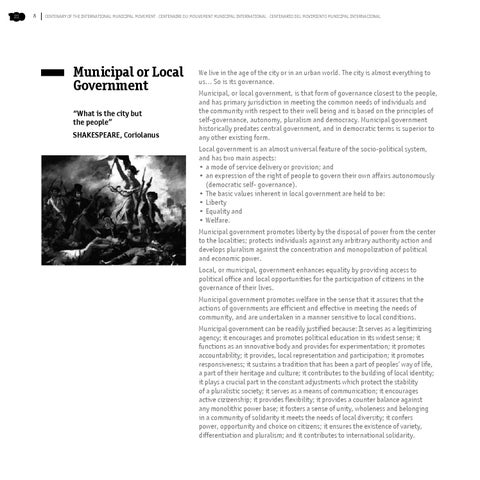
Municipal or Local Government “What is the city but the people” SHAKESPEARE, Coriolanus
We live in the age of the city or in an urban world. The city is almost everything to us... So is its governance.
Municipal, or local government, is that form of governance closest to the people, and has primary jurisdiction in meeting the common needs of individuals and the community with respect to their well being and is based on the principles of self-governance, autonomy, pluralism and democracy. Municipal government historically predates central government, and in democratic terms is superior to any other existing form. Local government is an almost universal feature of the socio-political system, and has two main aspects: • a mode of service delivery or provision; and • an expression of the right of people to govern their own affairs autonomously (democratic self- governance). • The basic values inherent in local government are held to be: • Liberty • Equality and • Welfare. Municipal government promotes liberty by the disposal of power from the center to the localities; protects individuals against any arbitrary authority action and develops pluralism against the concentration and monopolization of political and economic power. Local, or municipal, government enhances equality by providing access to political office and local opportunities for the participation of citizens in the governance of their lives. Municipal government promotes welfare in the sense that it assures that the actions of governments are efficient and effective in meeting the needs of community, and are undertaken in a manner sensitive to local conditions. Municipal government can be readily justified because: It serves as a legitimizing agency; it encourages and promotes political education in its widest sense; it functions as an innovative body and provides for experimentation; it promotes accountability; it provides, local representation and participation; it promotes responsiveness; it sustains a tradition that has been a part of peoples’ way of life, a part of their heritage and culture; it contributes to the building of local identity; it plays a crucial part in the constant adjustments which protect the stability of a pluralistic society; it serves as a means of communication; it encourages active cizizenship; it provides flexibility; it provides a counter balance against any monolithic power base; it fosters a sense of unity, wholeness and belonging in a community of solidarity it meets the needs of local diversity; it confers power, opportunity and choice on citizens; it ensures the existence of variety, differentiation and pluralism; and it contributes to international solidarity.