1913 2013
36 | Centenary of the international municipal movement · Centenaire du mouvement municipal international · Centenario del movimiento municipal internacional
in the domain of international municipal movement. And all parties, more or less, ascribed to the main mission and objectives of the new organisation. There was a solid and wellintentioned leadership, and efficient technocratic back up. What I saw as the main problem area of difficulty that we faced during this process was of a cultural nature. In other words, the different politicoinstitutional cultural codes which were (perhaps still are!) dominant in the two main components of the unification initiative, namely, IULA and FMCU.
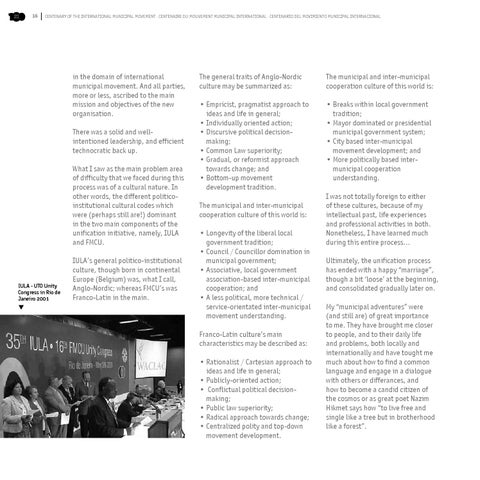
IULA - UTO Unity Congress in Rio de Janeiro 2001
▼
IULA’s general politico-institutional culture, though born in continental Europe (Belgium) was, what I call, Anglo-Nordic; whereas FMCU’s was Franco-Latin in the main.
The general traits of Anglo-Nordic culture may be summarized as:
The municipal and inter-municipal cooperation culture of this world is:
• Empricist, pragmatist approach to ideas and life in general; • Individually oriented action; • Discursive political decisionmaking; • Common Law superiority; • Gradual, or reformist approach towards change; and • Bottom-up movement development tradition.
• Breaks within local government tradition; • Mayor dominated or presidential municipal government system; • City based inter-municipal movement development; and • More politically based intermunicipal cooperation understanding.
The municipal and inter-municipal cooperation culture of this world is: • Longevity of the liberal local government tradition; • Council / Councillor domination in municipal government; • Associative, local government association-based inter-municipal cooperation; and • A less political, more technical / service-orientated inter-municipal movement understanding. Franco-Latin culture’s main characteristics may be described as: • Rationalist / Cartesian approach to ideas and life in general; • Publicly-oriented action; • Conflictual political decisionmaking; • Public law superiority; • Radical approach towards change; • Centralized polity and top-down movement development.
I was not totally foreign to either of these cultures, because of my intellectual past, life experiences and professional activities in both. Nonetheless, I have learned much during this entire process... Ultimately, the unification process has ended with a happy “marriage”, though a bit ‘loose’ at the beginning, and consolidated gradually later on. My “municipal adventures” were (and still are) of great importance to me. They have brought me closer to people, and to their daily life and problems, both locally and internationally and have tought me much about how to find a common language and engage in a dialogue with others or differances, and how to become a candid citizen of the cosmos or as great poet Nazim Hikmet says how “to live free and single like a tree but in brotherhood like a forest”.