1913 2013
26 | Centenary of the international municipal movement · Centenaire du mouvement municipal international · Centenario del movimiento municipal internacional
Within the limits of this introduction it would be impossible to elaborate an extensive typology of purposes and motivations. We will simply attempt to suggest the range of such motivations based on 3 observations.
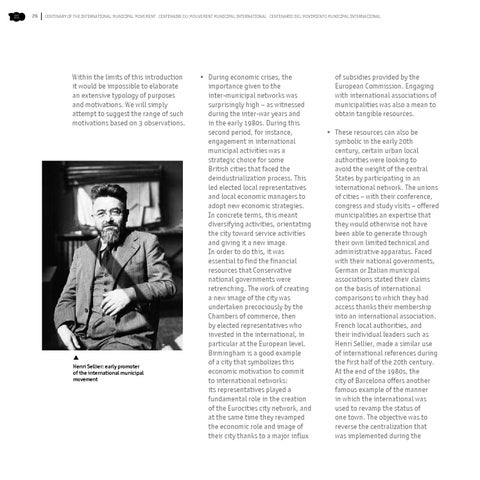
▲ Henri Sellier: early promoter of the international municipal movement
• During economic crises, the importance given to the inter-municipal networks was surprisingly high – as witnessed during the inter-war years and in the early 1980s. During this second period, for instance, engagement in international municipal activities was a strategic choice for some British cities that faced the deindustrialization process. This led elected local representatives and local economic managers to adopt new economic strategies. In concrete terms, this meant diversifying activities, orientating the city toward service activities and giving it a new image. In order to do this, it was essential to find the financial resources that Conservative national governments were retrenching. The work of creating a new image of the city was undertaken precociously by the Chambers of commerce, then by elected representatives who invested in the international, in particular at the European level. Birmingham is a good example of a city that symbolizes this economic motivation to commit to international networks: its representatives played a fundamental role in the creation of the Eurocities city network, and at the same time they revamped the economic role and image of their city thanks to a major influx
of subsidies provided by the European Commission. Engaging with international associations of municipalities was also a mean to obtain tangible resources. • These resources can also be symbolic in the early 20th century, certain urban local authorities were looking to avoid the weight of the central States by participating in an international network. The unions of cities – with their conference, congress and study visits – offered municipalities an expertise that they would otherwise not have been able to generate through their own limited technical and administrative apparatus. Faced with their national governments, German or Italian municipal associations stated their claims on the basis of international comparisons to which they had access thanks their membership into an international association. French local authorities, and their individual leaders such as Henri Sellier, made a similar use of international references during the first half of the 20th century. At the end of the 1980s, the city of Barcelona offers another famous example of the manner in which the international was used to revamp the status of one town. The objective was to reverse the centralization that was implemented during the