UCLG·CGLU · www.uclg.org
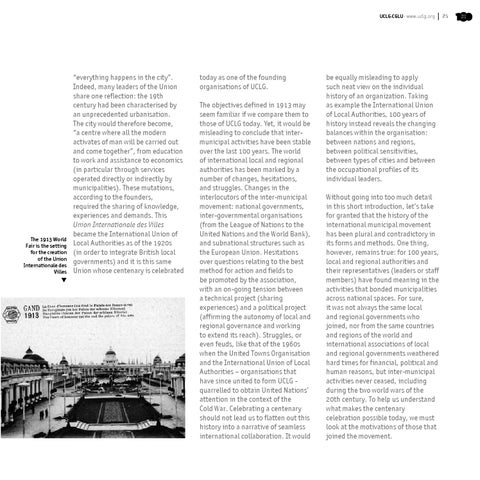
The 1913 World Fair is the setting for the creation of the Union Internationale des Villes
▼
“everything happens in the city”. Indeed, many leaders of the Union share one reflection: the 19th century had been characterised by an unprecedented urbanisation. The city would therefore become, “a centre where all the modern activates of man will be carried out and come together”, from education to work and assistance to economics (in particular through services operated directly or indirectly by municipalities). These mutations, according to the founders, required the sharing of knowledge, experiences and demands. This Union Internationale des Villes became the International Union of Local Authorities as of the 1920s (in order to integrate British local governments) and it is this same Union whose centenary is celebrated
today as one of the founding organisations of UCLG. The objectives defined in 1913 may seem familiar if we compare them to those of UCLG today. Yet, it would be misleading to conclude that intermunicipal activities have been stable over the last 100 years. The world of international local and regional authorities has been marked by a number of changes, hesitations, and struggles. Changes in the interlocutors of the inter-municipal movement: national governments, inter-governmental organisations (from the League of Nations to the United Nations and the World Bank), and subnational structures such as the European Union. Hesitations over questions relating to the best method for action and fields to be promoted by the association, with an on-going tension between a technical project (sharing experiences) and a political project (affirming the autonomy of local and regional governance and working to extend its reach). Struggles, or even feuds, like that of the 1960s when the United Towns Organisation and the International Union of Local Authorities – organisations that have since united to form UCLG quarrelled to obtain United Nations’ attention in the context of the Cold War. Celebrating a centenary should not lead us to flatten out this history into a narrative of seamless international collaboration. It would
| 25
be equally misleading to apply such neat view on the individual history of an organization. Taking as example the International Union of Local Authorities, 100 years of history instead reveals the changing balances within the organisation: between nations and regions, between political sensitivities, between types of cities and between the occupational profiles of its individual leaders. Without going into too much detail in this short introduction, let’s take for granted that the history of the international municipal movement has been plural and contradictory in its forms and methods. One thing, however, remains true: for 100 years, local and regional authorities and their representatives (leaders or staff members) have found meaning in the activities that bonded municipalities across national spaces. For sure, it was not always the same local and regional governments who joined, nor from the same countries and regions of the world and international associations of local and regional governments weathered hard times for financial, political and human reasons, but inter-municipal activities never ceased, including during the two world wars of the 20th century. To help us understand what makes the centenary celebration possible today, we must look at the motivations of those that joined the movement.
1913 2013