need to co-operate to ensure that environmental sustainability is on our agenda and the importance of listening to the voices of urban social movements who urge leadership to think about the future of our planet in the planning process. Mayor Eduardo Pereira, of Varzea Paulista, Brazil, representing UCLG, acknowledged the role of municipalities in development and lauded the Learning Exchange, as mutual learning between cities will help the democratisation and decentralisation process for global unity. Deputy Director-General, from the South African Department of Co-operative Governance and Traditional Affairs (COGTA), Ms Nellie Lester observed that South Africa does not have a federal state but local government is considered an equal sphere of government alongside the national and provincial spheres. She strongly supported the initiation of MILE in the eThekwini Municipality and the role that it can play in knowledge exchange. She advocated sustained commitment beyond a five year plan, to 30 – 50 years or even 100 year plans.
“Knowledge exchange should be encouraged BUT each city has a unique context, with unique needs, that will need unique responses” Nellie Lester, South Africa
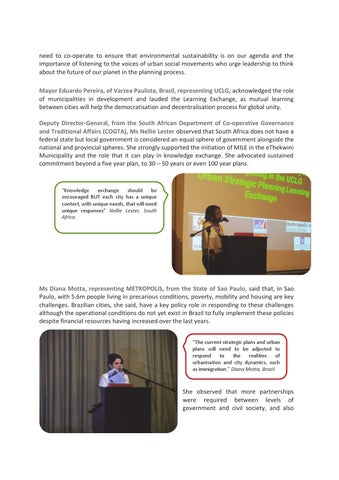
Ms Diana Motta, representing METROPOLIS, from the State of Sao Paulo, said that, in Sao Paulo, with 5.6m people living in precarious conditions, poverty, mobility and housing are key challenges. Brazilian cities, she said, have a key policy role in responding to these challenges although the operational conditions do not yet exist in Brazil to fully implement these policies despite financial resources having increased over the last years. “The current strategic plans and urban plans will need to be adjusted to respond to the realities of urbanisation and city dynamics, such as immigration.” Diana Motta, Brazil
She observed that more partnerships were required between levels of government and civil society, and also 3