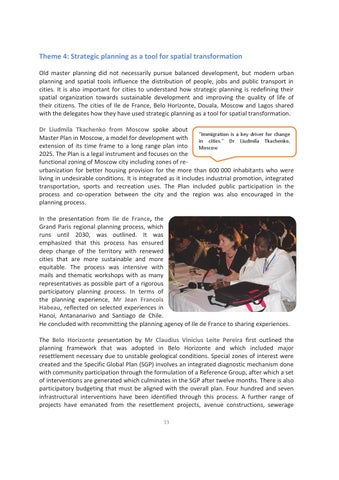
Theme 4: Strategic planning as a tool for spatial transformation Old master planning did not necessarily pursue balanced development, but modern urban planning and spatial tools influence the distribution of people, jobs and public transport in cities. It is also important for cities to understand how strategic planning is redefining their spatial organization towards sustainable development and improving the quality of life of their citizens. The cities of Ile de France, Belo Horizonte, Douala, Moscow and Lagos shared with the delegates how they have used strategic planning as a tool for spatial transformation. Dr Liudmila Tkachenko from Moscow spoke about �Immigration is a key driver for change Master Plan in Moscow, a model for development with in cities.� Dr Liudmila Tkachenko, extension of its time frame to a long range plan into Moscow 2025. The Plan is a legal instrument and focuses on the functional zoning of Moscow city including zones of reurbanization for better housing provision for the more than 600 000 inhabitants who were living in undesirable conditions. It is integrated as it includes industrial promotion, integrated transportation, sports and recreation uses. The Plan included public participation in the process and co-operation between the city and the region was also encouraged in the planning process. In the presentation from Ile de France, the Grand Paris regional planning process, which runs until 2030, was outlined. It was emphasized that this process has ensured deep change of the territory with renewed cities that are more sustainable and more equitable. The process was intensive with mails and thematic workshops with as many representatives as possible part of a rigorous participatory planning process. In terms of the planning experience, Mr Jean Francois Habeau, reflected on selected experiences in Hanoi, Antananarivo and Santiago de Chile. He concluded with recommitting the planning agency of Ile de France to sharing experiences. The Belo Horizonte presentation by Mr Claudius Vinicius Leite Pereira first outlined the planning framework that was adopted in Belo Horizonte and which included major resettlement necessary due to unstable geological conditions. Special zones of interest were created and the Specific Global Plan (SGP) involves an integrated diagnostic mechanism done with community participation through the formulation of a Reference Group, after which a set of interventions are generated which culminates in the SGP after twelve months. There is also participatory budgeting that must be aligned with the overall plan. Four hundred and seven infrastructural interventions have been identified through this process. A further range of projects have emanated from the resettlement projects, avenue constructions, sewerage 13
Issuu converts static files into: and more. Sign up and create your flipbook.