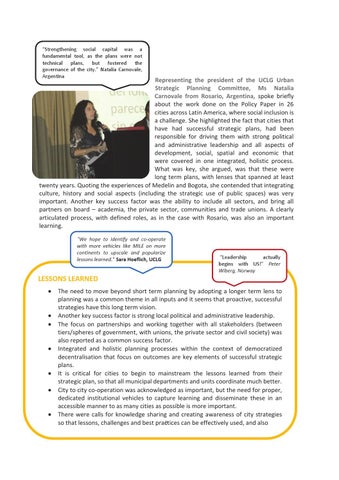
“Strengthening social capital was a fundamental tool, as the plans were not technical plans, but fostered the governance of the city.” Natalia Carnovale, Argentina
Representing the president of the UCLG Urban Strategic Planning Committee, Ms Natalia Carnovale from Rosario, Argentina, spoke briefly about the work done on the Policy Paper in 26 cities across Latin America, where social inclusion is a challenge. She highlighted the fact that cities that have had successful strategic plans, had been responsible for driving them with strong political and administrative leadership and all aspects of development, social, spatial and economic that were covered in one integrated, holistic process. What was key, she argued, was that these were long term plans, with lenses that spanned at least twenty years. Quoting the experiences of Medelin and Bogota, she contended that integrating culture, history and social aspects (including the strategic use of public spaces) was very important. Another key success factor was the ability to include all sectors, and bring all partners on board – academia, the private sector, communities and trade unions. A clearly articulated process, with defined roles, as in the case with Rosario, was also an important learning. “We hope to identify and co-operate with more vehicles like MILE on more continents to upscale and popularize lessons learned.” Sara Hoeflich, UCLG
“Leadership actually begins with US!” Peter Wiberg, Norway
LESSONS LEARNED ·
· ·
·
· ·
·
The need to move beyond short term planning by adopting a longer term lens to planning was a common theme in all inputs and it seems that proactive, successful strategies have this long term vision. Another key success factor is strong local political and administrative leadership. The focus on partnerships and working together with all stakeholders (between tiers/spheres of government, with unions, the private sector and civil society) was also reported as a common success factor. Integrated and holistic planning processes within the context of democratized decentralisation that focus on outcomes are key elements of successful strategic plans. It is critical for cities to begin to mainstream the lessons learned from their strategic plan, so that all municipal departments and units coordinate much better. City to city co-operation was acknowledged as important, but the need for proper, dedicated institutional vehicles to capture learning and disseminate these in an accessible manner to as many cities as possible is more important. There were calls for knowledge sharing and creating awareness of city strategies 6 so that lessons, challenges and best practices can be effectively used, and also for proper support to adapt local tools from one city to another, given their unique