Preface KwaDukuza, a medium-sized city located on the east coast of South Africa is a city of big aspirations. Regardless of its secondary position in the national urban system, we envision the opportunity in becoming more active in deciding on our future development. This is why we joined the setup of a UCLG Intermediary Cities planning group, which aims to strengthen the local governments and advocate for better international recognition of such cites. In the last ten years, our city has been facing rapid urbanization processes. The growth brought wealth, but inequality remains a challenge. We believe that understanding these processes is key to plan for sound urban governance. By joining this initiative, we want to better understand urban growth processes and ways we can shape them to become a viable example of an IntermediaryCity in the global context. On behalf of the Municipality of KwaDukuza and on a personal note, I would like to express my full support to this knowledge sharing experience that we were part of in March 2013. In particular I would like to thank our national and international guests from local and regional governments and COGTA, UCLG collaborators, the eThekwini municipality, MILE, our brothers and sisters from Newcastle and all those who made this possible, particularly the partner institutions: Cities Alliance, the European Union, UN-Habitat, GIZ, the Government of Norway and the ILO. The UCLG Urban Strategic Planning Committee presided by Durban/eThekwnini wants to encourage sharing and learning, particularly to promote planning instruments and methods, as well as inter-municipal cooperation on local, regional, national and international levels. In KwaDukuza, UCLG and MILE facilitated the exchange of knowledge between cities in the region and other South African and global intermediary cities. By mobilizing municipality representatives and planning practitioners we create a strong lobby to enhance our national policies, and we mandate our associations and networks SALGA and SACN to support this. This peer learning experience gives local governments not only better understanding of their situation in the global context but also exposure that allows for creating new networks and alliances that were only accessible for big players. In this way we made a big step forward from being followers of urban practices of big cities to being independent players marking their own way. Finally we acknowledged that the big advantage of being intermediary city is that the change is possible. Due our scale, i-Cities are more manageable than the big metros. Therefore implementation of policies and plans can show fast results on the ground. However the national governments need to support local governments with their actions. I would like to align with our Kwadukuza leader Albert Luthuli, when receiving the Nobel Prize in 1960: "Our vision has always been that of a non-racial, democratic South Africa which upholds the rights of all who live in our country to remain there as full citizens... For the consummation of this ideal we shall continue to labour unflinchingly." Half a century later we celebrate many rights, but there is still a lot to be done. I appreciate the encouragement of this initiative, convinced that change is possible and hard work is no obstacle.
Cllr Ricardo Mthembu, Mayor of KwaDukuza
“I appreciate the valuable platform that the UCLG has offered in connecting cities and facilitate learning. The evolution on City to City learning model is remarkable and eThekwini Municipality is committed to this practice.” /Cllr. Nomvuzo Shabalala, Deputy Mayor of eThekwini/
Contents 01
BACKGROUND TO THE PREPARATION OF THE POLICY PAPER..1
02
AFRICAN INTERMEDIARY CITIES IN CONTEXT…….…………...….….1
03
ADMINISTRATIVE BOUNDARIES AND INTERMEDIARY CITIES…5
04
PLANNING AND THE INTERMEDIARY CITY……………………………..6
05
LESSONS FROM THE KWADUKUZA LEARNING EXCHANGE…...18
References, list of participants and credits
01 BACKGROUND TO THE PREPARATION OF THE POLICY PAPER A learning exchange on intermediary cities was held in KwaDukuza in March 2013. The purpose of the workshop was to:
understand the situation of Southern African Intermediary cities and set them into context support cities of KwaDukuza and Newcastle in becoming viable intermediary cities establish a learning platform in Southern Africa in collaboration with the government, city and local government organisations enhance the growth and special role of South African intermediary cities use these cities as a base for transferring valuable knowledge to other cities in Africa
A number of key considerations emerged from the presentations which UCLG requested be drawn together into a report for supporting the knowledge management efforts. It draws on key themes emerging from the workshop including aspects relating to:
the varying characteristics of intermediary cities governance requirements need for social and economic development planning requirements including the scale and duration of the plans and the need for active citizen participation managing networking and knowledge management
02 AFRICAN INTERMEDIARY CITIES IN CONTEXT ´Intermediate’ generally refers to something in-between two extremes. In relation to settlement patterns, intermediate cities are located between small rural-type settlements and major metropolitan areas. While internationally and particularly in European research, the term ‘intermediary city’ is the more common term by which these cities are referred, they are also referred to as medium-sized or secondary cities in many countries. “Majority of the world urban The characteristics of intermediary cities vary across population is living in cities and between continents and countries, with each having different thresholds for what would hold such smaller than 1 million” a classification. Their position is determined by the / UN Statistics (www.un.org)/ country’s political, social and economic specificities. The sizes of cities vary considerably and so do the cities’ competence, budget and potential. One country may have an average population of 50,000 while in another; it could be as many as 2 millioni.
1
Intermediary cities tend to have strong links to the rural areas and act as markets for agricultural products and important commercial services and social services centres. Equally, these cities tend to strong links with the major metropolitan areas within a country for the provision of higher order goods, important transportation hubs and other related aspects. “SALGA recommends the adoption of the ’Secondary or intermediary cities’ lens as a way of ensuring that the unique characteristics of this type of cities are fully taken into consideration.” /Welcome Mdabe, Mayor of Ilembe and Chairperson of SALGA/
“An intermediary city should have the capacity to create relationships with other cities” / Prof. Josep Maria Llop, Director UNESCO Chair of UdL, UIA CIMES/ “There is an agenda on Secondary or intermediary cities and the challenge on putting appropriate mechanisms and responses. Cities Alliance has committed a major study in process.” /Ms. Adele Hosken, Cities Alliance/
Illustration 1: Lleida (Spain) is an example of European intermediary city
South Africa South African City Network (SACN) initiated a study on secondary cities. There is an unofficial list of 22 secondary cities in South Africa. As in the SALGA conclusion, SACN suggests that the concept of ‘differentiation’ has gained a lot of traction in South Africa’s policy environment for the following reasons:
“It is critical not to insist only on basic statistics for intermediary cities but to look at them as unique cities. SALGA and SACN are committed to make a difference, not only through the Integrated Development Framework but also in the way that municipalities are managed.” /Seana Nkanhle, SALGA/
2
making our society more inclusive ensuring that ‘towns’ or ‘small cities’ are continuously developing Municipalities are unique in character thus do not face the same challenges.
SACN emphasized the role of secondary cities in relieving the pressure off primary cities and as service centres for surrounding regions and rural hinterlands. The map demonstrates the core activities associated with each of the main intermediary cities in South Africa. While some of the cities could be regarded as administrative and/or service centres, many are strongly linked to supporting a particular function such as mining sector within their respective regions. Those cities related to mining have demonstrated rapid growth but are equally faced with long term vulnerability linked to the closure of mining operations or resource depletion. Illustration 2: Specialization of intermediary cities in South Africa “Many African cities grow and shrink because of poverty migration.” /Charles Patsika, UCLGA/
Urban-rural growth Increasingly, intermediary cities are recognised as being fundamental to the urbanisation process. Over the next 20 years, approximately two billion people are likely to urbanise, the majority of who will do so into intermediary cities in developing countries.ii These cities tend to offer access to urban infrastructure and better living conditions than those found within rural areas. They are often less polluted, offer job opportunities with more affordable and better located housing than the major metropolitan areasiii. Illustration 3 Settlements in KwaDukuza
The reason for the establishment of African intermediary cities also varies significantly. Some have strong historical roots, such as Blantyre in Malawi, while others have emerged for the extraction of raw material, such as Newcastle in South Africa. KwaDukuza, like many other intermediary cities, borders eThekwini, a major metropolitan city in South Africa. Others were established as “newtowns” for specific purposes, such as industries, universities or as administrative hubs. However, many intermediary cities grow in reaction 3
to rural poverty that converts them into a point for transit of poor population looking for services, education and employment opportunities.
Notwithstanding the reasons for establishment, internationally, intermediary cities are facing a number of challenges which include:
particularly in developing countries, poor and insufficient planning practices and instruments to face the challenges of growth and change lack of financial resources for addressing backlogs and growing the infrastructure base to absorb urbanisation pressures financial dependence often on national budget limited capacity and administrative challenges unstable and conflict ridden political structures in Africa Impact of climate change and the need for improving the management of urban growth and development.
Political positioning of intermediary cities in Africa “Intermediary cities get a sense of importance from this workshop. They understand that they matter and deserve attention.” /Soobs Moonsammy, Head of Planning, Durban, eThekwini/
“South African intermediary cities should not look like districts. We are making efforts to negotiate to upgrade on the level 5 to 4 classification.” /Cllr Ricardo Mthembu, Mayor of KwaDukuza/
“Many African cities are characterised by a legacy of colonialism and conflict and this has in many ways created massive spatial fragmentation” /Sara Hoeflich, Programme Manager, UCLG/
4
03 ADMINISTRATIVE BOUNDARIES AND INTERMEDIARY CITIES The determination of outer boundary of a municipality can have a direct impact on the ability to plan, management of functional linkages and the rendering of services. Many different approaches that have been adopted internationally were demonstrated as examples at the workshop.
Case Study 1:
Managing urban and rural areas within a single administrative area - Kwadukuza and Newcastle Local Municipalities, South Africa The consolidation, de-racialisation and the rationalisation of local government structures in South Africa saw the significant reduction in the number of structures. KwaDukuza and Newcastle local municipalities are two of the 229 local municipalities established in the country. The Constitutional approach and the decision to determine as few municipal areas as possible resulted in all municipalities in South Africa incorporating both rural and urban areas. Moreover, the geographic extent of the municipal jurisdictions tends to be large. For example, KwaDukuza, located in the Ilembe District Municipality has an area of 750 Km2 while Newcastle covers approximately 1854 Km2. When compared with other local municipalities in South Africa, both areas would be regarded as small as the average area for a municipality is in excess of 3500 Km2. The municipal boundaries have presented a number of challenges which include the need to plan for diverse communities not only within the urban space but also within the traditionally rural authority areas. Consequently, a municipality such as KwaDukuza contains some of the more expensive real estate in South Africa situated along the coastline which is offset by a number of large communities living further inland in poorly serviced and low socio economic conditions separated from the coast by large and productive commercial farming areas. The spatial development plans must not only address the needs of the different communities but also attempt to develop and manage the municipal area in a manner which demonstrates inclusivity and coherence.
Illustration 4: KwaDukuza Spatial Development Framework
“Many intermediary cities need two population indicators: day and night. The difference between day and night populations can easily reach 2:1. This reflects the importance to plan for this difference and also emphasises the role of public transport.� /Sara Hoeflich, Programme 5 Manager, UCLG/
On economic development, the Director of Planning laid out the comparative and competitive edge of KwaDukuza with respect to tourism, coastal endowments and its close proximity to the Dube Trade Port making it part of the planned ‘Aerotropolis’. The development challenges however, include massive in-migration, lack of bulk infrastructure, limited maintenance of existing infrastructure, inadequate policy to guide development, service backlogs, underdeveloped public transport system and other institutional issues.
Boundaries and intermediary cities Certainly, it would appear that “South Africa´s demarcation and the large there are a number of issues boundaries is a milestone to mitigate the spatial emerging in relation to expression of the segregation due to apartheid. administrative boundaries and The complementary steps are to work actively on their implications for spatial inclusion, as intermediary cities remain intermediary cities. There are a divided in settlements for the different social number of cases internationally groups.” /Sara Hoeflich, Program Manager,UCLG/ in which the boundary does not capture a number of poor communities that work and function within the city on a daily basis due to easy access to land, no service charges, fewer regulations in place for managing land use practices. The converse of this challenge is the South African approach with the establishment of very large local municipalities which contain a number of cities and towns with very diverse communities, land use practices and development needs. Administrative boundaries have often been in place for 40 to 50 years with revision of boundaries difficult to make. Rapidly increasing urbanisation is going to demand a reexamination of the outer boundaries of intermediate cities if planning and development initiatives like slum eradication are to be achieved.
04 PLANNING AND THE INTERMEDIARY CITY Planning today for the future? Intermediary cities need to be prepared for the future growth which is likely to take place within the next 20 to 50 years. This is especially important given the existing backlogs which, in many instances, are coupled with scarce financial and human resource capacity. Further, since communities are not involved equally, priority is given only to certain interests.
“In community participation/consultation on the IDP and planning, budgets are approved by community and grassroots. The challenge with respect to community and city administration is of overcommitment and underperformance.” /Carl Stroud, National Treasury South Africa/
Accountability of local leaders is higher if they are locally elected along own programs. Planning needs to address a city’s short term (5 years), medium term (10 years) and long term (20 years or more) development.
6
The basic contents of Long Term Plans The long term plan should at least contain the vision and associated goals for the city. It should outline the growth framework and the strategies necessary for managing the development of urban form. Levers for promoting economic growth and job creation must be identified and proactive rather than reactive investment in long range capital investment projects must be encouraged. Increasingly, long range plans will need to address strategies for combating the impacts of climate change. Clear projects and programmes should be included with measurable targets for monitoring purposes. Transparency in the preparation and implementation of the long term plan is essential for ensuring its success. City long range plans should align with regional and national plans. Such plans generally identify strategic development nodes, corridors and infrastructure projects which transcend administrative boundaries. Managing intergovernmental arrangements is often a challenge requiring clearly defined engagement structures and parameters. The planning and implementation of such plans would cross at least two or three political terms.
No “one size fits all” approach to long term planning No single long term planning approach is applicable or dominant for managing the growth and development of intermediary cities. As there are wide variations in the contexts in which intermediary cities are found, so too there are a range of planning methodologies which are applicable and appropriate for these different contexts. There appears to be a correlation between the size of the city and the planning instrument selected. Examples of such variations that were presented at the Learning Exchange are as follows
Case Study 2: Maringá, Brazil In Maringá, the city focused on promoting sustainable, participatory, social and economic development. The long term approach included three key elements, strategic planning, partnerships and promoting and ensuring development of an inclusive city. MARINGÁ, BRAZIL Maringá was established in 1947 as a new or planned town in the state of Parana. It is the third largest city in the state with an estimated population of 360 000. The city is part of a small metropolitan area surrounded by 2 municipalities and 7 others within a 40 km radius. The total population for the region is approximately 700 000. Illustration 5: Maringá, Brazil
In 1996/7, the City commenced its planning process by asking a number of critical questions:
The City is an important commercial and service centre within the region and has approximately 76% of its economic activity focussed on this sector. It has a growing industrial base which currently provides approximately 22% towards its GDP. 7
What are our problems? Why do we have these problems? What is their origin? Which ones can we eliminate? How can we solve them? What city do we want to live in? The long term planning focused on growing and changing the economic base away from agriculture to supporting and promoting heavy industry. The plans addressed those aspects which would attract investment and improve mobility within the city. A strong emphasis was placed on, for example, improving the public transport system, creating safe public spaces and providing competitive incentives for attracting industrial development. The planning process and implementation has been coupled with strong community partnerships and a strong commitment to improving transparency and confidence in local government. Based on the success of the first long term plan, the city recently developed it Maringa 2030 long term strategy to which the government, private sector and NGOs/CBOs are signatories. Key lessons emerging from the Maringa case study:
The city, through a public participatory process, asked key questions at the beginning of the planning process, the solutions to which were included in the long term plan The development of the long term plan was a transparent and inclusive process Promoting and ensuring good governance has been pivotal to the success of the plans implementation Instead of updating and changing the plan with each new political term, the focus was rather on the plan’s implementation i.e. a decision was taken as to what had to be accomplished and then it was done. This was achieved by each new political incumbent signing a pledge to continue with the infrastructure projects as outlined in the long term plan. The city focussed on economic levers for attracting investment and promoting efficient and effective transportation systems. Safety is an issue for the quality of life in intermediary cities in Latin America, such as Bucaramanga and Maringá “The strategy of Maringá involved civil society and business community in active participatory process. Today we are proud to have 0% unemployment / Silvio Barros, former Mayor of Maringá, Brazil/
Illustration 6: Community meeting in Maringá
8
Case Study 3:
Regional Long Term Planning – KwaZulu Natal Province, South
Africa City development is often more successful if it is undertaken within a coherent regional framework. The 2030 KwaZulu Natal Provincial Growth and Development Strategy (2030 GDS) is a regional plan which outlines, amongst other things, support strategies for the growth and development of intermediary cities. The plan addresses the following core aspects:
Situational overview and strategic analysis Long term vision for the Province Sustainable Growth and Development Strategy (GDS) Spatial Development Strategy Provincial Growth and Development Plan with indicators, targets, interventions, and catalytic projects Institutional framework Monitoring, evaluation and regulatory framework
KWAZULU-NATAL PROVINCE, SOUTH AFRICA KwaZulu –Natal is one of the 9 provinces in South Africa. It is located on the eastern part of the country, adjacent to the Indian Ocean. The province has an estimated population of approximately 10 million, many of whom live in poor socio economic conditions. There is one metropolitan area, eThekwini with a number of intermediary cities in the province, of which Newcastle and KwaDukuza are recognised as intermediary cities.
The 2030 KwaZulu-Natal GDS is aligned to the National Development Plan which outlines the overall national strategy for growth and development in South Africa. It is expected that all plans at municipal level will equally demonstrate alignment with the provincial plan and in so doing align to the National plan. Intermediary cities, as secondary provincial development nodes, are recognised in the plan to be important filters in the urbanisation process and as such provide key linkages to the development of tertiary nodes for the promotion of rural development. The plan consequently outlines a number of priority intervention areas which include a spatial focus on intermediary cities and towns. More specifically, it promoted the following aspects:
Secondary economic growth areas Secondary nodes in support of corridor development Compact urban development and prevent urban sprawl Focused investment and managed growth Densification (brown agenda) and infill development Economies of scale for effective and affordable service delivery Infilling where high levels of services are available (restructuring nodes) Increasing residential density (number of dwellings) Socio-economic up-liftment
9
Provision of sufficient bulk infrastructure services (demand & supply) Prioritising spending on infrastructural upgrading needs Effective and efficient public transportation systems linked to multi modal facilities The establishment of a single land use management system
“Intermediary cities need more franchise as they collect less and struggle for effective service delivery and also as the rate and consumer base is weaker. Additionally, the spatial organization is making infrastructure and services more expensive.” /Carl Stroud, National Treasury of South Africa/
Illustration 7: Plan of interventions in KwZulu-Natal
Key lessons emerging from the KwaZulu-Natal 2030 Growth and Development Strategy:
The plan follows a fairly standard approach toward the preparation and content of growth and development strategies Importantly, the plan links to the National Development Plan thereby supporting consistency in policy approaches from national to local government
There is a strong recognition of the importance of intermediary cities in the urbanisation process and as such, strategies have been developed to support their growth and development. The implementation of the plan has recently commenced. Its success will rest on the province’s ability to manage intergovernmental relations and to provide the necessary support to the intermediary cities in meeting the development objectives set for the province.
10
Case Study 4: Preparation of Base Plan – Lichinga, Mozambique Many intermediary cities or urban centres in Africa have a significant lack of infrastructure and services. They tend to be administratively weak, with limited financial and human resource capacity for promoting and supporting development. Moreover, many areas have little or no history of spatial or strategic planning. More recently, a Base Plan approach has been developed by the UIA-CIMES Work Programme of the International Union of Architects (UIA) and the UdLCIMES UNESCO Chair programme on “Intermediate Cities – Urbanisation and Development”. The methodology has been approved by UN-Habitat and has been adopted in at least 12 sites within Africa.
“The Base Plan is an urban and/or physical planning document that includes the principles and criteria for both sustainable development and strategic planning.” /Josep Maria Llop, UIACIMES, UNESCO Chair/
The Base plan approach recognises that all cities and towns require planning tools to support and guide their strategic and sustainable development. It is simple and flexible, without imposing limits, and therefore allows for more complex planning in the later stages of a city’s development. The readability of the plan is important to facilitate the governance and management aspects associated with the plan itself. The first “Base Plan” should address basic urban planning considerations:
The delimitation of the consolidated urban area and the areas of extension and reserve The basic road axes and transport infrastructure (bridges), amenities and services The system of open spaces (green zones and natural spaces) and their relations with the local environment The city’s morphology including the radius and line of urban form and the possible implications for the base plan The regulated urban areas and those of transformation and renovation (plans If relevant, a map should be included which outlines the relationships of the city and territory including a physical description of the networks A list of base project to be implemented in the next 10 years Possible risks such as flooding, earthquakes, pollution and related aspects
The Base Plan approach is limited to a synthesis of 2 maps, a few graphs, key data and related projects. Importantly, the plan is based on the community participation process and local consensus.
11
Within the Southern African context, this approach has been adopted with UCLG in Caia, Lichinga and Manhiça in Mozambique and Lubango, Angola.
Illustration 8: Base plan of Lichinga, Mozambique
Key lessons emerging from the base planning approach:
It is a simple tool which can fast track planning in low capacity urban centres with little or no previous planning experience It allows a “holding” mechanism to be put in place while capacity is developed, paving the way for more sophisticated planning instruments It allows communities and countries to start considering the impact of urbanisation and to plan for it accordingly. It deepens the understanding of territory and scale of a city It helps discussions for development being referred to the territory “Malawian, South African and Mozambican cities need to have their own cross border strategies.” /Costly Chanza, Director or Planning Blantyre, Malawi /
Case Study 5: The urbanisation pressure on the outer edge of the municipal boundary – Blantyre, Malawi The City of Blantyre is one of the four declared urban areas in Malawi. The area of the city is 228 Km2. The first outer boundary for Blantyre was determined in 1949 and revised in 1956. No further amendments had been made since that time.
12
Not only has the city experienced extensive growth, but proximity of the outer boundary to the city centre has made it possible for communities to establish themselves on the outer edge of the city. Consequently, Blantyre has a day time population of approximately 1 million whereas at night time, it is a little over 600,000. At least 350,000 people commute to the city on a daily basis to access markets, employment, social services and other related facilities. The current city boundary makes planning and servicing very difficult. While the daily commuters make use of the city which includes contributing to the local economy, Blantyre is not able to provide services to settlements which fall outside of it boundary. Such settlements are also growing due to fewer land use regulations and easy access to land. Evidently, the current administrative boundary of Blantyre demonstrates the complexities of addressing rapid urbanisation. Blantyre has an experienced network and attracts public and private partners. It is also part of the “Millennium cities initiative” - counting on GIZ support and holds several headquarters of African enterprises. While not consolidated in City Development Strategy, the City does have a number of planned activities.
BLANTYRE CITY, MALAWI Blantyre City, established in 1876, is located in the southern part of Malawi. The city has a day-time population of 1 000 000 and approximately 660 000 night time residents. However, approximately 60% of the city’s population reside in unplanned settlements. Blantyre City is the largest commercial and industrial centre in Malawi including the immediate sub region within the Southern African Development Community (SADC).
Progress in Malawi A number of learning opportunities have been created in Malawi through a range of initiatives such as the City of Johannesburg/Lilongwe City Development Strategy Mentorship programme and the learning exchange between Mzuzu and eThekwini for the preparation of a city vision. Both initiatives were supported by the UCLG. Certainly, capacity has been developed within Malawi to support the Blantyre City in its preparation for consolidated growth and development strategy. National government of Malawi is also in the process of preparing an urban strategy for Malawi supported by the Cities Alliance. This work is yet to commence in earnest. Key lessons emerging from the Blantyre City experience are: Unlike a number of other urban centres and cities in Africa, the city has a long history of structure planning “We need to give The challenges in relation to planning have been the lack of companies a room for growth.” /Emmanuel Ted capacity and financial resources to manage the implementation of Nandolo, CEO Blantyre, the prepared plans Malawi/ There is an urgent need to develop an urban policy framework for Malawi in order to support cities in the management of unplanned communities The capacity developed through the mentorship programme and learning exchange should be effectively used in supporting Blantyre City prepare a long term growth and development approach in the form of a City Development Strategy. “I-cities have a role to address growth and migration to change their role from transit point to final destination” /Richard Hara, CEO Lilongwe, Malawi
13
Case Study 6: Nampula, Mozambique An interesting comparison on spatial development is found in the city of Nampula, Mozambique that is of similar size (700,000). While Blantyre consists of poverty pockets, in Nampula, poverty can be found in the circular development. The different phases of growth and the history of the region are clearly seen. The city of Nampula has three rings:
The inner ring contains the Portuguese designed roads, shows Portuguese hierarchic planning system, grids, streets and infrastructure. It is currently the city centre. Second ring of 1 to 2 km expansion in walking distance from the inner ring, current city centre where the jobs are concentrated, contains informal settlements which duplicated during the years of civil war 1977 to 1992. Outer ring – city expansion, part of development plan “The challenge for African intermediary cities definition is on political content and articulation, to display their very diverse potential. Which functions should be implemented by local government, which by regional. They need concepts of economic agglomeration and a clear profiling and visibility. They focus too much on limitations because of size and status and remaining in secondary position” /Josep Maria Llop, Director UNESCO Chair of UdL, UIA- CIMES/
Currently, given to important mining in the area, Nampula is in the centre of the Nacala - Tete corridor. The investment is visible in the planned area whereas investment in the informal area is not so visible and obvious. The government wants to motivate citizens’ from the second to the third ring, but urban poor cannot afford to live far from the centre. Some strategic projects appoint now to improve the infrastructure and services of the second ring, but at much slower path as the third ring, which counts on private investment, is being developed.
Case Study 7: Swakopmund, Namibia The Municipality of Swakopmund has developed a strategic plan for guiding its growth and development. The strategy includes the municipality’s vision and mission statement which are linked to the city’s powers and functions. The medium and long term strategic plan which has a 5 to 10 year timeframe addresses three core elements:
Means for measuring progress Evaluation of objectives and goals Effective mechanism for ensuring budget control and application.
14
A number of key strategic projects have been identified which include:
SWAKOPMUND, NAMIBIA Swakopmund in Namibia is located on the north western portion of the country´s Atlantic coastline. It has an estimated population of 42000 inhabitants. It is an important intermediary city in Namibia with its economy dominated by the tourism and recreation
The development of the public coastal edge The positioning and construction of the future sewerage works The management and implementation of the structure plan Management of the town planning scheme Township development The development of Palm Beach industries. Development of parking areas Surfacing of streets The development of a new municipal complex The management of conservation areas including the historical heritage of the city. The development of a new municipal complex The management of conservation areas including the historical heritage of the city. Each Department in the city is tasked with ensuring that certain strategic projects are implemented according to the requirements of the plan.
15
Key lessons emerging from the Swakopmund long term planning approach are as follows:
The plan is strongly linked to the powers and functions of the municipality and as such is not reliant on other levels of government to achieve development goals and objectives The identified projects appear to be proactively developing the necessary infrastructure of the city such as the construction of the future sewerage works Highly visible projects have also been developed to support the growth of the town’s economy through the promotion of tourism
The plans and projects are measurable, actively monitored with strict budgeting and controls in place.
“Promote development for the benefit of the community, tendering and financing are as crucial as a clear relation between CEO and council.” /Marco Swarts, CEO Swakopmund, Namibia/
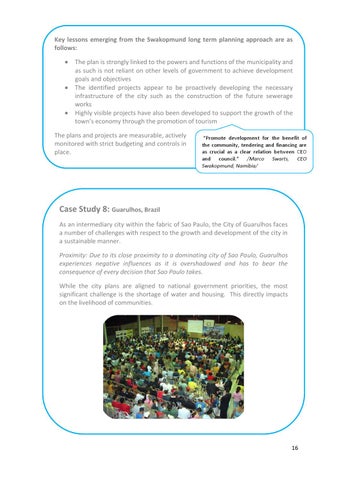
Case Study 8: Guarulhos, Brazil As an intermediary city within the fabric of Sao Paulo, the City of Guarulhos faces a number of challenges with respect to the growth and development of the city in a sustainable manner. Proximity: Due to its close proximity to a dominating city of Sao Paulo, Guarulhos experiences negative influences as it is overshadowed and has to bear the consequence of every decision that Sao Paulo takes. While the city plans are aligned to national government priorities, the most significant challenge is the shortage of water and housing. This directly impacts on the livelihood of communities.
16
The city has placed an emphasis on working with local communities especially during the budget cycle. For example, the city of Sao Paulo, of which the City of Guarulhos is part, manages a four year budget. Planning needs to be prudent as projects are funded through local taxes. Local communities are actively involved in the process of compiling, reviewing and implementing the budget. Projects are carefully selected to ensure that they address holistic or integrated outcomes. Vulnerable groups such as women and youth are targeted in budget discussions to ensure maximum involvement. In ensuring transparency in government, regular feedback is provided by the elected officials to local communities. Key lessons from the City of Guarulhos include the following: Extensive public participation in the budgeting process is possible and should be encouraged in intermediary cities. As it has been said, participation is as effective as communities have the capacity to involve. The City is supported by a legal framework which sets out the parameters and monitors the participation at the City level Participation occurs during the planning, reviewing and implementation cycles within the budgeting process Education is key and community consultations are improving constantly. The educational revolution started by Paulo Freire is behind much of the success of participatory budgeting Service backlogs on water, housing, justice are related what in Brazil is called “right to the city” The community is monitoring the commitments
“In Mozambique, effective service delivery is the main struggle as the Mozambican government allocates insufficient resources into urbanization.” /Abel Manhique, ANAMM, Mozambique/
“Guarulhos is an intermediary city, in which almost every decision is affected by the decisions Sao Paulo makes “ / Katia Lima, Guarulhos Municipality/
“Strategic planning is important for budgeting as there are sets of laws governing budgeting. Intermediary cities need have engaged in on-going participatory process that at this point could benefit by peer reviews with other cities.” /Emidio Sibinde, City of Dondo, Mozambique/
17
05 LESSONS FROM THE KWADUKUZA LEARNING EXCHANGE This section provides an integrated assessment of the lessons learnt at the KwaDukuza Learning Exchange.
Growing body of knowledge to support long range planning The case studies presented at the Learning Exchange adequately demonstrated the diversity of approach and the varying levels of sophistication in undertaking and implementing long range planning within intermediary cities. In addition, the different planning contexts were evident as there were examples from a city such as Maringa having a population of 360,000, strong economic growth and extensive urban infrastructure besides Blantyre City having at least 60% of the 1 million day time population living in unplanned settlements with no or very little infrastructure. Others are key urban centres in their countries but have no or a very limited history of urban or settlement planning and as such require a rudimentary approach such as a holding plan for the later development of a more comprehensive one. Evidently, there is no one approach that is optimal for all intermediary cities. Given the rate of urbanisation taking place internationally and that developing countries, particularly in Africa, are demonstrating the fastest growth rates, long range planning for intermediary cities is an imperative. Plans must anticipate and address the needs of urbanising communities in order to prevent the further growth and extension of unplanned and poorly serviced settlements. The effects of climate change on local communities must also be anticipated and addressed accordingly within the long range plans for the intermediary cities. Even the most basic of planning approaches, Base Planning, advocates that the “possible risks such as flooding, earthquakes, pollution and related aspects” be addressed within the two plan system. Optimally, local plans of intermediary cities should reflect regional and national development imperatives. In so doing, these cities should be able to expect support from national and regional governments in developing capacity at the local level, ensuring the provision of infrastructure and the coordination of development projects across the levels of government.
There is a growing body of knowledge on long range planning which was demonstrated both at the Learning Exchange and through other UCLG initiatives. Other organisations such as UN-Habitat are releasing material for supporting cities in their planning processes. Dissemination of experience and learning can occur through a range of options such as:
There is need for reclassification of cities in order to respond to development and growth. Frequent learning exchanges where participants can lobby their own organisations based on the ideas and concepts gained at such initiatives. This will allow for the organic growth of long term planning approaches which are suited to the local development context.
18
Forming city to city learning programmes where more detailed learning can take place The formation of city to city mentorship programmes for supporting the preparation of City Development Strategies The preparation and release of key learning points from learning exchanges, individual case studies, etc. The establishment of blogs or interactive websites for sharing and disseminating information on intermediary cities and long range planning.
Environmental and Climate Change KwaDukuza is a municipality severely threatened by climate change. Along the coastline, many settlements of rich communities are under risk and investments to reinforce infrastructures are questions over the long term. In the future, as a result of massive urbanisation, intermediary cities must be prepared to mitigate and adapt to climate change. African cities are urbanising rapidly and have the most vulnerable people that need to be considered in terms of service delivery. Although intermediary cities are contributing less to climate change emissions, they will be affected the most. It was highlighted by Dr Debra Roberts that innovation is essential in environmental management and she illustrated with examples the challenges of managing water and energy resources. To address water scarcity, for example, we need to relook at water catchment areas and their abilities to serve wider areas as opposed to developing more dams.
“(…) tools need to be revised: management should operate intelligently, moving away from normal methods towards alternatives to address new challenges related to climate change.” /Dr.Debra Roberts, eThekwini Municipality, Durban/
Good governance is pivotal Community Participation
“In view of the water crisis, careless management and use of drinking water for other purposes needs to be avoided.” /Marco Swarts, CEO Swakopmund, Namibia/
“Environmental aspects are only one category of sustainability (…) there are other aspects. Sustainability should therefore be understood in the broader context” /Silvio Barros, former mayor of Maringá/
A number of case studies demonstrated the importance of active community participation in the preparation and implementation of the long term strategic growth and development plans. Participation is reflected in a number of forms. Firstly, communities contribute to the decision making processes in the selection and prioritisation of projects and programmes. Secondly, as in the case of Maringa, communities become signatories to the plan, acknowledging their participation in its formulation but more importantly, reflecting their commitment to its implementation.
19
Thirdly, many cities have ensured that their performance, in relation to project implementation, is measurable and as such can be monitored by communities. The approach adopted by cities such as Maringa ensured that, while implementing the long range plans, the medium-term interests of the political structures were addressed and the short term or immediate needs of local communities were attended to. In so doing, all parties remained committed to the long-term processes. Like Brazil, South Africa also sets out a legal framework for supporting and promoting community participation. Some points raised by the participants:
Common understanding of intermediary cities underpinned by principle of differentiation based on local knowledge To create awareness, educate and change mind-sets to accept work and implement strategic planning Sell the concept of vaccination of project from disease political discontinuity PRPV- Party Resistant Project Vaccination. Signed agreements between parties
Financial Management Many intermediary cities struggle with extensive backlogs coupled with inadequate financial resources. It is imperative that cities get the “basics” of good governance right such as:
Strategic budgeting processes in which funds are clearly committed to projects and programmes Ensuring that financial systems are in place and are legally compliant Regular financial monitoring and reporting Improved revenue generation and collection Ensuring regular financial audits are undertaken.
Swakopmund, through ensuring that appropriate financial controls are in place, active revenue collection is linked to service delivery, committing funds to project and programmes which are closely monitored has allowed the city to not only grow and develop but more importantly, to do so debt-free. 20
In addition, clean financial management is a critical step in promoting and maintaining community trust in government. To this end, cities such as Maringa have highly transparent tendering processes with the unsuccessful companies monitoring the progress of the successful bidder against the tender specifications. This approach has removed any suspicion of fraud and corruption, improved the credibility and transparency of the city and importantly has allowed for a trusting relationship to be formed between the city and its citizens.
Political Maturity It is common practice in many intermediary cities for plans to be extensively modified from one political term to the next. This results in at least the following:
The inability to be proactive in the construction of multi-term infrastructure projects given the risk of a project being halted midway and or the funding not being made available after the planning process is completed Limited ability to set the direction for the city and to reach the end goal as initially outlined An undermining of planning processes contributing to the lack of community trust in local government Lack of willingness to participate given that plans are likely to change.
The city of Maringa addressed this problem by not only getting all stakeholder to be signatories to the plan but also for the politicians from one political term to the next to pledge to continue with the agreed long term projects and programmes. In Swakopmund, green economy is a way to differentiate development – the example of Freiburg shows that it is possible for intermediary cities “Developing intermediary cities is a way to make our societies more inclusive.” /Sithole Mbanga, CEO, SACN/
Some of the follow -up activities that the institutions proposed to do are as follows:
SALGA: Will consider other regions in Africa and engage with all municipalities categorised as intermediary cities for future dialogue on the subject matter. It will also facilitate more learning exchanges. UCLG: All stakeholders to familiarise themselves with other works and focus of the UCLG. Cities to participate in shaping the UN Post 2015 agenda on urban planning. UCLG-Africa to spread and strengthen institutes, associations and municipalities throughout Africa. COGTA: Will deal with seven municipalities on a differentiated approach by focusing on development pressure and undertake research on intermediary cities. ILO: Work under way with selected cities. Intermediary cities must also focus on unemployment and how to plan and manage the informal sector in cities. GIZ: Will continue to support selected cities and trans-border cooperation on financial management and strategic leadership. Willing to engage across boundaries (regional integration) to enhance effectiveness of planning
21
UCLG‘s concluding remarks session was extremely useful “Where local government is empowered in terms of powers and and will ensure the continued support to cities to engage functions and resources, they have and Cities Associations to facilitate these sessions and the ability to deliver.” /Michael speak across boundaries. UCLG thanked the hosts, city of Sutcliffe, consultant City Insight, KwaDukuza and KwaZulu Natal, to the partners Cities expert of the UCLG GOLD report/ Alliance, the Norwegian government, the GIZ German Cooperation, the European Union and the ILO, as well to the local government associations. While national associations will continue to support the capacity of their intermediary cities, there were high expectations that UCLGA will be at the forefront to take African cities to the world.
Strategic talk with the Kwadukuza politicians and councillors on the opportunities the emerged from the exchange: 1. 2. 3. 4.
Ms Dolly Govender, ExCo, Vice Mayor and Chair of Finance, ANC Ms Ann Mac Donald, ExCo, Democratic Alliance Ms Pinkie Mdletshe Mbambo, ExCo, Chair LED, ANC Ms Sara Hoeflich, United Cities and Local Governments
Concerns: "not to fall (from historical, through Apartheid) into functional segregation”
Some strategic suggestions to be considered: 1. Address dysfunction of service delivery competences: Water and sanitation service from district to municipality to enable coherent land management and revenue collection Disaster management – increase municipal competence (lessons spring flood)
2. Work towards cultural integration
local identity / nation building: Luluthi legacy: black ownership and leadership
3. Economic Integration Use tourism and anticipate their impact on the territory Improve negotiation with private sector and be more strategic in addressing and negotiating public/ private interests, tourism or construction sector Encourage investment and jobs where people live, not only next to highway
4. Spatial Integration Upgrade Kwadukuza to become a vibrant CENTER- investment should focus on facilities in the centre Link Balito and Kwadukuza Explore municipal transport to enable mobility
5. Social Integration
Empower people to live where they like Overcome the division and legacy of Apartheid Solidarity and civic behaviour of all groups, especially work with black elites
22
Decentralized cooperation between Mozambique and Brazil
Eight technicians of the Mozambican cities: Manhiça, Matola, Maputo, Xai Xai, Inhambane, Dondo, Lichinga and Nampula and two from the local government association ANAMM as well as representatives of the cities of Maringá and Guarulhos from Brazil participated in the seminar sharing their experiences on planning, financing and management in their countries through decentralized cooperation. This seminar is part of the program activities financed by the European Union, the Government of Norway and Cities Alliance that will enable further exchange between Brazil and Mozambican cities. More information: http://urbaferramentas.wordpress.com/ Great relevance emerged from the knowledge shared and especially from the group discussions that revealed similarities and differences between geographic and political contexts.
References Bolay et al, 2004 “Intermediate cities in Latin America risk and opportunities of coherent urban development” Cities, Vol. 21, No. 5
http://www.llga.org/call.php?idCall=44 i
UNHabitat, 2012, “Urban Planning for City Leaders”, Pg. 8 IBID iii Bolay et al, 2004 “Intermediate cities in Latin America risk and opportunities of coherent urban development” Cities, Vol. 21, No. 5 Pg.408 ii
23
Credits and participants Event organization and methodology design: MILE team (Sogen Moodley, Masingita Khandlhela, Janice Lee Moodley) UCLG USP Committee and City Future programme, COGTA, Kwadukuza Municipality Reporting and Content: Wendy Ovens, Sara Hoeflich, Maresce Stephanus, Pumla Jali Editing and Layout: Ewa Szymczyk, Venkat Aekbote, Alessa Bennaton Photographs: Janice Moodley, MILE, Alessa Bennaton Links and further information: www.uclg.org , www. mile.org.za, www.kwadukuza.gov.za, www.newcastle.gov.za, www.cogta.gov.za
List of participants Cllr. Ricardo Mthembu Cllr. Dolly Govender Cllr. Thulani Khuluse Cllr. Dumisani Ndimande Cllr. Pinky Mbambo Mdletshe Cllr. Sduduzo Gumede Sandeep Audhram Ann Mcdonald Madam Singh Sdudla Mhlongo Jetro Banda Jabulani Sibiya ShamirRajcomaar Mandla Manzini Sikhumbuzo Hlongwane Siyabonga Khanyile Sthembiso Kubheka Cecil Viramuthu Mava Ntanta Farlan Naidoo Raymond Ntombela Chimene Pereira Dhevia Sewdular Zama Mthembu Sfiso Zulu Bonginkosi Nhaca Ncamy Molefe Nombuso Maphanga Lindiwe Mbonambi Mzamo Magwaza Gilbert Phiri Ketone Masange Cllr Rumnugan Cllr Reman Sandile Dube Thisha Mhlanga Siphiwe Nzunza Mthokozisi Mhlongo Brenda Strachan Jacquie Subban Sogen Moodley Fezile Njokweni Genevieve Hartley Carolyn Kerr
Rajen Reddy Sibongiseni Shangase Masingita Khandlhela Janice Lee Moodley Maresce Stephanus Pumla Jali Soobs Moonsammy Puvendra Akkiah Bongumusa Zondo Dr. Ajiv Maharaj Dr. Debra Roberts Eric Apelgren Sherwin Singh Dorothy Lutchmiah Cllr. Nomvuzo Shabalala Delani Khanyile Mapule Letshweni Seana Nkanhle Lungi Plaatjies Sithole Mbanga Geci Karuri Adele Hoskin Sipho Ndlovu Carl Stroud Thulani Bhengu Penny Sibisi Henk Theron Siyabonga Manyanga Nontsundu Ndonga Martin de Lange Mervin Naik Mandisa Zungu Dr.Modjaji Malehlela Frikkie Brooks Sara Hoeflich Alessa Bennaton Prof Josep Llop Torne Domingos de Gusmรฃo Marques Silvio Barros Kรกtia Lima Guilherme Pacifico Charles Patsika Marco Swarts Nate Areseb
Arnaldo Monteiro Gift Daliso Richard Hara Constancia Bambo Abel Manhique Aderito Cumbane Fernando Carlitos Clodomiro Muiambo Victor Baptista Chiconela Isac Victorino Sique Medson David Ngoane Malizane Eugenio Casimiro Emidio Sibinde Julio Guilherme Wendy Ovens Cllr. W Van Der Schyf Cllr. B Ramadiro Cllr. M Maringa Cllr. M Mafuna Cllr. S Peetz Cllr. M Louw Cllr. A Stewart E.M. Mazibuko Cllr. M Maringa Cllr. M Mafuna Cllr. S Peetz Cllr. M Louw Cllr. A Stewart E.M. Mazibuko Cllr. M Maringa
24