Inclusion Policies as Stimulators of Diversity
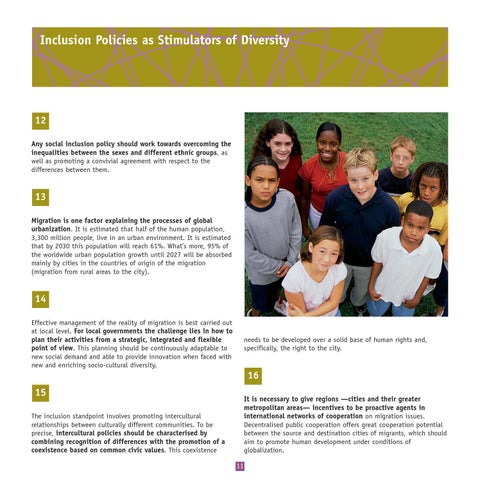
12 Any social inclusion policy should work towards overcoming the inequalities between the sexes and different ethnic groups, as well as promoting a convivial agreement with respect to the differences between them.
13 Migration is one factor explaining the processes of global urbanization. It is estimated that half of the human population, 3,300 million people, live in an urban environment. It is estimated that by 2030 this population will reach 61%. What’s more, 95% of the worldwide urban population growth until 2027 will be absorbed mainly by cities in the countries of origin of the migration (migration from rural areas to the city).
14 Effective management of the reality of migration is best carried out at local level. For local governments the challenge lies in how to plan their activities from a strategic, integrated and flexible point of view. This planning should be continuously adaptable to new social demand and able to provide innovation when faced with new and enriching socio-cultural diversity.
needs to be developed over a solid base of human rights and, specifically, the right to the city.
16 15
It is necessary to give regions —cities and their greater metropolitan areas— incentives to be proactive agents in international networks of cooperation on migration issues. Decentralised public cooperation offers great cooperation potential between the source and destination cities of migrants, which should aim to promote human development under conditions of globalization.
The inclusion standpoint involves promoting intercultural relationships between culturally different communities. To be precise, intercultural policies should be characterised by combining recognition of differences with the promotion of a coexistence based on common civic values. This coexistence 11