Asian-African Line
083
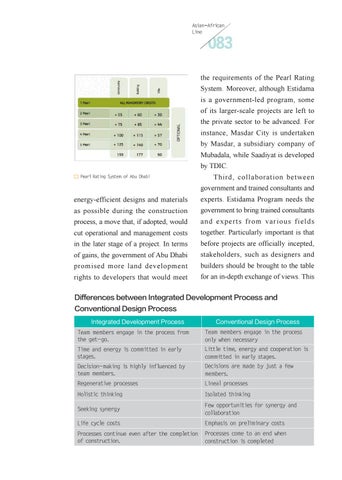
the requirements of the Pearl Rating System. Moreover, although Estidama is a government-led program, some of its larger-scale projects are left to the private sector to be advanced. For instance, Masdar City is undertaken by Masdar, a subsidiary company of Mubadala, while Saadiyat is developed by TDIC. â–Ą Pearl Rating System of Abu Dhabi
Third, collaboration between government and trained consultants and
energy-efficient designs and materials
experts. Estidama Program needs the
as possible during the construction
government to bring trained consultants
process, a move that, if adopted, would
and experts from various fields
cut operational and management costs
together. Particularly important is that
in the later stage of a project. In terms
before projects are officially incepted,
of gains, the government of Abu Dhabi
stakeholders, such as designers and
promised more land development
builders should be brought to the table
rights to developers that would meet
for an in-depth exchange of views. This
Differences between Integrated Development Process and Conventional Design Process Integrated Development Process
Conventional Design Process
Team members engage in the process from the get-go.
Team members engage in the process only when necessary
Time and energy is committed in early stages.
Little time, energy and cooperation is committed in early stages.
Decision-making is highly influenced by team members.
Decisions are made by just a few members.
Regenerative processes
Lineal processes
Holistic thinking
Isolated thinking
Seeking synergy
Few opportunities for synergy and collaboration
Life cycle costs
Emphasis on preliminary costs
Processes continue even after the completion of construction.
Processes come to an end when construction is completed