070
Learning from Cities— The 2nd Guangzhou International Award for Urban Innovation
within the previous two years. The energy savings of the current year are converted into points, and the Kwangju Bank would pay to carbon green card issuers once a year.
Implementation of the Initiative 1. Planning and implementation
In order to build a model city which can adapt to climate change, Kwangju introduced the carbon bank system. Carbon bank system calculates the reduced carbon dioxide emissions through
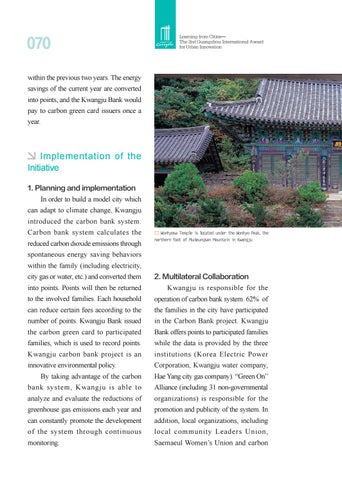
□ Wonhyosa Temple is located under the Wonhyo Peak, the northern foot of Mudeungsan Mountain in Kwangju
spontaneous energy saving behaviors within the family (including electricity, city gas or water, etc.) and converted them
2. Multilateral Collaboration
into points. Points will then be returned
Kwangju is responsible for the
to the involved families. Each household
operation of carbon bank system. 62% of
can reduce certain fees according to the
the families in the city have participated
number of points. Kwangju Bank issued
in the Carbon Bank project. Kwangju
the carbon green card to participated
Bank offers points to participated families
families, which is used to record points.
while the data is provided by the three
Kwangju carbon bank project is an
institutions (Korea Electric Power
innovative environmental policy.
Corporation, Kwangju water company,
By taking advantage of the carbon
Hae Yang city gas company). “Green On”
bank system, Kwangju is able to
Alliance (including 31 non-governmental
analyze and evaluate the reductions of
organizations) is responsible for the
greenhouse gas emissions each year and
promotion and publicity of the system. In
can constantly promote the development
addition, local organizations, including
of the system through continuous
local community Leaders Union,
monitoring.
Saemaeul Women’s Union and carbon