Asian-African Line
069
from non-industrial sectors, including Name of City: Kwangju
emissions from home and business.
Name of Country / Region: South Korea
It is an urgent need for Kwangju to
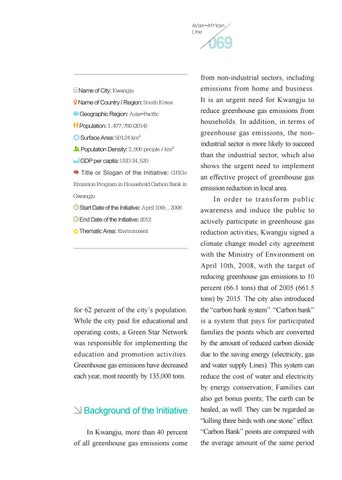
Geographic Region: Asia-Pacific Population: 1,477,780 (2014) Surface Area: 501.24 km2 Population Density: 2,900 people / km2 GDP per capita: USD 24,520 Title or Slogan of the Initiative: GHGs Emission Program in Household Carbon Bank in Gwangju
reduce greenhouse gas emissions from households. In addition, in terms of greenhouse gas emissions, the nonindustrial sector is more likely to succeed than the industrial sector, which also shows the urgent need to implement an effective project of greenhouse gas emission reduction in local area. In order to transform public
Start Date of the Initiative: April 10th , 2008
awareness and induce the public to
End Date of the Initiative: 2012
actively participate in greenhouse gas
Thematic Area: Environment
reduction activities, Kwangju signed a climate change model city agreement with the Ministry of Environment on April 10th, 2008, with the target of reducing greenhouse gas emissions to 10 percent (66.1 tons) that of 2005 (661.5 tons) by 2015. The city also introduced
for 62 percent of the city’s population.
the “carbon bank system”. “Carbon bank”
While the city paid for educational and
is a system that pays for participated
operating costs, a Green Star Network
families the points which are converted
was responsible for implementing the
by the amount of reduced carbon dioxide
education and promotion activities.
due to the saving energy (electricity, gas
Greenhouse gas emissions have decreased
and water supply Lines). This system can
each year, most recently by 135,000 tons.
reduce the cost of water and electricity by energy conservation; Families can also get bonus points; The earth can be
Background of the Initiative
healed, as well. They can be regarded as
In Kwangju, more than 40 percent
“Carbon Bank” points are compared with
of all greenhouse gas emissions come
the average amount of the same period
“killing three birds with one stone” effect.