046
Learning from Cities— The 2nd Guangzhou International Award for Urban Innovation
a long-term approach, a highly innovative driving force, broad-based collaboration and high political consensus, in which areas Linköping leads Sweaden and even the world. Collaboration and partnership with residents, trade and industry, other municipalities, universities, authorities and national and international networks has high priority in Linköping’s sustainability efforts. 2. Characteristics
In close cooperation with Linköping University, this project is featured by
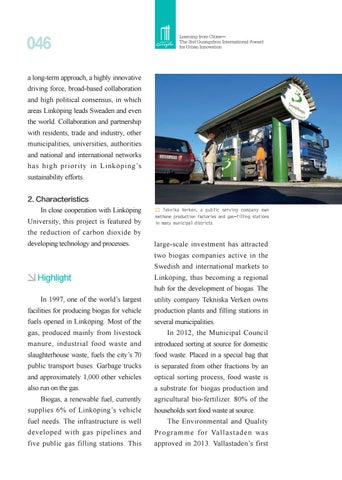
□ Teknika Verken, a public serving company own methane production factories and gas-filling stations in many municipal districts
the reduction of carbon dioxide by developing technology and processes.
large-scale investment has attracted two biogas companies active in the Swedish and international markets to
Highlight
Linköping, thus becoming a regional hub for the development of biogas. The
In 1997, one of the world’s largest
utility company Tekniska Verken owns
facilities for producing biogas for vehicle
production plants and filling stations in
fuels opened in Linköping. Most of the
several municipalities.
gas, produced mainly from livestock
In 2012, the Municipal Council
manure, industrial food waste and
introduced sorting at source for domestic
slaughterhouse waste, fuels the city’s 70
food waste. Placed in a special bag that
public transport buses. Garbage trucks
is separated from other fractions by an
and approximately 1,000 other vehicles
optical sorting process, food waste is
also run on the gas.
a substrate for biogas production and
Biogas, a renewable fuel, currently supplies 6% of Linköping’s vehicle
agricultural bio-fertilizer. 80% of the households sort food waste at source.
fuel needs. The infrastructure is well
The Environmental and Quality
developed with gas pipelines and
P r o g r a m m e f o r Va l l a s t a d e n w a s
five public gas filling stations. This
approved in 2013. Vallastaden’s first