Learning from Cities— The 2nd Guangzhou International Award for Urban Innovation
044
emissions from treated wastewater have decreased by 60% and 35% respectively since 2001 ◆
Nitrogen dioxide concentrations
in urban environments have fallen from 29 μg/m3 to 8 μg/m3 in the air since the late 1980s ◆
The number of kilometres driven
per vehicle/year has decreased from 13,000 to 12,000 km over the past 10 years ◆
50% increase in new “green car”
registrations ◆
56% of all the electricity used is
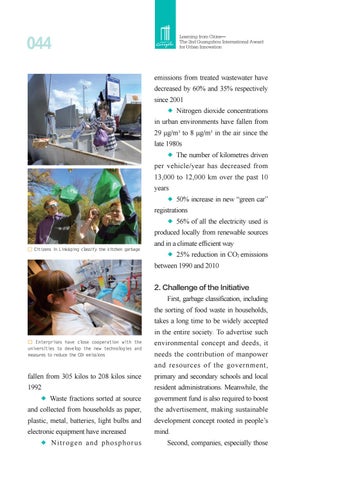
produced locally from renewable sources □ Citizens in Linköping classify the kitchen garbage
and in a climate efficient way ◆
25% reduction in CO2 emissions
between 1990 and 2010 2. Challenge of the Initiative
First, garbage classification, including the sorting of food waste in households, takes a long time to be widely accepted in the entire society. To advertise such □ Enterprises have close cooperation with the universities to develop the new technologies and measures to reduce the CO2 emissions
environmental concept and deeds, it needs the contribution of manpower and resources of the government,
fallen from 305 kilos to 208 kilos since
primary and secondary schools and local
1992
resident administrations. Meanwhile, the Waste fractions sorted at source
government fund is also required to boost
and collected from households as paper,
the advertisement, making sustainable
plastic, metal, batteries, light bulbs and
development concept rooted in people’s
electronic equipment have increased
mind.
◆
◆
Nitrogen and phosphorus
Second, companies, especially those