Learning from Cities— The 2nd Guangzhou International Award for Urban Innovation
042 Background of the Initiative Linköping Municipality has a long tradition of pro-active climate and environmental work. In 1993, a crossparty group was established to develop a local Agenda 21 plan, resulting in the “Plan of Action for a Sustainable Linköping in the Long Term” in 1998. In
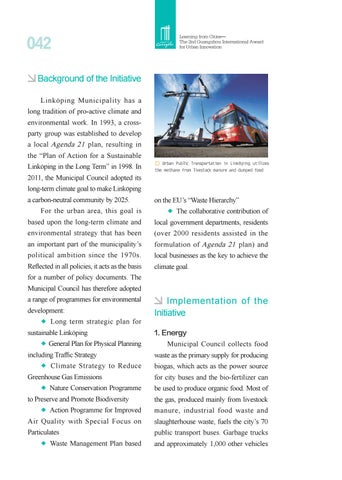
□ Urban Public Transportation in Linköping utilizes the methane from livestock manure and dumped food
2011, the Municipal Council adopted its long-term climate goal to make Linköping a carbon-neutral community by 2025. For the urban area, this goal is
on the EU’s “Waste Hierarchy” ◆
The collaborative contribution of
based upon the long-term climate and
local government departments, residents
environmental strategy that has been
(over 2000 residents assisted in the
an important part of the municipality’s
formulation of Agenda 21 plan) and
political ambition since the 1970s.
local businesses as the key to achieve the
Reflected in all policies, it acts as the basis
climate goal.
for a number of policy documents. The Municipal Council has therefore adopted a range of programmes for environmental development: ◆
Long term strategic plan for
sustainable Linköping ◆
General Plan for Physical Planning
including Traffic Strategy ◆
Climate Strategy to Reduce
Greenhouse Gas Emissions ◆
Nature Conservation Programme
to Preserve and Promote Biodiversity
Implementation of the Initiative 1. Energy
Municipal Council collects food waste as the primary supply for producing biogas, which acts as the power source for city buses and the bio-fertilizer can be used to produce organic food. Most of the gas, produced mainly from livestock
Action Programme for Improved
manure, industrial food waste and
Air Quality with Special Focus on
slaughterhouse waste, fuels the city’s 70
Particulates
public transport buses. Garbage trucks
◆
◆
Waste Management Plan based
and approximately 1,000 other vehicles