Project tools
BRAZIL
DESCRIPTION
SIMILARITIES
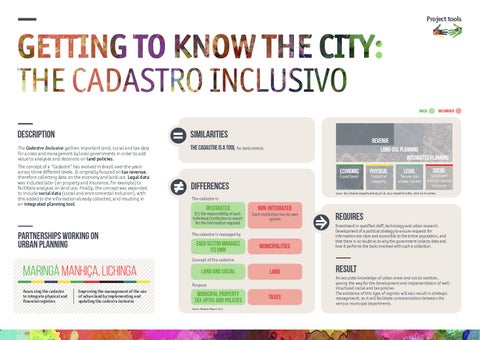
The Cadastro Inclusivo gathers important land, social and tax data for access and management by local governments in order to add value to analyses and decisions on land policies. The concept of a “Cadastre” has evolved in Brazil over the years across three different levels. It originally focused on tax revenue, therefore collecting data on the economy and land use. Legal data was included later (on property and insurance, for example) to facilitate analyses on land use. Finally, the concept was expanded to include social data (social and environmental inclusion), with this added to the information already collected, and resulting in an integrated planning tool.
THE Cadastre IS A TOOL for land control.
ECONOMIC Equal taxes
DIFFERENCES
REVENUE LAND-USE PLANNING INTEGRATED PLANNING PHYSICAL Cadastral mapping
Legal
Secure real estate market
social
Social and environmental inclusion
Source: Base Study developed by Articulação Sul, 2013, adapted from Erba, 2005. Our translation.
The cadastre is
INTEGRATED It’s the responsibility of each individual/institution to search for the information required
PARTNERSHIPS WORKING ON URBAN PLANNING
MOZAMBIQUE
NON-INTEGRATED Each institution has its own system
The cadastre is managed by
EACH SECTOR MANAGES ITS OWN
MUNICIPALITIES
REQUIRES Investment in qualified staff, technology and urban research. Development of a political strategy to ensure requests for information are clear and accessible to the entire population, and that there is no doubt as to why the government collects data and how it performs the tasks involved with such a collection.
Concept of the cadastre
MARINGÁ Manhiça, Lichinga
LAND AND SOCIAL
LAND
Purpose Asses sing the cadastre to integrate physical and financial registers
Improving the management of the use of urban land by implementing and updating the cadastro inclusivo
MUNICIPAL PROPERTY TAX (IPTU) AND POLICIES Source: Nampula Report, 2013
TAXES
RESULT An accurate knowledge of urban areas and social realities, paving the way for the development and implementation of wellstructured social and tax policies. The existence of this type of register will also result in strategic management, as it will facilitate communication between the various municipal departments.