The context
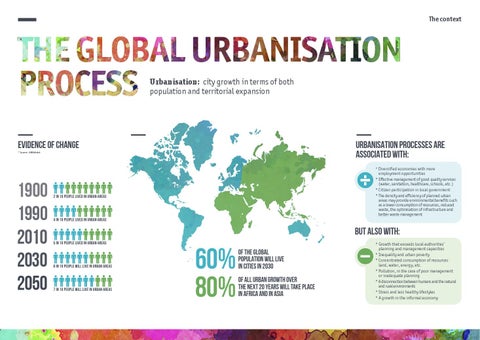
Urbanisation: city growth in terms of both population and territorial expansion
EVIDENCE OF CHANGE
URBANISATION PROCESSES ARE ASSOCIATED WITH:
* Source: UNHabitat
* Diversified economies with more
1900 1990 2010 2030 2050
employment opportunities * Effective management of good quality services (water, sanitation, healthcare, schools, etc.) * Citizen participation in local government * The density and efficiency of planned urban areas may provide environmental benefits such as a lower consumption of resources, reduced waste, the optimisation of infrastructure and better waste management
2 IN 10 PEOPLE LIVED IN URBAN AREAS
4 IN 10 PEOPLE LIVED IN URBAN AREAS
BUT ALSO WITH: 5 IN 10 PEOPLE LIVED IN URBAN AREAS
6 IN 10 PEOPLE WILL LIVE IN URBAN AREAS
7 IN 10 PEOPLE WILL LIVE IN URBAN AREAS
60% 80%
OF THE GLOBAL POPULATION WILL LIVE IN CITIES IN 2030 OF ALL URBAN GROWTH OVER THE NEXT 20 YEARS WILL TAKE PLACE IN AFRICA AND IN ASIA
* Growth that exceeds local authorities’ planning and management capacities * Inequality and urban poverty * Concentrated consumption of resources: land, water, energy, etc. * Pollution, in the case of poor management or inadequate planning * A disconnection between humans and the natural and rural environments * Stress and less healthy lifestyles * A growth in the informal economy